

What Happened To The Bodies From The Edmund Fitzgerald?
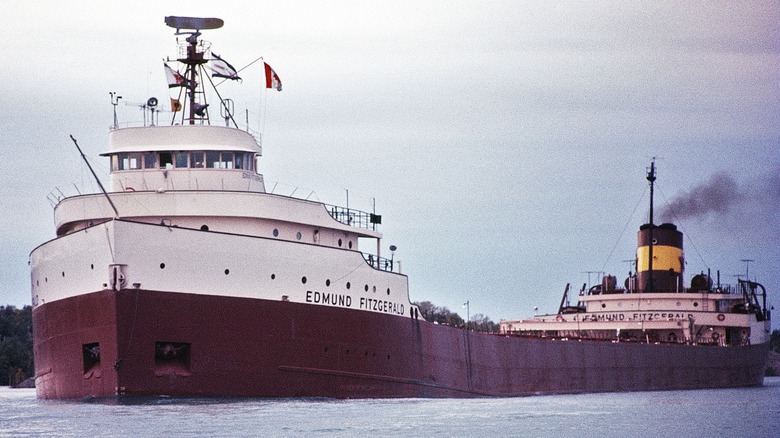
It was business as usual when the S.S. Edmund Fitzgerald set out into Lake Superior on November 9, 1975, at 2:15 p.m. A cargo vessel, the Fitzgerald was carrying 26,116 tons of processed iron ore from Burlington Northern Railroad, Wisconsin on the western side of Lake Superior to Zug Island in Detroit. The S.S. Arthur M. Anderson joined en route and followed behind at a distance of 10 to 15 miles for the remainder of the trip. In the face of an oncoming storm, the two ships decided to head for Whitefish Point on the eastern side of Lake Superior, where they hoped the waters would be calmer.
However, the weather had worsened by the next day; wind started gusting, snow turned blustery, and sprays of water blocked the Anderson's view of the Fitzgerald. The Great Lakes Shipwreck Museum explains that on November 10, waves battered the Anderson at 5:20 p.m. and nearly drowned the entire vessel an hour and a half later at 6:55 p.m. At 7:10 p.m., the Anderson's first mate, Morgan Clark, radioed the Fitzgerald to check in on the crew. "We are holding our own," the Fitzgerald's captain, Ernest McSorley, replied. Five minutes later, the vessel vanished from radar.
All 29 men aboard the Fitzgerald died that night, and within a mere 17 miles of their destination of Whitefish Point. The ship sank to the bottom of Lake Superior, 535 feet below the surface, and its crew with it. No victim has ever been recovered. The individuals on board the Fitzgerald rest within its wreckage, making the sunken ship both a memorial and a tomb.
[Featured image by Greenmars via Wikimedia Commons | Cropped and scaled | CC BY-SA 3.0]
Sunken and unrecovered
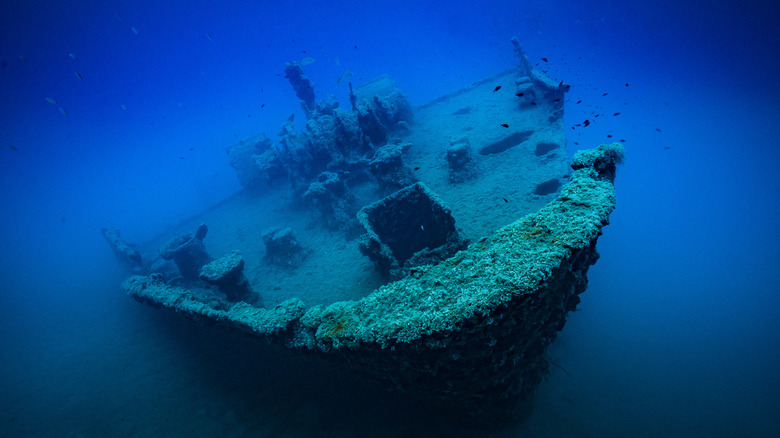
When the S.S. Edmund Fitzgerald sank, the Coast Guard set out to locate its remains in the waters of Lake Superior. They found it and took plenty of pictures of it, but no efforts were made to lift the wreckage or its crew to the surface. This is usually the case for shipwrecks — provided the wreck doesn't pose a danger to others — as it's seen as a respectful choice for the dead, especially in wartime. Besides, it would be practically impossible to lift a damaged vessel like the 730-foot-long Fitzgerald to the surface and onto dry land. This is why no victim has been recovered, let alone buried or cremated. They've simply been left alone.
That being said, in 1994, one body was accidentally found near where the Edmund Fitzgerald sank — or at least, what was left of it. The remains were partially covered in "seaman's coveralls," per the Los Angeles Times, but because the body was found almost 20 years after the vessel sank, there's really no way to confirm its identity. At the time, officials were considering retrieving the remains regardless of the difficulties involved, but ultimately seemed to have decided against it. As UPI quotes, Dr. Jim Cairns said that there was little purpose in recovery, anyway, as "there is no medical mystery to be solved and family members have said they'd like their relatives to remain in their natural grave."
Memorialized at the Great Lakes Shipwreck Museum
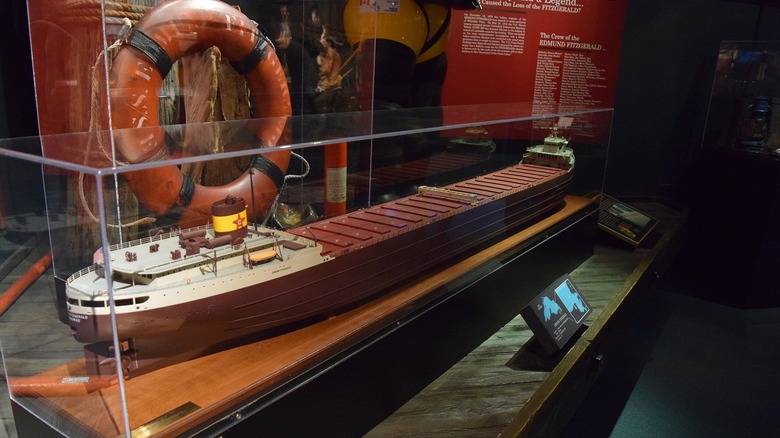
Even though the 29 crew members of the Edmund Fitzgerald are interred in Lake Superior, the Great Lakes Shipwreck Museum acts as an above-water memorial to the victims. A joint expeditionary venture in 1995 — 20 years after the Fitzgerald sank — involving the Great Lakes Shipwreck Historical Society, National Geographic Society, the Canadian Navy, and more, actually recovered the Fitzgerald's bronze bell. It now lives at the Great Lakes Shipwreck Museum, which itself is located at Whitefish Point, the freighter's intended safe harbor.
Interestingly, Find a Grave even lists the Great Lakes Shipwreck Museum as the final resting spot for most of the Fitzgerald's crew. That being said, we know that three crew members — Michael Armagost, the aforementioned Ernest McSorley, and Blaine Wilheim — have grave markers at different cemeteries. Strictly speaking, these markers are "cenotaphs" — memorials that look like grave markers — indicating that nothing is buried at that location and the person is interred elsewhere.
The exact cause of the Fitzgerald sinking is still being debated; the horrible weather on that day, the rapid sinking of the vessel, and the absence of survivors mean there were no witnesses. Many theories have been put forward, including the grounding of the vessel on a shoal, cargo overloading, and a failure to secure the hatches, perhaps due to them being defective. But much like the decision to let the Fitzgerald and its crew rest in peace, perhaps such discussions are best left alone.
[Featured image by Deb Nystrom via Wikimedia Commons | Cropped and scaled | CC BY-2.0]