

The 5 Best Grateful Dead Songs Of The '70s
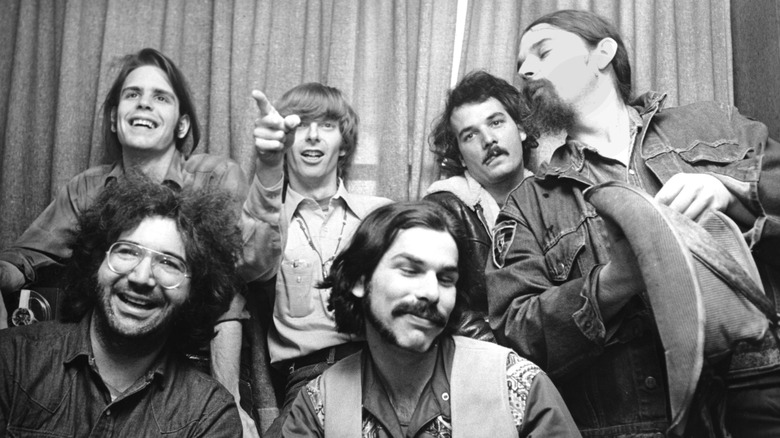
Forget about a needle in a haystack. Poring over the Grateful Dead's catalogue to pluck out five best '70s songs is like locating lentils on the ocean floor. Weird analogy? Well, this is the Grateful Dead we're talking about, that most trippin' of truckin' and jammin' bands that, in between crisp yet rambling slurries of improvisational musicianship, produced some studio albums. As Dead singer and guitarist Jerry Garcia once said and The Guardian quotes, "Making a record is like building a ship in a bottle. Playing live music is like being in a rowboat in the ocean." That ship, bottle, rowboat, and ocean granted us a colossal discography of stellar hits, from the '70s or otherwise.
When we say "colossal," we really mean it. The Grateful Dead's entire, evolving, psychedelic, folksy, jazzy, country, groovy discography consists of 13 studio albums and a gobsmacking 233 live albums – a world record. This makes choosing songs from the Dead particularly difficult, especially since the '70s was their most prolific and arguably best era. Also, do we choose studio versions or one-of-a-kind live versions? The Dead changed quite a bit over the '70s, as well, never achieving mainstream status but moving towards something more accessible with 1970's "Workingman's Dead" and "American Beauty" through their late '70s "disco Dead" phase.
In short, our choices have to reflect not only the best of the '70s Dead, in terms of composition and inventiveness, but encapsulate them over the entire decade, on both the studio and live fronts. This means choosing songs like the live version of "Estimated Prophet" from 1977's "Dick's Picks: Volume 3: Pembroke Pines, Florida 5/22/77," the 1970 hit staple, "Truckin'," and longtime Deadhead favorite, 1977's "Terrapin Station Medley."
Truckin'
Even non-Deadheads will have no trouble recognizing 1970's "Truckin'" as soon as the song hits singer Bob Weir's first, rapidly sung lyrics, "Arrows of neon and flashing marquees out on Main Street." "Truckin's" frantic lyrical flashes contrast with its carefree musical roll and bounce, like the roll and bounce of the touring vehicle that the song alludes to. This contrast, plus a downright catchy tune and a "meh, what are you gonna do?" shoulder-shrug attitude, makes "Truckin'" one of the Grateful Dead's most memorable, stand-out '70s tracks. It also ranks amongst the band's most widely-streamed songs, at about 70 million listens on Spotify.
As far as composition is concerned, "Truckin'" was a group effort from Jerry Garcia, Phil Lesh, and Bob Weir, who sadly died on January, 10, 2026. Using lyrics written by Dead collaborator Robert Hunter, "Truckin'" acts like a montage of life on tour. It mentions cities like Chicago, New York, Detroit, Houston, and New Orleans, feeling "sick of hangin' around and you'd like to travel," then getting "tired of travelin' and you want to settle down," and discusses drug use via a character, "Sweet Jane," who "lost her sparkle ... Livin' on reds, vitamin C, and cocaine." It even describes true-life run-ins with the law who are "gonna kick the door in again," warrant in hand. In between these vignettes, the song settles back into its laissez-faire chorus, just like the band listlessly rolling between cities.
This attention to detail, plus "Truckin's" tight musicianship, summarizes the Dead at the beginning of their semi-commercially-successful '70s. It also serves as a tentpole track during the release of two, spectacular 1970 albums, "Workingman's Dead" and "American Beauty."
Terrapin Station Medley
Indeed, the Grateful Dead might have been "tuh-rippin'" on substances when they wrote "Terrapin Station Medley" for their 1977 album, "Terrapin Station." We'll let the reader and the dancing, hoedown terrapins (turtles) on the album cover decide. But no matter its influence(s), "Terrapin Station Medley" is such a gonzo, ambitious, unparalleled musical effort from the Dead that no list of top '70s Dead songs could be complete without it. There's a strong case to be made that this is the most manifestly talented piece of work from the band, period.
Musically, "Terrapin Station Medley" is what we call a "suite," meaning a set of back-to-back songs that fuse into one, larger piece. In this case, the song clocks in at about 16 minutes long and has seven movements, like "Lady with a Fan" (the first movement) and "At a Siding" (the fifth movement). Listening only to the first movement, a mellow, clean electric guitar affair, you'd have zero idea how the suite is going to progress. We're talking a for-real symphonic structure that evolves into a full-blown movie soundtrack by about the 11-minute mark, complete with orchestral arrangement, a little Caribbean motif, some Middle Eastern flourishes, and more. In the end, it all sensibly resolves back to the original, main theme (but with a choir, naturally).
No matter that "Terrapin Station Medley" is a highly, highly architected and painstaking piece of music, it makes the cut over any live version because it's already on par with the digressions, complexity, and jam session energy of some of the Dead's longer live tracks. Live versions might match it, but they can't outdo it.
Ripple
If "Terrapin Station Medley" is the Grateful Dead at its most ambitious, then "Ripple" is the Dead at its most sincere. Fundamentally a gentle acoustic affair played and sung by Jerry Garcia, "Ripple" is a wise-beyond-its-years song from a band that, come 1970, had only been around for five years. Beginning as a meditation on the nature and relevance of music, itself — "Would you hear my voice come through the music? / Would you hold it near as it were your own" — "Ripple" develops into a sweeping, lushly arranged composition elevated by mandolin accompaniment and backing choir. Like the music the song describes, traveling from person to person, ear to ear, the song ripples out to become a fully blossomed version of itself.
The background choir tells us volumes about "Ripple's" subtext. If listeners think they're catching glimpses of reverant, gospel-tinged religiosity in the song, they're not wrong. The line, "If your cup is full, may it be again" echos the Bible's famous "The Lord is my shepherd" Psalm 23 with its line, "my cup overflows." From there, "Ripple" continues with the beautifully stated, "Let it be known there is a fountain / That was not made by the hands of men." But true to its culturally eclectic time, "Ripple's" chorus also references the common Buddhist allusion of the mind being like water: "Ripple in still water / When there is no pebble tossed / Nor wind to blow."
In the end, a listener can take "Ripple" as just a pretty song or fully dive into its philosophical musings. It's this flexibility of meaning, along with the song's musicianship, that make it one the Dead's finest '70s songs.
Estimated Prophet
In keeping with our theme of religiosity/spirituality but moving back to 1977's "Terrapin Station," we've got the excellent "Estimated Prophet," aka, the Grateful Dead do reggae (at least outside of the chorus). The album version of "Estimated Prophet" is a super funky, grooveable jam with all the "no, no, no, no" vocal interjections you'd hope for, plus some brass. It's also about a crisp five-and-a-half minutes long and feels complete without any of the Dead's live tinkerings.
That being said, we're going to highlight the longer, live version of the song off "Dick's Picks Volume Three: Pembroke Pines, Florida 5/22/77" because it enhances the original while not taking anything away from it. Recorded in 1977 and released in 1995 following the death of Jerry Garcia, the live version continues beyond the studio version's fade-out. It segues into an extended, trance-inducing, improvised solo dripping with effects that make it resemble a human voice. This section demonstrates precisely why the Dead thrived in a live setting, as the solo sounds organic, perfectly phrased, and could have kept going on and on even longer than it did.
"Estimated Prophet" excels on the lyrical front as much as it does the musical front. It's a dark window into the delusional mind of a cult leader that reaches peak menace with the lines, "And I'll call down thunder and speak the same / And my work fills the sky with flame / And might and glory going to be my name /And men going to light my way." We're not talking heavy, chugging riffs or anything, but a low, simmering sense of danger that pervades the whole track and helps make it unique.
Shakedown Street
The opening to the Grateful Dead's "Shakedown Street" might have you thinking that you're listening to a song inspired by Pink Floyd's "Another Brick In The Wall (Part 2)." But no, "Shakedown Street" came first in 1978 on the album of the same name, while "The Wall" came out in 1979. But, that song comparison should help explain two key facets of "Shakedown Street:" the prominent, funky bassline and the high-pitched, jangly guitar. Fundamentally, "Shakedown Street" is a dance track firmly rooted in late-70s disco, but retaining some classic, psychedelic Grateful Dead flavor.
Like before, we're going to highlight a live version of "Shakedown Street," this time from "Dick's Picks Volume Five: Oakland Auditorium Arena 12/26/79," released in 1996. In comparison to the live version, the studio version is underdeveloped. The live version has a slightly lower tempo, a jazz shuffle-like beat, some incredibly cool alternative instrumental lines built around "Shakedown Street's" core chord progression, and goes on and on like a true jam session. It's not too hard to imagine being there, in the crowd, lost in the moment and the music, dancing your heart out to a lightning-in-a-bottle rendition of a killer track.
As mentioned earlier, it's this era of the Grateful Dead that some folks described as "disco Dead." "Shakedown Street," either the album or the song, didn't go over well with fans, who feared the Dead were going mainstream. But in retrospect, "Shakedown Street" capped the Dead's musical journey through the '70s and paved the way for their '80s phase. Though the "disco Dead" label was hurled as an insult, it's more accurate to say that the Grateful Dead elevated disco elements rather than got dragged into the disco dregs.