

Crossover Rock Songs That Define Music History
From rock 'n' roll's beginnings, rooted in Black rhythm and blues — itself a fusion of jazz, blues, and gospel – it has continually incorporated various musical elements as it progressed over the decades. From folk to country to hip-hop, rock musicians have broken down barriers and merged these various disparate genres into a new sound that would kick open the doors for others to follow, helping to reshape popular music.
There are a few musicians who were pivot points on rock 'n' roll's journey, including Bob Dylan and the Beatles. Both completely transformed the popular musical landscape and often incorporated various musical genres to push the boundaries of rock. Dylan's fusion of folk and rock and the Beatles' use of groundbreaking orchestral elements are examples of this.
Still, there are other bands that, while not of the same stature as Dylan or the Beatles nonetheless helped define rock history with crossover songs, like the Byrds' hugely influential country-rock sound on the single "You Ain't Going Nowhere" from the 1968 album "Sweetheart of the Rodeo." Blondie's "Rapture" from 1981 combined rap and rock, which was a precursor to the monumental collaboration between Run-D.M.C and Aerosmith five years later. Without these crossover rock songs, the musical landscape might sound very different today.
Dylan goes electric and creates folk rock
Bob Dylan and his band going electric at the Newport Folk Festival on July 25, 1965, has become a cultural touchstone suffused with myth — like Pete Seeger allegedly wielding an axe to try to cut the electric cables (which wasn't true). But by the time he appeared at the event, Dylan's masterful fusion of folk and rock, "Like a Rolling Stone," had already been out in the world for nearly two weeks. It was released on July 15, 1965 (the complete six-minute version came out five days later), and unlike the mixed reception the song received at the folk festival, it was a huge success, spending 12 weeks on Billboard's Hot 100 Charts where it peaked at No. 2 in September that year. The song appeared on Dylan's Highway 61 Revisited, helping to push the record into the No. 3 spot on the U.S. album charts.
The song wasn't just a hit, turning Dylan into a bona fide rock star, but was hugely influential on generations of musicians, from Jimi Hendrix to Joni Mitchell to Lucinda Williams to Bruce Springsteen. Springsteen said hearing the song for the first time felt "like somebody kicked open the door to your mind" (via YouTube). As Rolling Stone magazine has said, Dylan "transformed popular song with the content and ambition of 'Like a Rolling Stone.'"
The Byrds went somewhere new
The Byrds, one of the most important bands of the 1960s, have Bob Dylan to thank for a song that helped them create a crossover rock song that solidified country rock and would give rise to this burgeoning sound in the coming decade. The song was "You Ain't Going Nowhere," and it appeared on the band's seventh album, "Sweetheart of the Rodeo," the first rock album by a major band to fully integrate country music into its rock sound. And it's unlikely that this album would have come to be without Gram Parsons, who joined the Byrds in 1968 and stayed for less than a year.
While rock had flirted with country music since the 1950s (from Elvis Presley to the Everly Brothers) and into the 1960s with Buffalo Springfield, it was Gram Parsons who pushed the integration of the genres to the next level with his International Submarine Band, which he left to join the Byrds. He nudged the Byrds further towards a true country sound. The band recorded "You Ain't Going Nowhere" in Nashville with country petal steel legend Lloyd Green heavily featured in this song that led off the album and became its first single. While it wasn't a massive hit at the time, it was incredibly influential on other artists from the Eagles to Linda Ronstadt to Emmylou Harris to the outlaw country genre of the 1970s. It would also heavily influence alt-country from the 1990s onward.
A Beatles song fusing classical music and rock
The Beatles are indisputably one of the most influential bands in history, shaping popular music as we know it through innovative recording techniques, instrumentation, and songwriting, not to mention altering popular culture. The band's 1966 album "Revolver" was the first shot across the musical bow with recording techniques as varied as tape looping, back masking, automatic vocal double tracking, and close-miking of the instruments, along with innovative instrumentation that was incredibly influential. And the song "Eleanor Rigby," with its lyrical exploration of loneliness is especially so. It featured no rock instruments, with the band simply singing over a string section that included four violins, two violas, and two cellos playing the melody.
Although the Beatles had already incorporated strings in "Yesterday" in 1965, this more fully integrated an orchestral sound into the composition with producer George Martin's arrangement, highlighting just how important Martin was to the Beatles. The song went to No. 1 in the U.K. and No. 11 in the U.S. It also won the Grammy Award for Best Contemporary Solo Vocal in 1967, but more importantly, it influenced artists as varied as the Moody Blues, Sinead O'Connor, and hip-hop artists the Game and Ja Rule. The song was even covered by Ray Charles in 1968. Rolling Stone magazine has listed it as among the greatest songs in history, which is kind of incredible for a song that only features strings and vocals.
Blondie's rapturous melding of hip-hop and rock
New wave pioneers Blondie brought the New York underground to the world with a vital mix of rock, disco, reggae, and early hip-hop. They shot to the top of the charts, starting with "Heart of Glass" in early 1979, and dominated the charts with four No. 1 singles into 1981. One of these, "Rapture," from the band's groundbreaking 1980 album "Autoamerican," helped introduce early hip-hop to a mainstream audience. It became the first song with rap lyrics to reach the top of the charts, remaining in the No. 1 spot on the Billboard Hot 100 for two weeks in January 1981. In the song, Debbie Harry name-checks both rap pioneer Fab 5 Freddy (who had rapped over an early version of "Rapture" called "Yuletide Throwdown") and DJ Grandmaster Flash.
The video received heavy airplay on MTV and presented an even deeper dive into the New York scene, including painter Jean Michel Basquiat Dj-ing, graffiti artist Lee Quiñones, Fab 5 Freddy, and others. The song helped bridge the gap between rock and hip-hop, broke down racial barriers, and introduced several members of later rap giants Wu-Tang Clan and Mobb Deep to hip-hop for the first time. Other seminal hip-hop artists would go on to sample and reinterpret "Rapture," including Grandmaster Flash and the Furious Five in 1981 with "The Adventures of Grandmaster Flash on the Wheels of Steel" and KRS-One with his 1997 song "Step Into a World (Rapture's Delight).
Run-D.M.C. and Aerosmith broke down more barriers
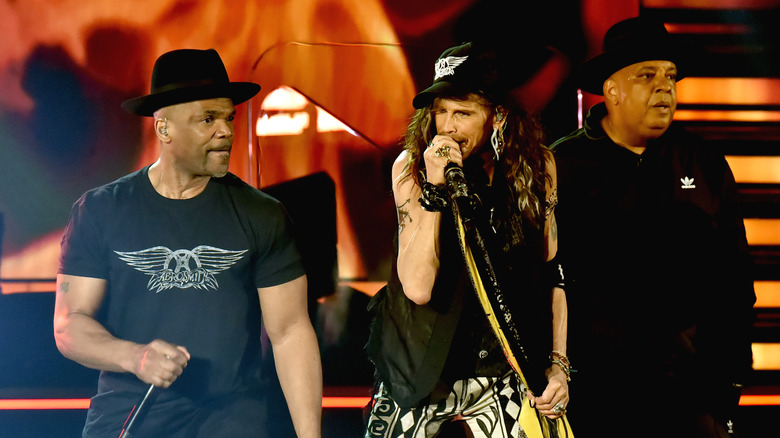
Blondie may have introduced the general public to hip-hop, but it was rap greats Run-D.M.C. and hard rock giants Aerosmith that took the rap-rock hybrid to the next level, and in the process, kicked off an entirely new sound. The song "Walk This Way" from Run-D.M.C.'s 1986 album "Raising Hell" was a cover of Aerosmith's hit from a decade earlier. On the song, Joseph "Run" Simmons, Daryl "D.M.C." McDaniels, and DJ Jam Master Jay (born Jason Mizell), joined forces with Aerosmith's singer Steven Tyler and guitarist Joe Perry for what would turn out to be a monster hit.
Run-D.M.C. had already broken new ground with their stripped-down sound, streetwise fashion, and overlapping rhyming. Their self-titled first album from 1984 had gone gold, the first hip-hop act to do so. But "Walk This Way" would take them even farther. The rap-rock hit went to No. 4 on the Billboard Hot 100 (doing better than Aerosmith's original) with the album going platinum, another first in hip-hop. The song spawned a new musical world where bands like Rage Against the Machine thrived, Public Enemy joined forces with thrash metal masters Anthrax, and the sub-genre Nu Metal came to be. Like the other crossover songs on this list, it helped change the face of rock.