

Fugitives From America's Most Wanted Who Were Finally Captured

Debuting in 1988, "America's Most Wanted" quickly became one of the United States' foremost crime shows. The brainchild of host John Walsh, the show was born out of his own grief at the abduction and murder of his son, a long-unsolved crime finally laid at the feet of serial killer Ottis Toole. Over the nearly 800 episodes in the show's original run through 2011, Walsh hosted dramatic recreations of real crimes, urging viewers to call in with tips to help investigators prosecute fugitive criminals and bring closure to victims.
The show's effect on law enforcement has been formally studied, with researchers reporting that fugitives featured on the show were measurably more likely to be apprehended quicker than those who didn't come under the "AMW" spotlight. Statistics can be hazy due to the many crimes the show has featured and the complexity of investigations, but over 1,000 suspects have been caught at least in part due to their appearance on the show, including a number of people on the FBI's "10 Most Wanted" list. And it turns out America wants more "America's Most Wanted": As of 2024, the show is back on the air with new episodes.
David James Roberts
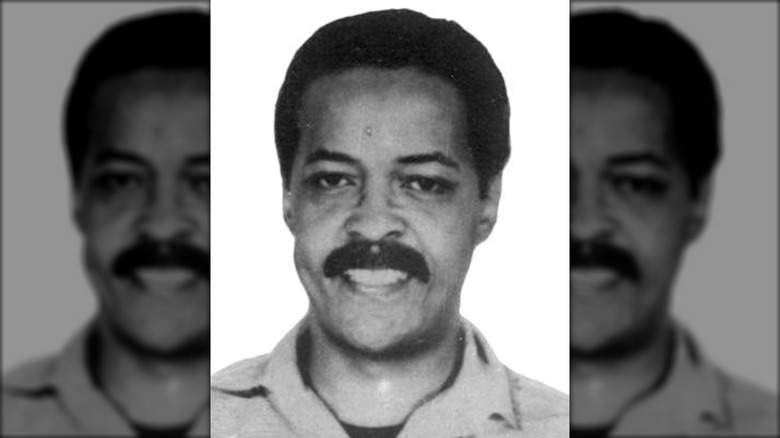
The very first fugitive to be spotlighted on "America's Most Wanted" was also the first to be captured. The collaring of David James Roberts a mere four days after his "debut" on "AMW" proved that the publicity generated by the crime show could be a powerful asset in tracking and catching criminals and suspects at large. Roberts was indicted for murder and arson in 1975, and while on bail pending trial, he committed further assaults and another murder. In 1986, he escaped custody in Indiana and was in the wind, and the FBI placed him on its "10 Most Wanted" list the following year.
This escapee and killer was an excellent choice for "AMW," both for the shock value of his crimes and because he seemed likely to continue his savage career if left at liberty. Roberts was found in Staten Island, New York, managing a homeless shelter under an assumed name. Many people called to turn Roberts in, including his apparent girlfriend, right after the show. He was in the hospital at the time and skedaddled from his bed there, but he was quickly caught. Roberts was reportedly the first person to see his own crimes reenacted for him on the soon-to-be hit show.
Paul Steven Mack

Divorcee and single mother Margie Danielsen thought her luck was turning around when she met Sean Lanier, a handsome chef who brought her roses on their first date. She dumped him a few weeks later, when he broke into her home (to leave gifts, but still creepy). But they later reconciled when he came to her crushed by his daughter's death. The two married, but Danielsen found more red flags, including controlling behavior and a death certificate for the daughter that was rife with apparent errors.
Lanier could explain! He was in New Zealand's witness protection program, apparently having run afoul of some hobbits with a taste for vengeance. Danielsen was mulling this interesting excuse when she got a call from a friend who had tuned into "America's Most Wanted." This friend had recognized "Lanier" as Paul Steven Mack, whose crimes had nothing to do with fern forests and kiwis and everything to do with two dead women, one in Ohio and one in California.
Chilled by the realization that her daughters were close in age to Mack's victims, Danielsen gathered his fingerprints to present to police. At the time, they were already closing in thanks to other tips — Mack had had the hubris to take a guest spot cooking on local TV. He was convicted of one murder and allegedly confessed to the second before his death in prison in 2018.
Mark Austin Goodman

One hesitates to root for an armed robber, but the story of Mark Austin Goodman does make you wonder what was going on in Oklahoma in the 1980s. Goodman was a serial bank robber: At the time of his 1988 appearance on "AMW," he was the prime suspect in 10 bank thefts in Oklahoma City, all in 1987. That's almost one a month, which raises a lot of questions. What were the police and security companies doing? Why did anyone go to the bank after, say, the fourth robbery? What is there in Oklahoma City to spend so much money on that you need to keep robbing banks? And in addition to this tally, Goodman had escaped from custody six times.
After he appeared on "America's Most Wanted" and was captured again, Goodman made one final escape, ditching prison during a power outage, before being captured for the final time. He pled down the laundry list of federal and Oklahoma charges to just two robberies and an escape from federal custody. He was still sentenced to 40 years (in a hearing that reportedly had federal marshals standing at every door of the courtroom), even though it turns out he had been using a BB gun for at least some of his crimes.
Joseph Kindler

Joseph Kindler had a long record of burglary before he committed the crime that brought him to the attention of "America's Most Wanted" and, ultimately, its viewers. Kindler beat and drowned a witness of his burglaries and was convicted of this crime in Philadelphia. The death penalty had been recommended but not formally sentenced when Kindler hoofed it. After he appeared on the program, a viewer spotted him in lovely New Brunswick, Canada. While Kindler's capture by Canadian authorities proved the international reach (and appeal) of "AMW," problems arose with his extradition. Canada has no death penalty and hesitated to extradite a suspect to face the death penalty, which Pennsylvania might well impose.
The question led to a case before the Canadian Supreme Court, arguing that the Canadian government had an obligation to ensure that Kindler would not face death in the United States. The appeal was rejected, and Kindler was sent back into U.S. custody, making the Canadian case very much the next guy's problem. Kindler was indeed sentenced to death, but the execution was not carried out. Kindler was eligible for resentencing, and in 2018, his sentence was reduced to life thanks to his record of jailhouse conversion, acceptance of responsibility for his crimes, and the invention of a new kind of smoke detector.
Frederick Merrill

Frederick Merrill has one of the cutest names of any criminal ever. Starting his career as a burglar shortly after finishing high school (education first!), he developed a secondary talent for escape. The first time, Merrill pulled the classic "put a dummy in the bed so it looks like you're sleeping" to conceal his absence. Police caught him at his mother's house. Good ol' Mom was ready to help, though: She showed up at the prison with a jar of peanut butter in which she had concealed several tools to help her son escape once more. Merrill got out of prison but was soon stopped at a roadblock. This hijink did, however, earn him the nickname "Peanut Butter Bandit." This cutesy, aw-shucks sobriquet stuck with him throughout his criminal career, even as he turned to sexual assault in the 1980s.
After Merrill was arrested for his violent crimes in the 1980s, he escaped again, MacGyvering tools out of bedsprings and itsy-bitsy-spidering his way down a drainpipe, feats that earned him a spot on "AMW." He was eventually collared for good. Paroled in 2013, he was back in jail just a few months later for a mundane parole violation: using the internet.
Raylene Brooks

Gender differences in crime mean that there are, in general, fewer dangerous female criminals, and therefore fewer chances for women to "star" on "America's Most Wanted." But fewer isn't none, as Raylene Brooks proved to her dismay. One of the first women to appear on the program and among the first female suspects to be captured, Brooks drove the getaway car when her boyfriend shot and killed a Los Angeles police officer in a drive-by attack. A reward didn't generate enough heat to catch the pair, so the LAPD directly requested that "AMW" feature the crime.
Brooks was only 17 at the time — her boyfriend was 27 and should have known better about a lot of things — but her youth didn't help Brooks much. She got two life terms after her trial, as an adult, on three attempted murder charges and the dead officer's manslaughter, with parole eligibility after 18 years. Police organizations have regularly agitated against her being granted parole.
John List
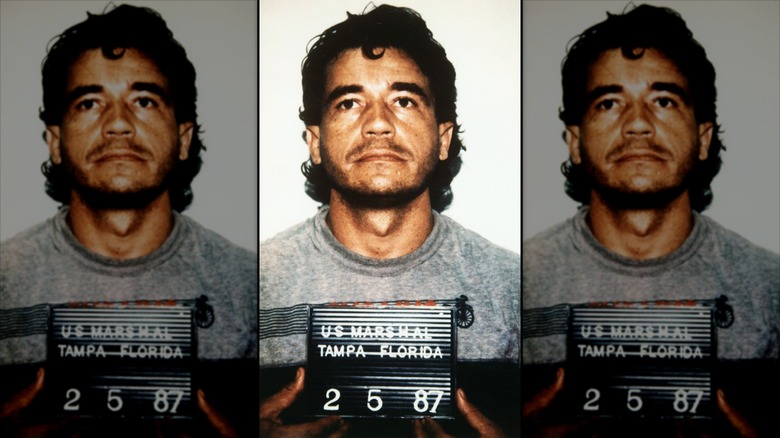
In 1971, John List had a midlife crisis that he handled badly: Instead of getting a tattoo or an absurd car, the New Jersey accountant shot and killed his children, wife, and mother. He left behind five corpses and a letter to his pastor, explaining his hope to protect his family from the evil in the world and apparently missing the irony. Eighteen years later, "America's Most Wanted" ran a segment with a model of how an aged List might look, and the jowlier countenance of the pencil-pushing family annihilator was immediately recognized by a neighbor in Virginia. At trial, List blamed his experiences in World War II and the Korean conflict, also making the somewhat irrelevant points that he thought a letter to his pastor should be private and that he had enjoyed his new life, in which he had remarried and attended church.
In interviews after his conviction, List has maintained that he acted in part to ensure his relatives went to heaven. Inexplicably optimistic, List stated in a 2002 interview with Connie Chung that he expected that, when he got to heaven, his family would have forgiven him or maybe even forgotten the whole thing! He died in 2008, so by now, he may know what his victims thought of that interview.
Frank Van Dyke Hobbs

Frank Van Dyke Hobbs, a Virginia DJ, developed a taste for two kinds of escape. He'd skip out on marriages when they no longer suited him (without going through the bothersome process of divorce), and when the authorities caught up with them, he'd slip away from them too. Hobbs had three wives when he was ordered to stand trial in 1984, and as the court date approached, he changed his mind about his plea bargain and bolted. The police in Tennessee let him escape four times, after he variously lied, rammed them with a car, and feigned a suicide attempt. The trickster was finally caught (by Mississippi police) and returned to Tennessee. Take one guess what he did while they were trying to decide whether or not to extradite him to Virginia.
Hobbs showed up on "America's Most Wanted" shortly after he married another woman, in Texas, and he was apprehended and sent to Virginia. There, he claimed he'd never intentionally been married to more than one woman at a time, conflicting with the testimony of a growing number of women who had gotten wind of the now-famous cases and came forward claiming to be one of the many Mrs. Hobbses. He got away with a suspended four-year sentence. No word on how the alimony situation shook out.
Adam Ezerski

In 2001, it seemed a new serial killer might be preying on gay men. Adam Ezerski, previously a small-time crook and drug dealer, was on the run after allegedly killing two gay men on consecutive days in Florida in July, heading west in a car rented by one of his Florida victims. Ezerski was apparently, or at least allegedly, not gay himself, with his brother telling the press that he enjoyed both chasing women and threatening gay men — though that didn't convince police he hadn't gotten close to his victims through flirtation or promises of sex.
Ezerski was feared to be heading to San Francisco, where he could indeed find any number of gay men to attack, and law enforcement and community members blanketed the city in flyers with his face. He was ultimately nabbed in Reno, where he seemed to have bolted after finding the Bay too hot from both the flyers and a spot on "AMW." Police ultimately ruled him out for one of the Florida murders, but he pleaded guilty to the robbery and murder of the other victim, getting 25 years.
Steven Tatro

Stephen Tatro is described as presenting himself as a "medicine man," but anyone with any mystical ability might have avoided the embarrassing circumstances of his capture. Tatro, who also went by Two Bears (it is not possible to ascertain from available information if Tatro is indeed Native American), murdered his business partner in 1997, shooting the other man in an apparently impulsive attack involving a borrowed travel trailer. Tatro would later claim that the angle of the wound made it impossible for him to be the triggerman, but the courts put more weight on the victim's dying words (via Justia Law): "Two Bears shot me."
After his initial arrest, Tatro fled, and he was apprehended even before his episode of "America's Most Wanted" aired when people recognized him from the promotional spots. Tatro faked a heart attack and wriggled out of custody, leading to his being featured on "AMW" again and apprehended again — but this second time, while trying to evade police, he was stopped when he ran into a cactus, making him the first "America's Most Wanted" figure to be caught twice. He was convicted of the murder and sentenced to 50 years in prison. No word on whether the cactus received a medal.
The Texas Seven
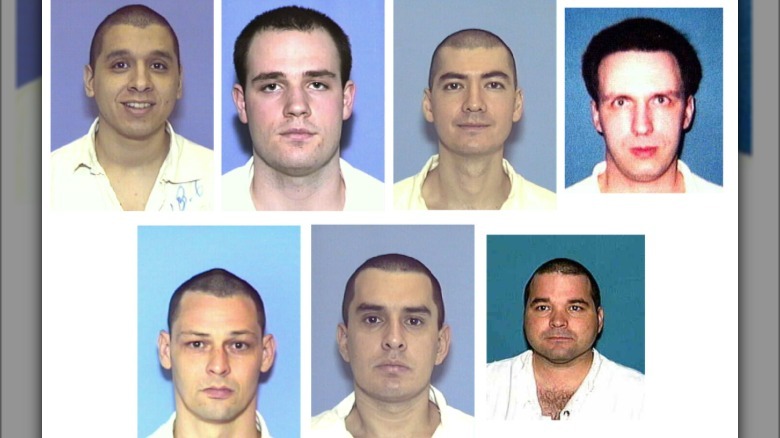
In 2000, many Texas prisons were understaffed and paid the staff they had pitiful wages for long shifts. These overstretched guards presented an opportunity for seven convicts, who overpowered their captors, dressed in their clothing, and hopped into a waiting car that was left for them by the father of one of the escapees. (They were inadvertently helped by prison employees who silenced an alarm rather than going to investigate it.) The Texas Seven booked it to Colorado, where they set up residence in a mobile home park, grew out their beards, and told everyone they were missionaries. Unfortunately, on their way to Colorado, they robbed a sporting goods store near Dallas as part of a broader spree and were interrupted by a police officer, whom they murdered.
It took just a little over a month after their escape for the Texas Seven to be featured on "America's Most Wanted," and the owner of the RV park immediately turned them in. Six were captured within the next four days, with the seventh escapee dying by suicide when his rearrest seemed imminent. All were tried and sentenced to death for the murder of the police officer, a result made possible by a Texas law that can assign responsibility to all participants in a crime.
Brian David Mitchell and Wanda Barzee
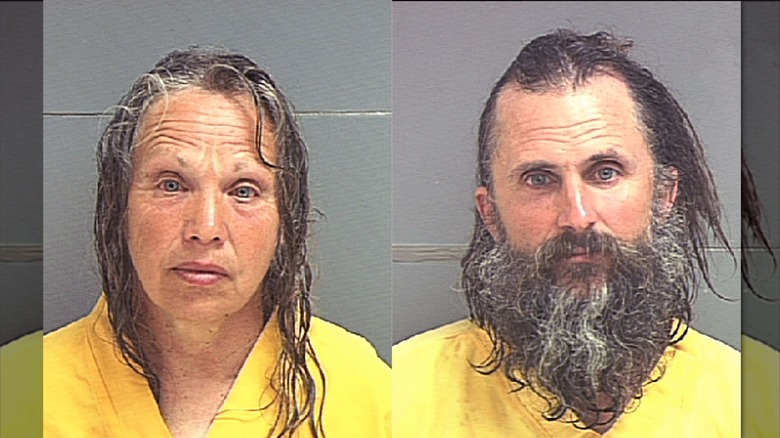
In June 2002, Elizabeth Smart, a Utah teenager, was kidnapped from her bedroom. Her abductors, a man and a woman, left Smart's younger sister as a witness. She recognized the man as someone who had briefly worked for the family, using the name "Immanuel." Some eight months after Smart's abduction, a sketch of "Immanuel" was broadcast on "America's Most Wanted" as part of a feature on the kidnapping. A few weeks later, witnesses identified the man walking down the road in the company of two veiled women. One was his wife and accomplice, and the other proved to be, miraculously, the living and as-well-as-you-could-expect Elizabeth Smart. (This isn't even the strangest place a kidnapped child has been found.)
Immanuel was really Brian David Mitchell, and his wife and confederate was Wanda Barzee. They had taken Smart to California and lived rough before returning to Utah, where they were found just outside Smart's native Salt Lake City. Mitchell and Barzee put Utah taxpayers through a long legal dog-and-pony show that involved both of them being found incompetent for trial at different points, though both were eventually tried and convicted of charges related to Smart's abduction.
Mitchell was sentenced to life, while Barzee got 15 years, though in early 2025 she was returned to custody for violating the conditions of her parole. Smart, thankfully, appears to have healed well and thrived, working as a victims' advocate and television presenter. She also got married and gave birth to three children, whose bedroom windows presumably have good strong locks.
If you or someone you know may be the victim of child abuse, please contact the Childhelp National Child Abuse Hotline at 1-800-4-A-Child (1-800-422-4453) or contact their live chat services.
If you or someone you know needs help with mental health, please contact the Crisis Text Line by texting HOME to 741741, call the National Alliance on Mental Illness helpline at 1-800-950-NAMI (6264), or visit the National Institute of Mental Health website.
If you or someone you know is struggling or in crisis, help is available. Call or text 988 or chat 988lifeline.org