

'70s Flop Songs That Tanked With Critics But Soared With Rock Fans
Sometimes, the critics get it wrong. While some terrible songs have truly earned the right to be included in the most brutal music reviews of all time, other critically reviled songs are deservedly beloved by rock fans. After all, even the most experienced music critic doesn't have the ability to time-travel and see a song's future legacy. Instead, they have to depend on their own ears, opinions, and music knowledge. All this means that some classic rock songs — especially the more experimental ones — tanked with critics when they were first released.
Today, many music critics generally give albums positive reviews, fearful of losing access to artists and angering fans. Things were different in the '70s, when critics appeared to compete to write the harshest, most creative takedown they could, just for fun. Music critic Lester Bangs — memorably played by Philip Seymour Hoffman in "Almost Famous" — once even suggested that the lead singer of a band he didn't like should be assassinated.
As we did with our list of music critic reviews that aged poorly, we dove deep into music publication archives to compile this list of '70s flop songs that fell flat with critics, but rock fans came to adore. We read contemporaneous negative reviews of hit songs from the '70s and contrasted those reviews with the song's chart performance, fan reception, and overall legacy.
Paul McCartney — Uncle Albert/Admiral Halsey
Apparently, no one took the Beatles' breakup harder than the critics who panned their early solo albums. The playful "Uncle Albert/Admiral Halsey," from Paul and Linda McCartney's 1971 album "Ram," drew even more ire than usual. Rolling Stone called it "the nadir in the decomposition of Sixties rock thus far" and "incredibly inconsequential and so monumentally irrelevant," adding that the song is proof that Lennon was the more talented of the Lennon-McCartney songwriting duo (and this was at a low point in the Lennon-McCartney relationship). Ouch!
"Uncle Albert/Admiral Halsey" is admittedly an odd song. It combines several disconnected (and catchy) fragments and features nonsensical lyrics like "The butter wouldn't melt, so I put it in the pie, alright?" Still, it's not like this was out of left field for McCartney. The quirky lyrics fit right in with some of McCartney's lighthearted songs from "The Beatles" (aka the White Album), while the medley style recalls side B of "Abbey Road." Rock fans agreed, sending the song to the top of the Billboard Hot 100, becoming McCartney's first solo No. 1. Today, "Uncle Albert/Admiral Halsey" is sometimes regarded as a precursor to modern indie rock.
Kate Bush — Wuthering Heights
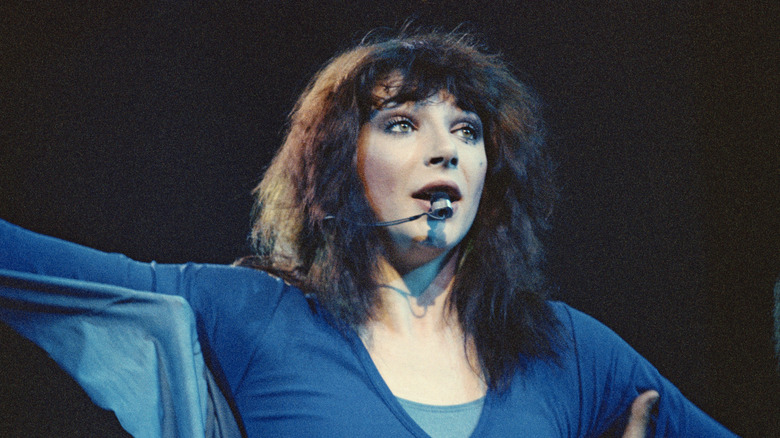
"Wuthering Heights" was Kate Bush's debut single, and critics did not know what to make of it. Released in 1978, "Wuthering Heights" is a reimagining of the Emily Brontë gothic romance novel, with Bush singing from the perspective of Cathy's ghost. Bush's distinctive vocal style and melodramatic lyrics appeared so out of left field that many critics reacted with derision. The eccentric pair of music videos, showing Bush doing interpretive dance in a studio and a field, didn't help. Melody Maker called the song "bizarre," Record Mirror called it "rotten," and even the Brontë Society weighed in, calling it a "disgrace" (all via Quietus).
Despite the negative critical reception, "Wuthering Heights" was a hit with rock fans. The song reached the top spot on the U.K. Singles chart, and its legacy endures today. If anything, its reputation is growing. Since 2013, fans have gathered globally to celebrate the song in events called "Wutherings." Attendees wear red dresses to match the one Bush wears in the music video and do their own wild dance moves. Along with "Running Up That Hill," "Wuthering Heights" is one of Bush's best-known and most beloved songs today.
Neil Young — After the Gold Rush
"After the Gold Rush" was the title song from the 1970 solo album Neil Young released after the hit Crosby, Stills, Nash, & Young album "Deja Vu," and critics apparently missed the presence of the other three folk rock superstars. There's no other explanation for why this now-beloved album got such harsh reviews. Rolling Stone's 1970 review of the album kicks off with the lines, "Neil Young devotees will probably spend the next few weeks trying desperately to convince themselves that 'After The Gold Rush' is good music. But they'll be kidding themselves," and only gets worse from there.
The album was a moderate chart hit when it was released, but its legacy grew over time, and "After the Gold Rush" is now considered by fans and critics alike as one of Young's best songs. In 2024, Rolling Stone even put it on its list of the 500 greatest songs of all time — quite a change from that first review.
Bob Dylan — Idiot Wind
Bob Dylan's 1975 album "Blood on the Tracks" is now considered one of the best of all time, but when it was released, critics weren't so sure. Overall, the album received mixed reviews. "Idiot Wind," a nearly eight-minute song written in the wake of Dylan's divorce, was particularly polarizing. Rolling Stone hated the song, stating that Dylan "sounds like a shadow of his former self" and critiquing "the childishness (without any redeeming childlike wonder)" of the lyrics.
"Idiot Wind" is a mean song, but that's the point — it's a divorce song that's aimed at not only Dylan's ex-wife but at himself. The chorus begins "Idiot wind/ Blowing every time you move your mouth," but as the song goes on, the lyrics move from childish taunts to earnest heartbreak. At the end of the song, Dylan admits and laments his lack of understanding about his ex and changes the "you" to "we": "We're idiots, babe/ It's a wonder we can even feed ourselves." While critics didn't get it, listeners were moved by the angst-filled song. Today, it remains a fan favorite.
Queen — Bohemian Rhapsody
Yes, Queen's biggest hit was also one of their most critically reviled. When "Bohemian Rhapsody" was released in 1975, critics were puzzled by the six-minute rock suite with lyrics like "Scaramouche, Scaramouche, will you do the fandango?" — and not in a good way. Time decried the song's "Gilbert and Sullivan operatics" and added, "Queen's lyrics are not the stuff of sonnets." In a review of a Queen tour a few years later, The New York Times wrote that the lyrics are "pretentious and irrelevant" and the song sounds "mostly pretty empty, all flash and calculation." (It wasn't just "Bohemian Rhapsody," either: Generally, critics had a very negative response to Queen in the '70s.)
Rock listeners, however, thought the song was creative rather than pretentious. They loved the operatic nature of the lyrics and the dramatics of lines like "Mama, just killed a man." Thanks to fans, "Bohemian Rhapsody" reached No. 1 on the U.K. Singles Chart despite the negative critical response. The song has always been a fan hit, but critical acclaim came slowly over the years, and the song is now widely considered one of the greatest of all time.