

Interviews That Derailed Rock Bands' Entire Careers
Imagine working all your life to achieve fame and critical acclaim as a world-class rock musician, only to see your reputation crumble after uttering some poorly judged words during a routine interview. Today, many stars receive media training to lessen the chance that they'll put their foot in it when speaking to the press. However, even with efforts to keep rock stars on message, history shows that just a single appearance can decisively alter a band's career trajectory — and in some cases rob the group of its superstar status.
Here, then, are four notable examples of times when rock bands saw their careers shaken by controversial interviews. There are three examples from the classic rock era — one from the '60s, one from the '70s, and one from the '80s — as well as a more modern example that has similar destructive potential. All in all, these incidents show that even today's media landscape can offer pitfalls for rockers who haven't learned when to hold their tongue.
John Lennon claims Beatles 'bigger than Jesus,' 1966
The Beatles could do little wrong after the band arrived in the U.S. in 1964. An era-defining appearance on "The Ed Sullivan Show," one of the best TV shows of the 1950s, introduced the British stars to American listeners. From there followed a bevy of chart-topping singles and studio albums, as well as incredible live performances given to delirious, screaming crowds. But the Fab Four's golden run as a touring phenomenon came to an abrupt end in 1966, when John Lennon made some remarks in an otherwise inconsequential interview that changed The Beatles' career forever.
Lennon was speaking to his friend, journalist Maureen Cleave, who was interviewing the performer for the London Evening Standard (via Beatles Interviews), when he suggested: "Christianity will go. It will vanish and shrink. I needn't argue about that; I'm right and I will be proved right. We're more popular than Jesus now. I don't know which will go first — rock 'n' roll or Christianity. Jesus was all right but his disciples were thick and ordinary. It's them twisting it that ruins it for me."
The quote then circulated in the United States after being picked up by the fanzine "Datebook" and amplified by conservative groups opposed to the band. The interview became the biggest scandal of the Fab Four's career, leading to radio bans, death threats, and public burnings of The Beatles' records and memorabilia. Lennon apologized repeatedly, but his comment permanently altered the group's reputation in the eyes of some fans and emboldened those who had been suspicious of the band to begin with. The blowback was one of the factors that led to The Beatles' decision to stop touring and focus solely on studio work.
The Sex Pistols' Bill Grundy interview, 1976
Warning: Video contains explicit language.
Some point to the Sex Pistols' legendary concerts at the Lesser Free Trade Hall in Manchester as the moment that punk exploded in Britain. But for wider British society, it was the band's notorious appearance on the TV show "Today" that catapulted the new youth movement to national attention. The Sex Pistols was brought in as a last-minute replacement for hard rock band Queen, which wasn't able to make the interview due to frontman Freddie Mercury having a dental procedure. As such, host Bill Grundy seemed unprepared for the encounter with the young punks and their entourage.
Grundy misguidedly attempted to talk down to them, comparing them to classical composers and receiving nothing but sarcastic, confrontational answers from the band. Soon, the members started cursing on live TV. After Grundy seemingly made a suggestive comment to one of the young women accompanying the group, guitarist Steve Jones began hurling expletive-laden insults at the host, who goaded him on in the final moments of the show before the credits rolled.
The interview was disastrous for Grundy: He was suspended by Thames Television for two weeks, and his TV career never recovered. Meanwhile, the Sex Pistols was dropped by its record label EMI, which nixed the release of the single "Anarchy in the U.K." The track was banned by many radio stations, and wary promoters canceled upcoming live shows. The band's notoriety made it a legend and one of the biggest icons of the punk movement, but it was a rocky start to a short-lived career dogged by controversy (here are the many reasons the Sex Pistols broke up).
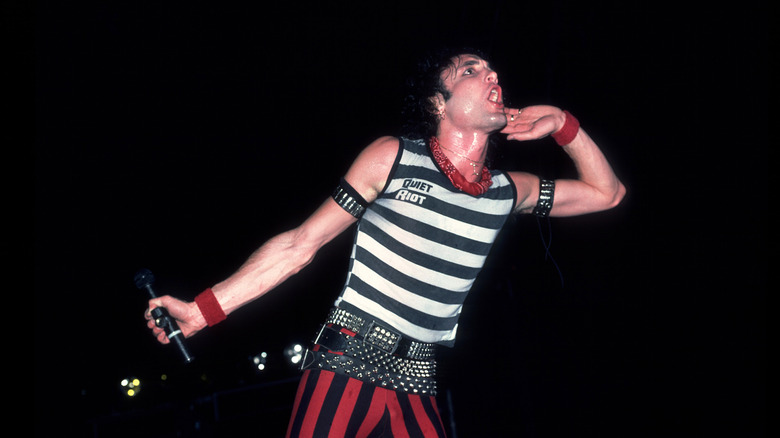
Quiet Riot's Kevin DuBrow insults Ozzy Osbourne, 1984
Quiet Riot was debatably the first heavy metal band to achieve a No. 1 album in the United States with "Metal Health" in 1983. But while that record was a game-changer that eventually went five times platinum, the band was unable to maintain its seat at rock's top table, and frontman Kevin DuBrow's opinionated interviews were a factor in the band's downfall.
DuBrow formed Quiet Riot alongside guitarist Randy Rhoads in 1975, and it was a long journey to mainstream acceptance. Frustratingly for the band, it wasn't long before DuBrow threw it all away. Even before the release of the band's sophomore album, the Quiet Riot singer had taken to bashing contemporary metal bands in interviews, going so far as to criticize the vocals of legendary Black Sabbath frontman Ozzy Osbourne. That comment in particular eroded much of the goodwill Quiet Riot enjoyed in the metal community up until that point. When "Condition Critical" was released in 1984, the album struggled to perform to the standard set by "Metal Health," and listeners turned to other heavy metal bands arriving on the scene.
DuBrow was fired from the group in 1987, after which it became a revolving door of musicians. The band was also the subject of a legal dispute, with DuBrow attempting to reclaim the name for his own musical projects. Quiet Riot staggered on, but it never again found the wide audience it enjoyed on its debut.
Matty Healy's podcast appearance tarnishes The 1975, 2023
In many ways, the classic rock bands of the past benefited from a narrower media landscape, with the traditional platforms such as magazines and pre-planned TV interviews often allowing them to present themselves in a good light. But as The 1975's frontman Matty Healy found in 2023, today's combination of long-form content and social media can potentially be disastrous for stars who forget that a poorly thought-out utterance can go viral in no time. Indeed, Healy's appearance on "The Adam Friedland Show" has the potential to derail the band's career.
Healy has often been outspoken in public appearances, but on this show (which was removed from Apple and Spotify), he participated in a discussion that drew outrage from listeners and the wider internet. Several comments were sexist, while others referred to his apparent penchant for pornography with racial overtones. Meanwhile, on the subject of up-and-coming rapper Ice Spice, Healy joined the hosts in laughing at jokes about her ethnicity and imitations of a Chinese accent. The controversy provoked negative headlines and drew stern criticism from other artists. Although Healy later apologized to Ice Spice on stage, many fans view him differently now — what was formerly considered a precocious wit is seen by some as problematic recklessness.
On paper, the controversy has done little harm to The 1975's commercial prospects — the band still gigs widely and even headlined the U.K.'s Glastonbury Festival in 2025. But the damage to his image might have painted Healy into a corner in terms of his persona. Only time will tell if it impacts his creative output and how fans react to new material released after the scandal.