

5 Iggy Pop Songs That Transformed Rock's DNA
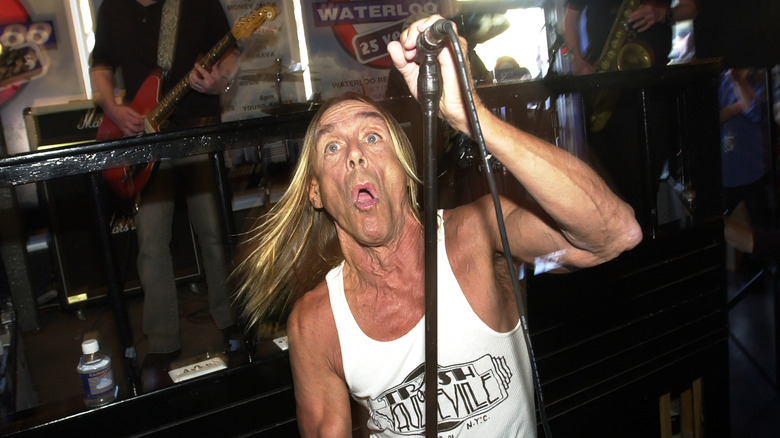
The phrase "living legend" tends to get thrown around a lot in the rock world, yet there is no term that better describes Iggy Pop. Since emerging in the late 1960s as frontman for Detroit rock band The Stooges, the erstwhile James Newell Osterberg Jr. has been a driving force in rock, nicknamed the "Godfather of Punk" for the influence he's had on music over a period spanning six decades and counting.
Pop has experienced multiple musical evolutions over the years while remaining distinctly and idiosyncratically himself. Like fellow proto-punk pioneer Lou Reed, his most iconic songs have come from collaborations with David Bowie. Other collaborators over the years — an eclectic list, to be sure — have included The B-52's Kate Pierson, Queens of the Stone Age's Josh Homme, jazz organist Dr. Lonnie Smith, Guns 'N Roses guitarist Slash, and producer Danger Mouse.
Meanwhile, Pop continues to hit the road and go on tour — still performing with his signature sans-shirt look. In fact, it speaks volumes about his continued cultural relevance that the same month of his 79th birthday in April 2026, he was also a headliner at Coachella, the music world's annual bastion of hipper-than-hipness. With that in mind, there's no better time to reflect on his immense influence on music by highlighting five Iggy Pop songs that transformed rock's DNA.
I Wanna Be Your Dog
Released in August 1969, The Stooges' self-titled debut album blasted out of Detroit like the Apollo 11 space capsule that rocketed to the moon the previous month. During a summer when The Archies' "Sugar Sugar" and the first album from Crosby, Stills & Nash were climbing the charts, imagine the shock of placing "The Stooges" LP on a turntable, dropping the needle, and experiencing the sonic assault of "I Wanna Be Your Dog."
As a fuzz-toned guitar repeatedly plays a simple three-chord progression, the song builds to a doom-laden crescendo when the chorus hits, with Pop singing, "Now I wanna be your dog." Boasting a spare, minimalist sound, as if the band members had only just learned how to play their instruments, the song emphasizes energy over musicianship. Unsurprisingly, it's widely considered one of the most influential songs in shaping the nascent punk movement that would explode a few years later.
Clocking in at just over three minutes, the song is brief and punchy. That, however, hadn't been the original plan. "Each of the songs was meant to have a seven- to 15-minute instrumental after the conclusion of the song format," Pop explained in an interview with Uncut. "The good news was the song parts were good and the improv was good up to about a minute. The bad news was that after that, we hadn't put the homework into making an improv stand up as a listening experience."
Search and Destroy
When Iggy Pop and the band — now renamed Iggy & the Stooges — recorded its 1973 album "Raw Power," the shirtless singer's outrageous onstage antics had become notorious. Whether bleeding profusely after rolling around on broken glass, hurling hunks of watermelon at the audience (giving one fan a concussion), or performing high on PCP, Pop was rock's wildest wild man. Not coincidentally, Pop and the rest of the band had serious drug habits. "We were all one step away from becoming junkies, and the ones that weren't junkies were out of touch with reality," Pop told Uncut of the band's state when recording the album that would spawn arguably his most important song, "Search and Destroy."
A three-and-a-half-minute masterclass in punk rock — before punk was even a thing — the song boasts lyrics inspired by an article he'd read in Time magazine about the Vietnam War. Pop may not have been at his sharpest cognitive clarity, but he still recognized a song that would cement his legacy. "But 'Search And Destroy' is the masterpiece," he added. "And I knew it when we did it, so I felt a sense of relief that my immortalization, basically, was secured."
"Search and Destroy" may have not cracked the top 40, but it inspired the next generation of rockers. In fact, musicians including the Sex Pistols' Steve Jones and Mötley Crüe's Nikki Sixx have claimed the song as a major influence. Even Nirvana's Kurt Cobain called "Raw Power" his favorite record of all time.
Nightclubbing
When examining the truth about Iggy Pop and David Bowie's relationship, it all began when they met in 1971 at NYC hotspot Max's Kansas City, sparking a lifelong friendship. After The Stooges split up in 1974, Pop was ready to pursue a solo career. Enter Bowie, who was about to embark on his Berlin Trilogy ("Low," "Heroes," and "Lodger"), charting a new musical course inspired by German synthesizer pioneers Kraftwerk. Bowie agreed to produce Pop's first solo album, 1977's "The Idiot," which resulted in Pop embracing a similar sound in his groundbreaking single "Nightclubbing."
According to Pop, Bowie was using "The Idiot" as a guinea pig while crafting the sound characterized in those three wildly influential records. "Because there are things he did with me that he couldn't do as David Bowie, because it would have slowed him down or might have been a wrong move," Pop explained to Uncut. "And then he was also able to use me to practice."
Recording the album in Paris, the synth-driven "Nightclubbing" was almost dystopian in its sound. It's easy to draw a straight line from that song to the synthesizer-heavy new wave hits of the early 1980s (The Human League of "Don't You Want Me" fame was particularly inspired by the track, as was Grace Jones, who recorded her own hit cover in 1981). Just as he'd laid the foundation for punk, "Nightclubbing" saw Pop (with an assist from Bowie) once again influence the next generation of rock.
Lust for Life
Released the same year as "The Idiot," "Lust for Life" was also produced by David Bowie. For their second collaboration, recording took place in Berlin, although Bowie was anxious to move on to his own records. "Bowie was tired of spending time on my projects and I think he wanted to get it over with really quickly, so: 'Let's just rock and get this guy out of my hair,'" Pop told Uncut of how the album's now-iconic title track, "Lust for Life," quickly came together. "David and I had determined that we would record that album very quickly, which we wrote, recorded, and mixed in eight days ..." he told Joe Ambrose for the book "Gimme Danger."
"The whole thing was written sitting on our backs in his apartment with his kid's ukulele," Pop told Uncut. At one point, Bowie offered a title, "Lust for Life," telling Pop to go write a song to fit it. So he did, improvising lyrics on the spot: "I'm worth a million in prizes," he sings, in one of the song's more memorable lines.
The song immediately grabs listeners with the unmistakable, frenetic drumbeat courtesy of Hunt Sales. According to Sales, he combined the beat of Motown hit "You Can't Hurry Love," the theme song of Saturday morning cartoon "George of the Jungle," and the Armed Forces Radio call signal. The tune's enduring power was evident when it was utilized in a pivotal scene in the 1996 film "Trainspotting," gaining a second life and resurrecting Pop's career.
The Passenger
Another hugely influential song from "Lust for Life" was "The Passenger." Propelled by guitarist Ricky Gardiner's loping, hypnotic riff, the song does a bang-on job of sonically creating the feeling of movement (he was imagining wandering in a field, and Iggy Pop's lyrics are about traveling on Berlin's S-Bahn subway). Prior to working with Bowie on those back-to-back albums, Pop had checked himself into the Neuropsychiatric Institute in Los Angeles in order to address his heroin usage. "They used to let me go walkies with the group for an hour in the Neuropsychiatric Institute in Westwood and I saw [director Michelangelo] Antonioni's [film] The Passenger' was playing at the Westwood Theater and it made a big impression on me," he told Uncut. "'The Passenger' was derived from the Antonioni film, the [Jim] Morrison poem, and a lick that I was doodling in the studio. It was never supposed to be a song," he said elsewhere in the interview.
A prototypical post-punk anthem, released before punk hit the mainstream, "The Passenger" also offers hints of goth, well before that particular genre became a thing. Its enduring nature was clear when Siouxie and the Banshees recorded a cover in 1987. The track has also been covered by R.E.M. and INXS frontman Michael Hutchence, who was sadly among the rock stars that hid a tragic secret for years. Meanwhile, the song's legacy continues to resonate and can be heard in the work of bands ranging from Joy Division to Nirvana.
If you or anyone you know needs help with addiction issues, help is available. Visit the Substance Abuse and Mental Health Services Administration website or contact SAMHSA's National Helpline at 1-800-662-HELP (4357).