

Rock Bands Who Lost Their Keyboardists To Mega-Successful Artists
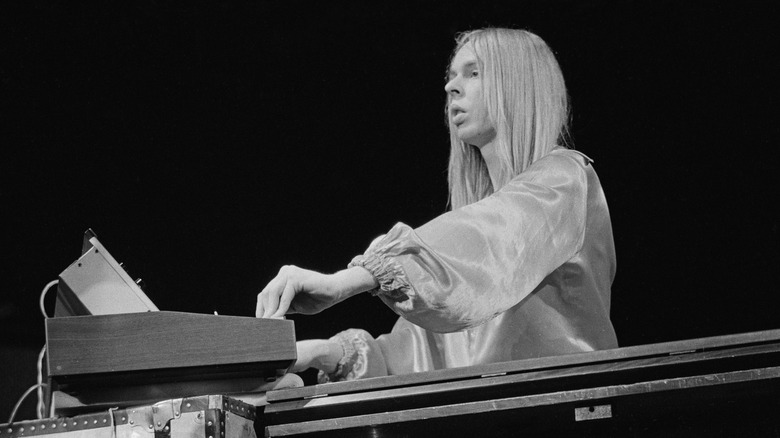
Plenty of rock bands have acted as incubators for artists who left for greener pastures, and keyboardists have been no exception to those who walked away. Because keyboardists do so much to shape a group's sound — laying down a boogie-woogie foundation, providing synthesizer stings to progressive epics, or adding shade and color to contemplative folk songs — rock bands that see them lured away are faced with a quandary.
Some of these bands, such as Chicken Shack, simply soldiered on without altering their sound, replacing their departed pianist with another. Others, including the Strawbs, continued to evolve and trace a career as arguably unique and successful as the group their former keyboardist left for. And then there were the bands that stumbled and withered, or had to deal with the double-whammy of losing a prized keyboard player twice over. Regardless of the outcome, these rock bands ultimately expanded rock's family tree, fostering and launching more bands and branches that have either flourished or withered, yet leaving rock music so much richer for it.
The Nice — Keith Emerson
The British band The Nice grabbed the spotlight with rocking versions of classical music and blistering live shows. At the band's center, keyboard wunderkind Keith Emerson was a showstopper, jabbing daggers into his keyboards to sustain notes. Launched as a four-piece with Emerson, drummer Brian Davison, bassist-vocalist Lee Jackson, and guitarist Davy O'List, The Nice courted controversy with its 1968 rampage through Leonard Bernstein's "America," after Emerson burned the American flag during a live performance. When O'List left, the band continued as a trio, but its keyboardist was growing restless.
Jackson thought Emerson felt chained to his instrument, a perception enhanced when "[Emerson's] mother came to a gig and brought Pledge furniture polish," Jackson recalled in Will Romano's "Mountains Come Out of the Sky: An Illustrated History of Prog Rock." After Emerson left the Nice to form Emerson, Lake & Palmer (ELP), The Nice broke up.
Davison launched "Every Which Way," which dropped a self-titled album in 1970. Jackson formed Jackson Heights, which released four albums from 1970 to '73 that received critical acclaim, with some critics comparing the band to Crosby, Stills, Nash & Young. In 1973, Jackson and Davison returned to The Nice's format — a trio fronted by a virtuoso keyboardist — joining Patrick Moraz in Refugee.
Refugee — Patrick Moraz
When Patrick Moraz teamed with former The Nice bassist Lee Jackson and drummer Brian Davison in Refugee, he had already played an award-winning set at the Zurich Jazz Festival at age 16, followed by launching the rock band Mainhorse, which released one self-titled album. Jackson had originally approached Moraz about joining the bassist's band Jackson Heights, but as their partnership evolved, Jackson brought his old bandmate Davison on board and formed Refugee.
Refugee played its debut show in 1973 and released a self-titled debut album in 1974, which some critics have since hailed as one of that decade's best. The swirling, coruscating Papillion, the album's centerpiece, is as impressive as Emerson, Lake & Palmer but less bombastic; as adventurous as the Nice but more organic. Following Refugee's inaugural tour, Yes' manager contacted Moraz, and after auditioning for the progressive rock icons, Moraz joined Yes and put the kibosh on Refugee, which played its final show in 1974. In a 2002 interview with Notes From the Edge, Moraz called Jackson and Davison "very good and dedicated musicians with whom I'd had a fantastic time."
Refugees from their defunct band, Jackson formed another short-lived band, Stripjack, before continuing as a member of various other bands, while Davison drummed with jazz-rock combo Gong before becoming a music teacher. In 2002, Jackson and Davison unexpectedly reunited with Keith Emerson to play a few concerts as the Nice, and "Vivacitas," a live set recorded in Glasgow, was released that year.
Strawbs — Rick Wakeman
Long before he sported flamboyant capes and embarked on ambitious solo projects, Rick Wakeman was a busy session player for artists such as Cat Stevens and David Bowie. When a folk band called the Strawbs came calling, Wakeman joined to play on its 1970 album "Just a Collection of Antiques and Curios," which reached No. 27 on the U.K. charts. Wakeman's irreverence surfaced on a TV appearance, where he played his keyboards with a paint roller. "It certainly was noticed," Strawbs founder Dave Cousins told journalist Dan Wooding (via Assist News). Indeed, it so happened that the band Yes had also noticed.
After Wakeman joined Yes in 1971, the Strawbs didn't falter for long. In fact, the band went on to its greatest successes. The 1972 LP "Grave New World" departed from the band's folk roots and embraced rock, reaching No. 11 in the U.K. Other highlights include 1973's "Bursting at the Seams," which marked the band's transition to progressive rock, and 1974's "Ghosts," which enjoyed a bite at the U.S. charts.
Cousins and Wakeman remained friends, teaming up to record the album "The Hummingbird" in 2002. After Cousins died in 2025, Wakeman wrote on Facebook, "Dave was determined to take the music to a new level and his songwriting and lyrics were just a joy to work with." Recalling a 2024 reunion show where he and Cousins played the Strawbs' uplifting "A Glimpse of Heaven," Wakeman added, "Dave now truly has a real 'Glimpse of Heaven.'"
Chicken Shack — Christine McVie
Stan Webb, a guitarist who emulated blues player Freddie King, founded Chicken Shack in 1965, and a few years later recruited Christine Perfect (later McVie), who performed on the band's 1968 debut album, "40 Blue Fingers, Freshly Packed and Ready to Serve." In 1969, Chicken Shack scored its biggest hit single with a cover of Etta James' "I'd Rather Go Blind," played and sung by McVie, which reached No. 14 in the U.K. It also so happened that Chicken Shack shared a label with Fleetwood Mac.
After falling in love with and marrying Fleetwood Mac bassist John McVie in 1968, Christine followed her new husband to his band, becoming an official member in 1970. Filling the open keyboard position with Paul Raymond, Chicken Shack soldiered on. Subsequent albums adopted the heavier rock sound in vogue at the time, but Chicken Shack's label dropped the group, and everyone but Webb left to join Savoy Brown; after two more lackluster LPs, the band broke up. Webb, who turned 80 in February 2026, has revived Chicken Shack several times since, and was still playing live in 2004.
The Spencer Davis Group
The Spencer Davis Group, led by guitarist Spencer Davis, broke the U.K. Top 10 four times in the 1960s, including two No. 1 singles. But at the band's commercial peak, the star of the show was often Steve Winwood, the young keyboardist and vocalist. Winwood takes the spotlight with two hits he co-wrote, the rollicking R&B-infused 1966 "Gimme Some Lovin'" and the jubilant, propulsive 1967 "I'm a Man," both of which reached the Top 10 in the U.S. Winwood left the band in 1967 and formed Traffic, creating a legacy of critically acclaimed albums and four Billboard Hot 100 hits.
Recruiting keyboardist Eddie Hardin, whose vocals bore a similarity to Winwood's, the Spencer Davis Group reshaped its sound and cracked the U.K. Top 40 two more times, but saw minimal success in the U.S. Those songs were 1967's "Time Seller," with sawing cello and percussive guitar that recalls the heavy psychedelia of the Move, and the following year, the band tackled conformity with the socially conscious yet no less psychedelic "Mr. Second Class."
In 1970, Davis dissolved the band and moved to the U.S. The band revived in 1973, and subsequently went through a handful of lineups, but never regained its commercial momentum. Recalling Winwood after his departure in later years, Davis frankly said (via The Guardian), "I think Steve never sounded as good with Traffic ... as he did with us."