

10 Strange But True Stories From 1970s Rock
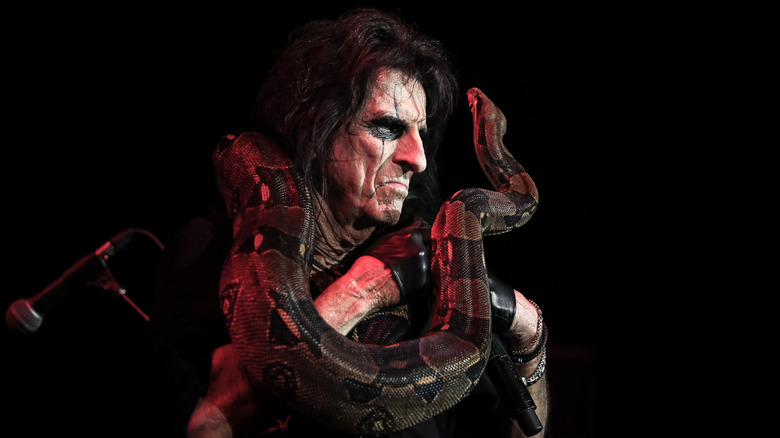
Rock 'n' roll is supposed to be the furthest thing from safe; it is meant to be dangerous and unpredictable by its own design. However, in the 1970s, there were a few incidents that even the most ardent and passionate fan of the genre couldn't help but say, "Yo! That was wild, dawg!" These stories may sound implausible, even far-fetched by any stretch of the imagination — however, they're surprisingly true.
From Alice Cooper auditioning a snake for his band to the members of Kiss mixing their own blood into a comic book, it was a different time in the 1970s. One may wonder how many of these events would happen today, though considering how the world doesn't appear to be getting any less strange, perhaps that's a foregone conclusion. With that said, let's roll back the clock and walk on back to discover the strange but true stories of some of the most important rock bands of the 1970s, each one of which is worthy of its own movie.
Elvis Presley asked Richard Nixon to appoint him a federal agent position
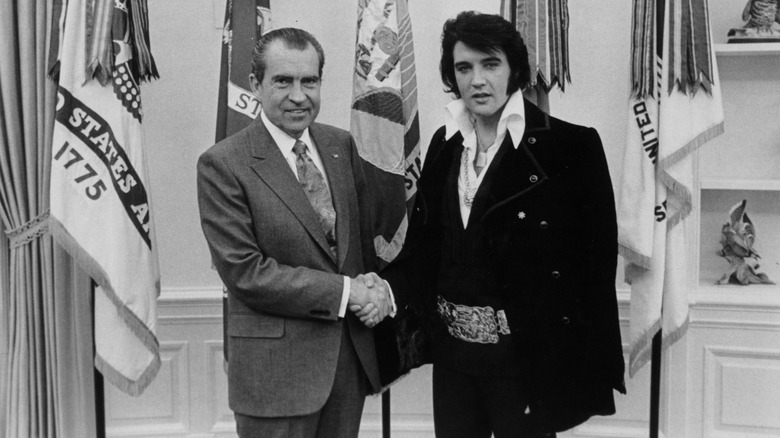
There's a phrase: sex, drugs, and rock 'n' roll. However, in the 1970s, the U.S. government — led by President Richard Nixon — didn't like the middle section of that saying, so it fought hard against it and its associated counterculture. One person who decided he wanted to help the government was the King himself, since, as it turns out, Elvis Presley had an interesting relationship with law enforcement.
Elvis met with then-U.S. Vice President Spiro Agnew in 1970. The rocker wanted to be part of the government's anti-drug drive, suggesting that he could put his high profile to better use. When he later went to the White House, Elvis handed a letter intended for Nixon to a guard, in which he asked to be appointed a "federal agent-at-large." This culminated in Elvis meeting with the president, during which he gifted him a gun and mentioned once again how he wanted to help out the administration.
Following Nixon and Elvis' warm but uneventful meeting, the president wrote a letter to the singer and thanked him for the gift and visit. But what about Elvis' request to become a federal agent? Well, Nixon didn't say a word about it. Then again, if it did happen, would it have been publicized?
Pink Floyd didn't recognize Syd Barrett years after he left
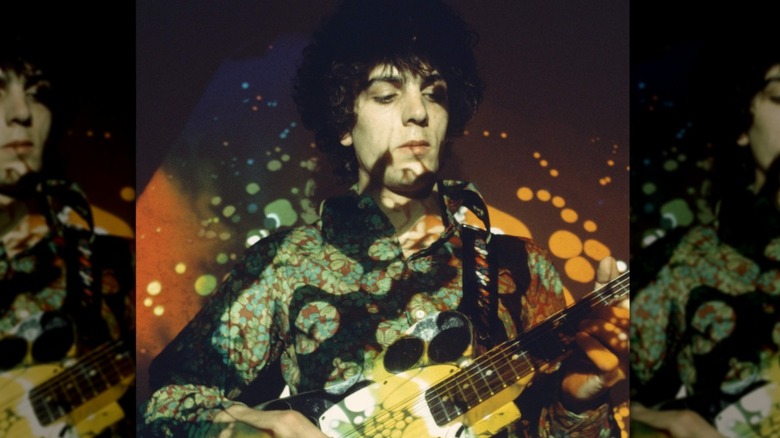
When looking back at Pink Floyd's history, it's important to remember that Syd Barrett played a fundamental role in the rock band's formation. He was the lead vocalist and guitarist from the group's inception in 1965 until 1968, when he was kicked out of Pink Floyd. Afterward, Barrett experienced a whirlwind time in both his music career and personal life, drifting in and out of the public eye. His appearance also notably changed, with many people, including his former bandmates, not recognizing him the next time they saw him.
In 1975, Barrett visited Pink Floyd while the group recorded the album "Wish You Were Here" at Abbey Road. "Roger [Waters] was sitting, mixing at the desk, and I saw this big bald guy sitting on the couch behind [him]," Pink Floyd's Richard Wright recalled (via SydBarrett.net). "... And I didn't think anything of it. In those days it was quite normal for strangers to wander into our sessions."
According to Wright, neither he nor Waters recognized Barrett, who seemingly decided he would be recording guitar with them that day — even though he didn't have a guitar with him. "... it took me a long time, and then suddenly I realized it was Syd, after maybe 45 minutes," Wright added. The meet-up didn't turn violent or ugly; it was just bizarre. It would also be the last time that his former bandmates would see him. Barrett died in July 2006 at the age of 60.
Jeremy Spencer left Fleetwood Mac to join a cult
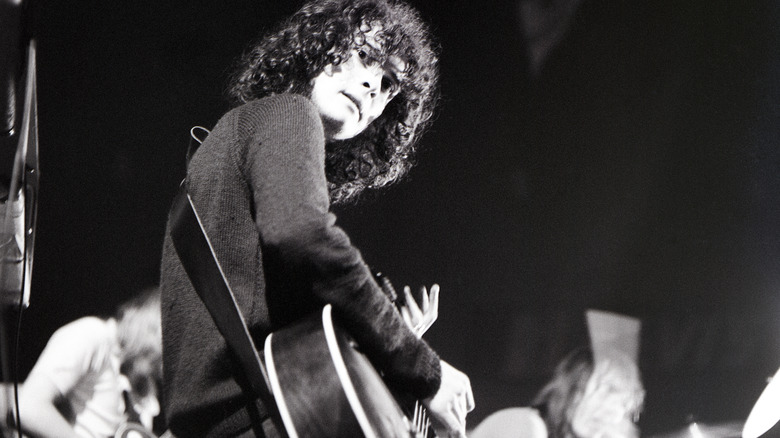
In 1970, Fleetwood Mac underwent a dramatic transformation. The bluesy sound evolved into rock on the album "Kiln House," which featured Jeremy Spencer handling lead vocals on many of the tracks. The group headed out on tour in support of the record and its new era, but on the Los Angeles stop, Spencer left the hotel and never came back, forcing the band to cancel a gig. A few days later, his bandmates found him. So, what was the reason for Jeremy Spencer leaving Fleetwood Mac? He had joined a cult, the Children of God, which eventually became known as the Family.
When Fleetwood Mac spoke to Spencer, he explained his decision, citing it as a brand-new calling for him. "This whole thing is not like him at all," bassist John McVie told Rolling Stone at the time. "He doesn't want to play any more, just serve Jesus and God. That's fair enough, but there should be a balance." Fleetwood Mac called up its former singer, Peter Green, to finish the tour, but Spencer never returned, as he embraced his new life within the Children of God and brought his family into it.
Decades later, several of Spencer's children left the Family and opened up about the inner workings and lifestyle, as well as the slim-to-none likelihood of Spencer ever leaving. When discussing why Spencer might have been attracted to the group in the first place, Spencer's son Jez told The Guardian, "We blame acid on Dad joining, and Mum was just so young."
Alice Cooper held an audition for a snake
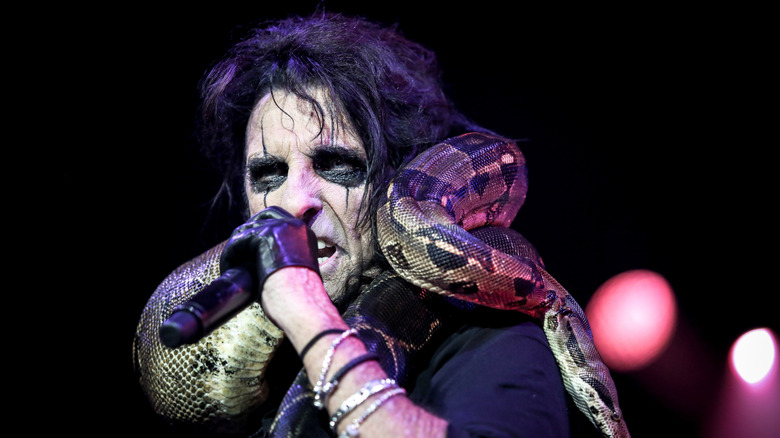
While the music is important to Alice Cooper, the theatrical element has long been just as essential for the original shock rocker. From fake beheadings to neck-hugging snakes, Cooper loves to turn a concert into an all-out entertainment show for his fans.
In the 1970s, a boa constrictor by the name of Julius Squeezer had become an unofficial member of the band, forming a part of Cooper's live shows. However, Julius suffered a cruel and horrible fate after his food killed him. While trying to snack on a rat, the creature bit the snake and resulted in Julius going to the big serpent graveyard in the sky. "It was [a] bit like being bit on by your Wheaties," Cooper told Muse.
While Cooper missed Emperor Squeezer and likely said a little prayer for his fallen friend, the show had to go on. Thus, Cooper needed a snake replacement for his upcoming gigs. It would have been all too easy to go into a pet store and pick one out from there (imagine if someone could do that for bassists), but Cooper is all about the theatrics, so an audition was held — with judges — to pick out a new companion for Cooper's stage show. Reportedly, 40 snakes slithered up onstage and put their best, uh, tail forward to be selected for this once-in-a-lifetime opportunity, with the eventual winner being a boa named Angel. It was like "America's Got Talent," but for snakes and without Simon Cowell.
The Who's Keith Moon ran over his driver
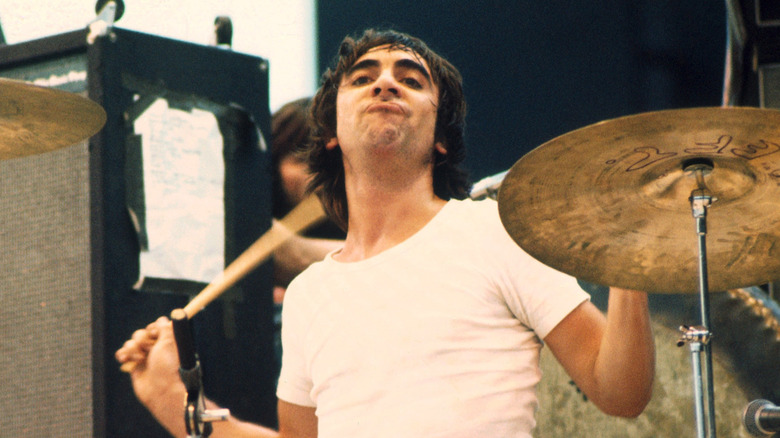
The Who drummer Keith Moon landed a bad reputation in the music industry because of his wild ways. Whether he destroyed hotel rooms or drove his car into a swimming pool, the musician liked to live on the extreme side of life. However, a horrible incident in 1970 proved to be a case of matters escalating way too far, even if Moon wasn't seen as the culpable party in the tragic situation.
A few days into the new year, Moon and Co. headed out to a pub for a night out on the town. Right away, Moon's superstar appearance and demeanor rubbed some patrons up the wrong way, so they decided to take out their ire on Moon's car, a snazzy and expensive Bentley, as Moon and his companions were leaving the pub. The incident took a violent and aggressive turn, so Moon hightailed it, hopping into his Bentley and riding away. In the ensuing commotion, Moon ended up hitting and dragging his bodyguard and driver, Neil Boland, under his car. Sadly, Boland died.
Since Moon didn't have a driver's license and had been drinking as well, Moon faced a series of serious charges for the incident. In the end, the court cleared Moon of all charges, as the judge stated (via Rolling Stone), "You had no choice but to act the way you did and no moral culpability is attached to you." Moon would die eight years later at the age of 32.
The Misfits wrote a song in jail
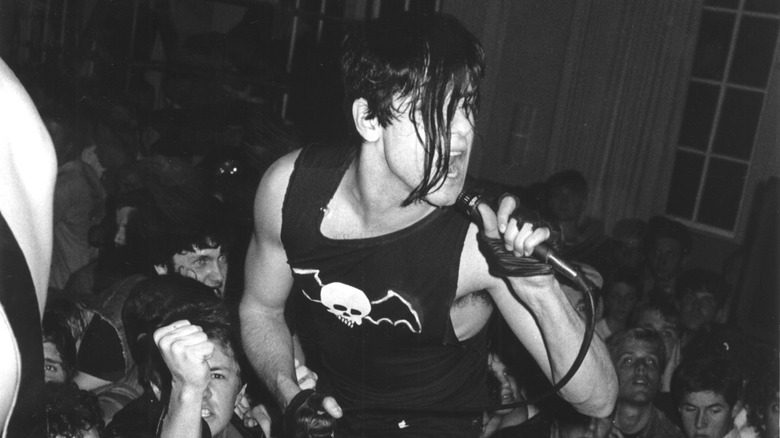
In 1979, the Misfits endured a tough time on a U.K. tour. The experience wasn't what anybody might have expected, but it took a turn for the worse after vocalist Glenn Danzig and guitarist Bobby Steele were arrested and spent two nights in a London jail. The legend goes that Danzig and Steele scuffled with a group of skinheads outside of the Rainbow Theatre, which culminated in them spending time in the slammer — time that they used to write the track "London Dungeon."
Speaking to Vice in 2008, Steele contested parts of the urban legend. He stated that he never saw any of the skinheads that his former bandmate claimed were itching for a fight, and it was Danzig "getting into this fantasy about these imaginary skinheads conspiring to beat us up." It all escalated after Danzig started sharpening a piece of glass in preparation for a tussle, and a convoluted fracas involving the venue's bouncers and police resulted in both Danzig and Steele ending up in jail.
Initially, Danzig and Steele were held in separate cells before being put together in one — and this is where they decided to use their time for the benefit of the Misfits. "That's when we came up with 'London Dungeon,'" Steele said. "We were sitting in the jail cell slapping out the drum beat on our thighs, and humming the bass line. It was a real echo-y jail cell and it sounded really cool."
The members of Kiss mixed their blood into comic book ink
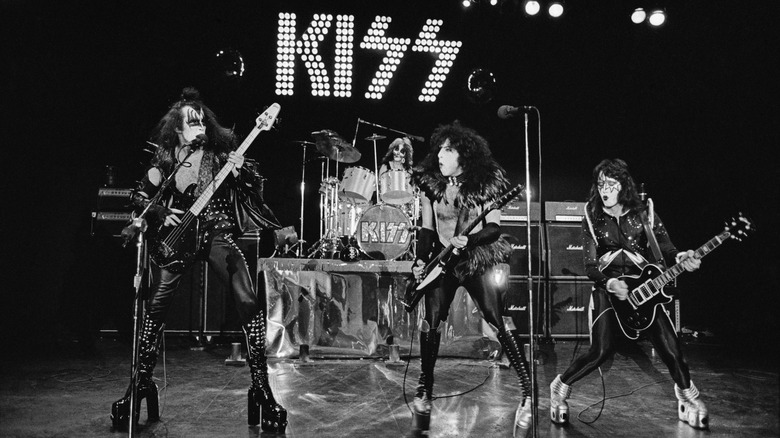
There's one band that never failed to see a marketing stunt as an opportunity to increase sales and attention for the group; lest we forget, Kiss once attempted to start a wrestling faction. Gene Simmons and the crew have conceptualized some weird ideas and released mighty strange merchandise over the years, but nothing tops the time in 1977 when they partnered with Marvel Comics to release a comic book about the band.
Now, a comic about a rock band isn't a novelty, and many other groups have done the same throughout the years, but how many can say the book was "printed in real Kiss blood"? Sure, that sounds gimmicky and surely not true, but here's the bizarre part: it is. Comic book fans were actually flicking through pages etched with the blood of Simmons, Paul Stanley, Ace Frehley, and Peter Criss — hopefully they washed their hands after reading.
According to Simmons' memoir "Kiss and Make-Up," this wasn't the band members' initial idea. Instead, it came from the Kiss management team. "We got into a DC3, one of those big prop planes, and flew up to Buffalo to Marvel's printing plant, where they pour the ink and make comic books," Simmons said. "A notary public actually witnessed the blood being drawn." Kiss had its blood drawn then put into vials, which were then mixed with the ink used in the comic book printing run.
The Yardbirds' Keith Relf was electrocuted and died while playing guitar
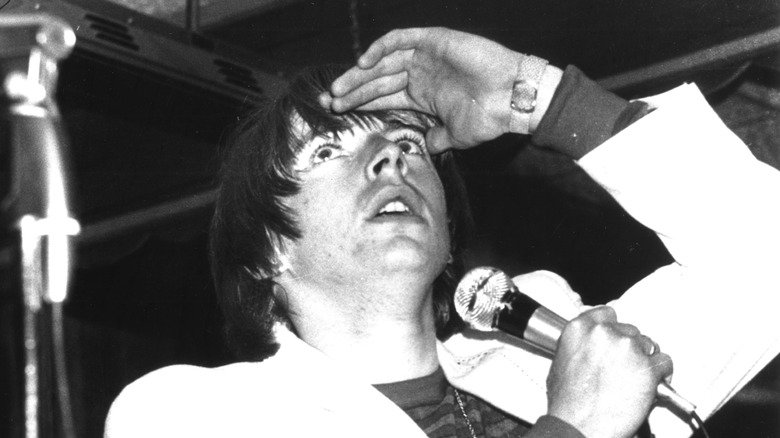
Throughout history, there have been many bizarre freak accidents that have claimed the lives of people. One of the strangest befell musician Keith Relf, who fronted the Yardbirds in the '60s. While Relf hadn't tasted the same level of success as the rest of the star-studded outfit, he continued to play music, but his passion turned out to be his unexpected downfall in May 1976.
Relf went down to his basement to play his electric guitar, but his guitar connection was ungrounded, which is recognized as a major electrical hazard. It so happened that Relf trod on a gas pipe while jamming, resulting in an electric current coursing through his body and electrocuting him. Relf didn't survive the unfortunate accident, dying at the age of 33. It's a tragic event under any circumstance, but it was further compounded by gossip about the actual nature of his death, since so many people couldn't believe he had died in such a manner and wanted all the details. Later, his family confirmed that Relf died after being electrocuted in his basement.
His underrated legacy lived on, though. Decades later, Led Zeppelin's Jimmy Page, who once played with the Yardbirds, discussed how it would have been difficult to put the band together again without Relf's inclusion as the vocalist. "Keith Relf was really damn good," Page told Uncut.
Frank Zappa was pushed offstage by a jealous fan
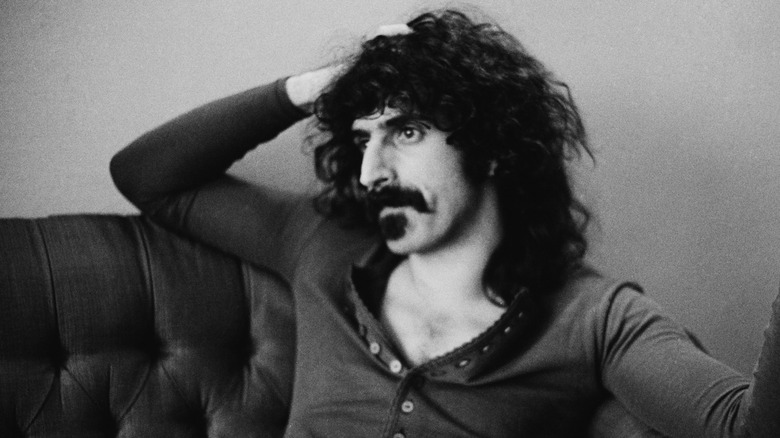
Frank Zappa had an eventful December in 1971. One show with the Mothers went up in flames, then another resulted in him having to use a wheelchair for a period of time. The latter, in particular, is such a strange story that showcases how deranged certain fans can be.
Playing at London's Rainbow Theatre, the same venue where the Misfits' Glenn Danzig and Bobby Steele would be arrested years later, Zappa and the band played for the crowd. Zappa started to play a cover of the Beatles' "I Want to Hold Your Hand." All of a sudden, 24-year-old Trevor Charles Howell appeared and pushed Zappa off the stage. Howell's reason for this? Jealousy. His girlfriend was a fan of Zappa's and Howell didn't like it.
The tumble caused significant damage to Zappa. "The band thought I was dead," Zappa wrote in his memoir "The Real Frank Zappa." "I had fallen fifteen feet down into a concrete-floored orchestra pit, my head was over on my shoulder, and my neck was bent like it was broken. I had a gash in my chin, a hole in the back of my head, a broken rib and a fractured leg. One arm was paralyzed." Zappa's assailant was caught before he escaped, then handed over to the police. Howell spent a year behind bars for his actions.
Gram Parsons' pals stole his body after he died
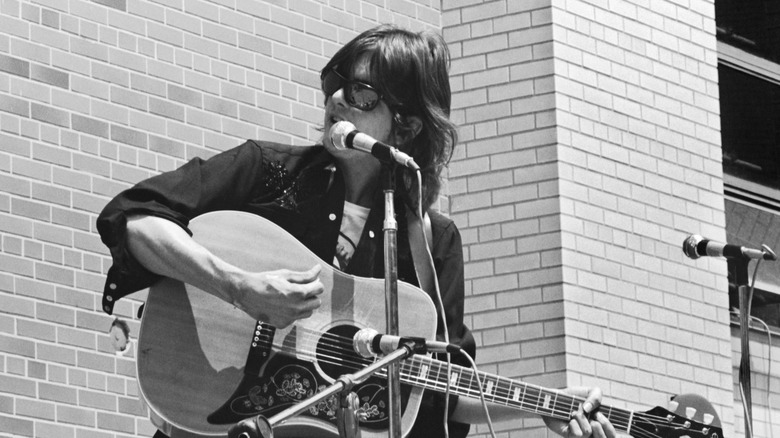
Gram Parsons didn't join rock's harrowing 27 club, instead dying a year younger at 26 after a drug overdose in 1973. According to his road manager, Phil Kaufman, Parsons had made a deal with him at another mutual friend's funeral that whoever died next should have their body burned at the Joshua Tree National Park. Parsons and Co. had been hanging out there for years and held a close attachment to the place.
There was one problem, though: when Parsons died, his stepfather made preparations to transport the body back to New Orleans. Kaufman knew that wouldn't have been what Parsons wanted for himself, so he came up with a plan and roped in another friend, Michael Martin, to assist him. The pair "borrowed" a hearse, then intercepted Parsons' coffin before it made its way to the funeral home, so it wasn't quite grave robbing — technically, at least. Then they drove to Joshua Tree, set the coffin on fire, and honored Parsons' last wishes. Since then, Joshua Tree has become a place where Parsons' fans go to pay tribute and their last respect to the musician.
If you or anyone you know needs help with addiction issues, help is available. Visit the Substance Abuse and Mental Health Services Administration website or contact SAMHSA's National Helpline at 1-800-662-HELP (4357).