

5 Bob Dylan Songs We'd Trade The World To Hear Again For The First Time
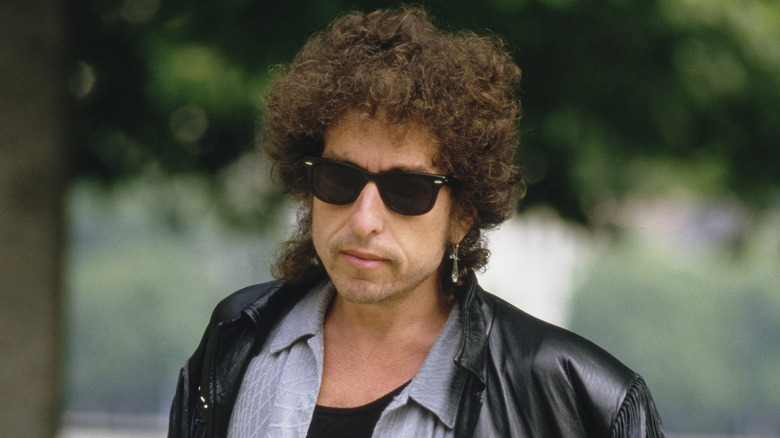
Few artists have a catalog as memorable as Bob Dylan's — and that's why we'd love to forget all about him. Hear us out. What if you could pick five tunes by the Pulitzer Prize-winner that you could hear again for the very first time — musical miracles that thrilled you, surprised you, or rocked your world? Imagine that you've woken up with no recollection of "Tangled Up in Blue" or "Blowin' in the Wind." There's an embarrassment of riches before you. What mere five would you want to experience from a fresh perspective?
The songs we chose possess a few qualities that would make our hypothetical mind wipe worthwhile. One is that moment in a song when we're suddenly uplifted, the point where a well-crafted piece of music surges to something much more. Another is an overall mood that triggers an upwelling of emotion. Yet another is wordplay that suggests more than one meaning, and every interpretation is intriguing if not profound. In the end, there is no set template for choosing the Dylan songs you'd want to experience anew, just as there is no formula for his genius.
Subterranean Homesick Blues
Howling guitars and ramshackle drums grab you like a freight train rattling into the station — but "Subterranean Homesick Blues" is just beginning. Four bars in, Bob Dylan's adenoidal drawl kicks out hilarious, black-as-a-smokestack clouds of wordplay: "Johnny's in the basement, mixin' up the medicine/ I'm on the pavement, thinkin' about the government." "It's from Chuck Berry, a bit of 'Too Much Monkey Business' and some of the scat songs of the '40s," Dylan told the L.A. Times, via Internet Archive's WayBack Machine, citing the song's influences.
To that, he added the stream-of-consciousness acuity of beat poets like Jack Kerouac and Allen Ginsberg. It's not just Dylan's words, an amalgam of politics and Lewis Carroll-worthy nonsense, that make the tune so infectious. Dylan's melodic talk-singing and the song's loose-limbed construction, flitting from an 18-bar to a 19-bar blues depending on what Dylan wanted to say, give "Subterranean Homesick Blues" its shapeshifting, cyclical quality.
Speaking of Ginsberg, he's an extra in the song's influential proto-music video, shot for D.A. Pennebaker's "Don't Look Back" documentary. As a wryly sarcastic Cassandra, Dylan flips through cue cards as his first U.S. Top 40 tune draws us into a verbal and musical maelstrom. Amid wailing locomotive harmonica and a shift to electric guitars that would get him branded a "Judas" by some folk music fans, Dylan tells us to strap in for a bumpy ride. More than 60 years after its debut, the song still conjures the immediacy it had when we first heard it.
Like a Rolling Stone
A split second after Bobby Gregg's opening snare, Al Kooper's trilling Hammond organ hits like a tidal wave crashing ashore, kicking off "Like a Rolling Stone" like a starting gun. The delay between the drum and keys is a tantalizing tease, paid off with a skirl of sound that never fails to trigger an upwelling of emotion. It would be a pleasure to hear it again for the very first time.
Once that opening hooks you, Bob Dylan's inscrutable lyrics transport you to a phantasmagoric dreamscape populated by a "mystery tramp," "Napoleon in rags," and a "scrounging," directionless antagonist. Listeners pored over Dylan's rambling, rhythmic words, trying to discern the identity of "Miss Lonely" who apparently drew the songwriter's ire while riding "on a chrome horse with [her] diplomat." Potential candidates included singers Marianne Faithfull and Joan Baez, but answers have never come easy with Dylan.
"When I used words like 'he' and 'it' and 'they' ... I was really talking about nobody but me," Dylan said in "Revolution in the Air: The Songs of Bob Dylan 1957-1973," adding an additional layer of ambiguity to the song. Hitting No. 2 in the U.S., "Like a Rolling Stone" completes Dylan's transition from folk balladeer to revolutionary rock star, and distills the era's turmoil into an accusation and challenge: "How does it feel?" Boasting the most thrilling beginning in rock music, the enigmatic classic retains its secrets to this day.
Highway 61 Revisited
"Highway 61 Revisited" is another enduring Bob Dylan classic with a beginning that pulls us back to the first time we heard it. In this case, it's the funhouse slide whistle that spirals like a cyclone and warns like a police siren. The whistle, reportedly brought to the "Highway 61 Revisited" album sessions by Al Kooper, was proffered as a substitute for Dylan's harmonica. It kicks off this absurdist American travelog disguised as rollicking blues rock.
Starting with a colloquial take on the Old Testament — "Oh God said to Abraham, "Kill me a son / Abe said, "Man, you must be puttin' me on" — the song unfurls a parade of surreal scenarios: a doubtful getaway for "Georgia Sam," who could be Mississippi bluesman Blind Willie McTell; a dumping ground for consumerist junk; the breakdown of the ideal nuclear family; and a gambler staging a holocaust. The through line is Highway 61, better known as the Blues Highway, the route that Black Americans, including blues greats like Muddy Waters, followed in the great migration from the Deep South to Northern cities.
Dylan's lyrics arguably tackle '60s issues such as racism, the environment, and escalating war, but Dylan's highway isn't confined by time or space. "Highway 61 Revisited" is populated by dollar-chasing grifters like the gambler, but it also celebrates the music that sprang from the Mississippi Delta to enrich us all. It's a historical and mythological roadmap of America, where past, present, and future are superimposed over one another. You can't get more timeless than that.
Knockin' on Heaven's Door
Bob Dylan's work on Sam Peckinpah's revisionist 1973 Western "Pat Garrett and Billy the Kid" is masterful, if too often cut up and misused by the project's producers. "The [Pat Garrett] music seemed to be scattered and used every other place but the scenes which we did it for," Dylan says in "Revolution in the Air: The Songs of Bob Dylan 1957-1973," "Except for 'Heaven's Door.'"
The song plays during a scene where mortally wounded Sheriff Baker walks with his wife, "Mama," to a riverbank, where they wordlessly watch the sunset as Baker dies. Over a spare, cyclical melody that seems as spontaneous as a Black American spiritual, Dylan's lyrics eschew his signature tongue-twisting wordplay and instead reveal what's left unsaid on-screen: "Mama, put my guns in the ground / I can't shoot them anymore / That long black cloud is coming down."
Even divorced from the scene, the music is gloriously moving and deceptively simple. Riding jangling, whirlpooling guitar, the song builds, lifted by a warm, swarming gospel chorus. Earthy yet celestial, heartbreaking yet liberating, the song signals serene acceptance of change — not just of mortality, but any passages we encounter on life's journey. Hearing this secular hymn to letting go gracefully, is a moment we'd gladly experience and savor anew.
Mozambique
"Mozambique" gets off to a breezy start with Bob Dylan's lifting nylon-string guitar and Rob Stoner's sashaying bass. Even before we hear the lyrics, the sprightly melody suggests sunlight dappled through swaying palm trees and dancing on azure water. Of all the Dylan songs we examine here, "Mozambique" is the one least likely to be singled out for critical appreciation, but it offers Dylan's most direct and straightforward lyrics, set to music that whisks you up in a sensuous whirl of emotions: "Lying next to her by the ocean / Reaching out and touching her hand / Whispering your secret emotion / Magic in a magical land."
When we first heard the tune, it ushered in a feeling of contentment — if only for its three-minute running time. "Mozambique," like six other songs on its 1976 parent album "Desire," was co-written by Dylan and songwriter-theater director Jacques Levy. Reportedly, the two tunesmiths' mission on "Mozambique" was to come up with as many words ending in "ique" that they could think of.
Some listeners divined a political subtext in "Mozambique," equating the lyric "the lovely people living free" with support for the nation's newfound independence. The rest of the song's radiant, romantic lyrics belie this interpretation. "Mozambique" is a carefree song with masterful performances, particularly from violinist Scarlet Rivera, whose skirling bowing dances around Dylan's and Emmylou Harris' conjoined vocals. Reaching No. 54 on the Billboard Hot 100, the tune is more about a feeling than a place, a captivating reverie of sunshine and bliss.