

5 Hits That Prove 1968 Was The Decade's Best Year For Bluegrass Music
Though it's known for being when "flower power" was in full bloom, the 1960s were an incredibly fertile period for bluegrass, producing some of its most innovative and trailblazing sounds. That might surprise many, as "innovative" is not one of the words that's usually associated with bluegrass, a genre that prides itself on sticking to its roots. But even bluegrass couldn't avoid the transformative touch of the times, making 1968 one of its most exciting years. Much like those hippies putting flowers in their hair when they gathered in San Francisco, bluegrass was a young, budding, 20-something by the '60s — sorta.
The history of bluegrass dates back to the 1600s, when settlers from Ireland, Scotland, and England relocated to the Appalachian region of the United States. They brought their musical traditions — like jigs — and blended them with the American sounds of blues, country, and gospel, developed down in the Mississippi Delta (the banjo, after all, is African in origin).
Arnold Schultz, the son of a former enslaved person, developed a guitar playing style that would greatly influence Bill Monroe, whose band — Bill Monroe and the Blue Grass Boys — gave the genre its namesake. Monroe's appearance on the Grand Ole Opry radio broadcast in 1939 is commonly accepted as the birth of "bluegrass," and it would take off during the '40s and '50s, until right before a hip-shaking boy from Memphis became the King of Rock 'n' Roll. But the music didn't wither once Elvis Presley and Beatlemania took over. As you'll see, it was still growing strong.
Foggy Mountain Breakdown — Flatt and Scruggs
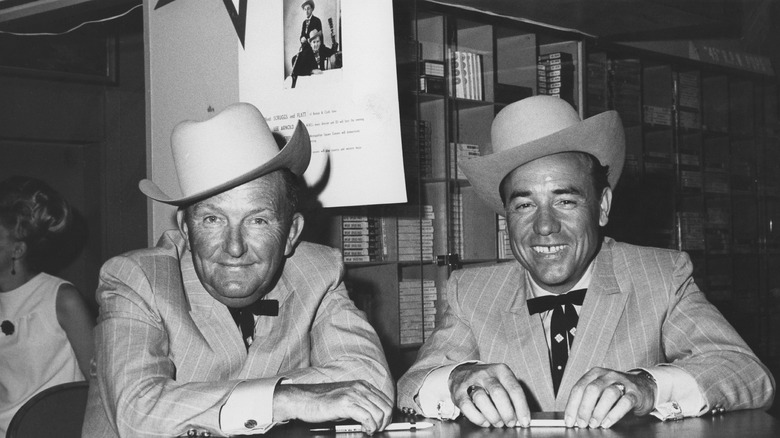
Bill Monroe's Blue Grass Boys was, in a way, the bluegrass version of Menudo, cycling through different members who'd often use their tenure in Monroe's group to launch their own careers. Two such players were singer Lester Flatt and banjo player Earl Scruggs, who cut their teeth as Blue Grass Boys before forming their own band, the Foggy Mountain Boys, in 1948.
Earl Scruggs was to the banjo what Les Paul was to the electric guitar. Scruggs learned how to use his thumb, index, and middle fingers to pluck the strings, creating this continuous "roll." This technique of playing, named after him — "Scruggs Style" — helped make Flatt and Scruggs stars.
The two worked in radio and television while recording multiple albums and singles. One such track, "The Ballad of Jed Clampett," an adaptation of the duo's theme to "The Beverly Hillbillies," reached No. 44 on the Billboard Hot 100 on February 9, 1963.
Before the decade was done, Flatt and Scruggs struck gold for themselves — not oil like Jed Clampett, but a Grammy Award. In 1967, "Bonnie and Clyde," the hit movie starring Warren Beatty and Faye Dunaway, used "Foggy Mountain Breakdown," a song Flatt and Scruggs recorded in 1949. A version released in 1968 charted on the Hot 100 and won the Grammy for best country performance, duo or group, vocal or instrumental. The movie's popularity helped introduce bluegrass music to a new generation and give Flatt and Scruggs one last taste of success before they parted ways in 1969.
Rocky Top — The Osborne Brothers
Long before there were the Brothers Osborne of modern country music, there were the Osborne Brothers of bluegrass fame. Sonny and Bobby Osborne developed their skills as kids, performing around their home of southeastern Ohio. Sonny was a banjo prodigy. He'd soon be known for his 6-string banjo, adding a G-string to a normal 5-string version of the instrument. As for his brother, Bobby developed a signature voice that was as high if not higher than his hero, Bill Monroe.
While Bobby served in the Korean War, Sonny went off to work with Monroe. "I was 14 working as a Blue Grass Boy ... on the Grand Ole Opry back when those things were big time important," said Sonny in a 2020 Q&A with Bluegrass Today. "I didn't know much at all, but I could play the banjo and knew how to sing the baritone part in the quartet songs. I couldn't play very good, but I was cheap."
Following his discharge, Bobby rejoined Sonny and the Osborne Brothers kick-started their music career. They'd court controversy by incorporating electrified instruments and drums on recordings in the '50s and '60s, setting the stage for the progressive bluegrass movement of the 1970s (which used electric instruments while bringing in elements of pop, jazz and rock).
The Osborne Brothers hit the peak of their success with "Rocky Top," a song that sold 85,000 copies within the first 10 days of its release in 1967. A year later, they released 'Yesterday, Today & the Osborne Brothers,' containing not just "Rocky Top," but a glimpse of the future of bluegrass.
Del McCoury Sings Bluegrass — Del McCoury
Bill Monroe is the thread that connects many players in the early bluegrass scene. Along with the Osborne Brothers, Monroe helped give Delano Floyd "Del" McCoury his start.
Inspired by Earl Scruggs, McCoury picked up the banjo as a lad. Playing with Jack Cooke, himself a former Blue Grass Boy, led to McCoury joining Monroe's group in 1963. But it turns out that Monroe didn't need a banjo player. He'd forgotten he'd hired Bill Keith a few days before McCoury joined the band. McCoury switched to guitar, and soon became the lead singer for Monroe's group. Del would record six singles as a Blue Grass Boy, while appearing multiple times on the 'Grand Ole Opry' radio show.
After a year playing for Monroe, McCoury broke out on his own, eventually releasing his debut album, "Del McCoury Sings Bluegrass," in 1968. This was an auspicious start to a lengthy career. McCoury would form the Dixie Pals the following year, a group that would last for two decades. Del would become one of the most decorated bluegrass performers in history, winning the International Bluegrass Music Association Male Vocalist of the Year six times, and Entertainer of the Year 10 times.
McCoury's playing has been highly influential on a number of groups within the bluegrass and jam band scenes, including Donna The Buffalo, The String Cheese Incident, and Phish, who have shared the stage with Del numerous times.
Wheatstraw Suite — The Dillards
By 1968, the Dillards were known as "a bluegrass group whose audience was found almost exclusively among folkies," according to music journalist Richie Unterberger. That crossover appeal was not by accident. Formed at the start of the decade, the Dillards were quick to sample sounds of the day — folk, southern rock, pop, jazz — making them one of the forefathers of the progressive bluegrass (or "newgrass") sound.
The first few Dillards releases ("Back Porch Bluegrass," "Pickin' & Fiddlin") were traditional fare. But, by 1968, the band, founded by brothers Doug and Rodney Dillard, was set to reach beyond bluegrass. That culminated with "Wheatstraw Suite," an album that Unterberger described as "a cornucopia of folk, bluegrass, rock, country, and pop that nevertheless felt natural and unforced."
"Wheatstraw Suite" was a melding of the past, present, and future. The album is half originals, half covers of pop and rock songs in bluegrass-inspired arrangements, including the Beatles' "I've Just Seen a Face" and Tim Hardin's "Reason to Believe." Though not a commercial hit, critics and fellow musicians praised the Dillards' album for its boldness and beauty. And since its release in 1968, "Wheatstraw Suite"' has been considered the band's "masterwork."
New Shades of Grass — Emerson And Waldron
Bill Emerson and Cliff Waldron only played together for a brief time, but their debut album, "New Shades of Grass," was a showcase of bluegrass's transitional phase in the late '60s. Full of instrumental arrangements that demonstrated both Waldron's distinctive guitar picking and Emerson's shining banjo stylings, the 1968 LP merged traditional bluegrass with elements of folk and country, helping give new grass — or progressive bluegrass — its name.
Emerson first began playing with Buzz Busby and the Bayou Boys before co-founding the Country Gentleman, a highly influential progressive bluegrass band. Not one to let the grass grow under his feet, Emerson spent a few stints with other bands before returning to play with the Bayou Boys. When a band member dropped out of a concert, fate led Emerson to call Waldron, a rising star in the bluegrass scene.
Emerson was impressed with Waldron's performance, as Waldron recalled in a 2021 interview: "I told him that it was just the way I played guitar. He said, 'What you are doing fits my banjo. Do you want a job?'" The pairing was brief: A year after the highly influential 1968 release of "New Shades of Grass," Emerson was back with the Country Gentlemen. Waldron continued with the band, dubbing it Cliff Waldron and the New Shades of Grass.