

5 Generation-Defining Guitarists Hardly Anyone Talks About Anymore
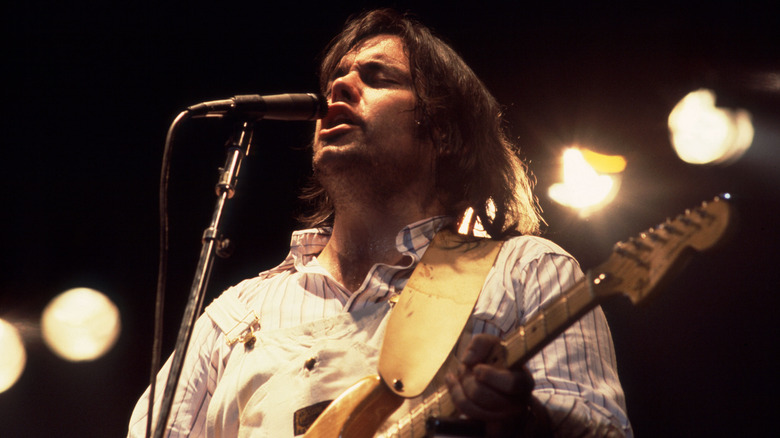
When looking back at the history of rock music, certain guitarists have come to be associated with specific eras. While it's true that critics couldn't stand Led Zeppelin at first, guitarist Jimmy Page is now seen as a trailblazer who's come to define the essence of hard rock guitar during the 1970s. During the following decade, Prince combined rock and funk while demonstrating a level of guitar virtuosity that few have matched. Yet there are also those shredders who made a massive musical impact on their respective generations, revered by fellow ax wielders but rarely remembered by the majority of music fans.
While these musicians never reached the levels of fame attained by the likes of Page, the Stones' Keith Richards, or other guitar luminaries who left their imprints on rock, it wasn't due to lack of talent. In fact, these unsung guitar heroes made their marks in the music of their time, even if they never did become household names. To explore this further, we're looking at five generation-defining guitarists hardly anyone talks about anymore.
Rory Gallagher
He turned down an offer to replace Mick Taylor in the Rolling Stones. His many acolytes include Queen's Brian May, Guns N' Roses' Slash, and U2's the Edge. He was Rory Gallagher, a blues-rock guitarist of enormous versatility, whose playing was infused with elements of jazz, folk, and Celtic music from his native Ireland.
Gallagher first came to attention with the power trio Taste, whose track "I'll Remember" is among the five rock songs from 1970 that are so underrated. As a solo artist, Gallagher was perpetually on the cusp of stardom, the perennial next big thing, yet never strove for fame. With his battered Stratocaster (purchased as a teenager) and his humble stage attire of faded jeans and a flannel shirt, flash was never his thing. Yet when it came to sheer virtuosity, few could touch him. "He had a style that was all his own," said Rush guitarist Alex Lifeson in a 2019 interview.
Worshipped by guitarists yet seldom remembered by rock fans, El Pais noted that Gallagher has long been the frontrunner for the title of "greatest guitarist you've never heard of." "He was a magician, you know?" May told El Pais in 2023. "One of the few people back then who could make his guitar do whatever he wanted." Gallagher died at age 47 in 1995.
Peter Green
Peter Green landed his big break when he was tapped to replace Eric Clapton in John Mayall's Bluesbreakers. Green didn't stick around long, and after quitting, he hooked up with drummer Mick Fleetwood and bassist John McVie to form a blues-rock band called Fleetwood Mac. This first iteration, however, was a world away from the version that conquered the world with "Rumours" — and Green was the band's star attraction until he abruptly quit in 1970.
The passage of time may have relegated Green to a minor footnote in the band's history, but the truth is far more complicated. Fleetwood Mac's early success can be attributed entirely to his stunning guitar work, on display in tracks such as "Oh Well," "Black Magic Woman," and "The Green Manalishi (With the Two Prong Crown)." Sadly, when looking back at the tragic real-life story of Fleetwood Mac, Green's lifelong experiences with mental illness prevented him from reaching the rock stardom he deserved. He died in 2023 at age 73.
Among Green's many admirers was Led Zeppelin's Jimmy Page. "I have total respect for the work of Peter Green. He had the complete package. He was a beautiful guitar player, fantastic songwriter, and his vocal delivery was just superb," Page told Guitar World. "I just think he was so unbelievable at the point in Fleetwood Mac's career when they did 'Oh Well.' It's a brilliant track. The whole construction of it, as a piece of work, was just fantastic. It's a great one to play."
Lowell George
Little Feat holds a unique place within 1970s rock. The band's sound was unmistakable, combining boogie-style Southern rock with elements of blues, funk, jazz, and country, all held together with the sublime slide guitar of Lowell George. Prior to his 1979 death from a heart attack at 34, George proved himself to be a true original. Just check out the slide solo on "Dixie Chicken," as boldly funky as it is meticulously precise. In addition to being Little Feat's lead guitarist, singer, and chief songwriter, George was also the band's producer (he also produced records for other artists, including the Grateful Dead's "Shakedown Street"). His guitar can also be heard throughout Robert Palmer's classic "Sneakin' Sally Through the Alley" album.
In a tribute he wrote for Guitar World, guitarist Joe Bonamassa revealed that George's unique slide sound came not only from his distinctive style of playing but also from his choice of gear: A Sears Craftsman socket (used to tighten spark plugs) as a slide and a rare Dumble Overdrive Special Reverb (which Bonamassa now owns). "It's the best amp I've ever played through," George declared in a 1977 interview with "Guitar Player." At the time, his playing impressed not just fans but even some of his fellow rock stars. "Band-wise, Little Feat is my favorite American group," Led Zeppelin's Jimmy Page told Rolling Stone in 1975.
Leo Nocentelli
Before the band's breakup in 1977, the Meters was New Orleans' tightest, funkiest band, a group of players with impeccable chops and swampy swagger. In addition to its own set of albums, the band also backed legendary Big Easy pianist and producer Allan Toussaint and played on the albums he produced (including Labelle's hit "Lady Marmalade"). A big part of the Meters' groove can be attributed to guitarist Leo Nocentelli.
Ranked No. 23 on Guitar Player's list of the 50 all-time greatest rhythm guitarists and No. 93 on Rolling Stone's greatest guitarists roundup, Nocentelli remains a hugely respected musician whose sound came to define 1970s New Orleans funk. The Meters' enduring legacy is evident in the fact that his guitar licks on the 1969 instrumental "Cissy Strut" have been sampled by dozens of rappers, including N.W.A., A Tribe Called Quest, and Run-DMC.
Yet the true expanse of his range came through with the 2021 release of "Another Side," a long-lost solo album he'd made in the 1970s. A collection of primarily acoustic folk-rock originals, "Another Side" represented a huge departure from his work with the Meters, demonstrating his amazing versatility as a guitarist. "I was studying classical guitar at the time and adopted a fingerstyle approach," Nocentelli told Guitar Player in 2021. "I didn't use a pick on the entire album. It's a different mindset and a different approach from the funky electric pick playing I was doing with the Meters."
Danny Gatton
When examining the rockabilly genre, 1950s-era guitarists like Carl Perkins, James Burton, Scotty Moore, and Eddie Cochrane come to mind. Then there was Brian Setzer, who was instrumental in reviving the genre decades later with the Stray Cats. One name that's rarely mentioned is that of Danny Gatton, who emerges in the late 1980s to bowl over guitarists while flying well under the radar of the average music fan.
From a sonic perspective, Gannon was the best of the best. Yet in that image-conscious MTV era, when bands wore spandex, Aqua Net-teased hair, and gym-built physiques, he was an outlier: Middle-aged, paunchy, and coiffed with a hairstyle not unlike Elvis in his Vegas phase. Yet Gatton could outplay the best of them. That shone through in "Nit Pickin'," an audacious instrumental track in which he unleashes a ferocious flurry of rockabilly guitar virtuosity and then leaps from genre to genre, ranging from Nashville twang to Chicago blues.
"Danny Gatton was a players' guitar player, hailed by both Rolling Stone and Guitar Player as the greatest unknown guitarist anywhere," guitar whiz Steve Vai once told Guitar Player magazine (via Classic Rock). "His legend has only grown since his untimely suicide in 1994, along with appreciation for his blinding speed, effortless genre-hopping, flawless technique, and never-ending appetite for tinkering and problem-solving. Danny Gatton comes closer than anyone else to being the best guitar player that ever lived."
If you or someone you know needs help with mental health, please contact the Crisis Text Line by texting HOME to 741741, call the National Alliance on Mental Illness helpline at 1-800-950-NAMI (6264), or visit the National Institute of Mental Health website.
If you or someone you know is struggling or in crisis, help is available. Call or text 988 or chat 988lifeline.org.