

5 Alternative Rock Songs That Snapped The Gen X Generation Awake
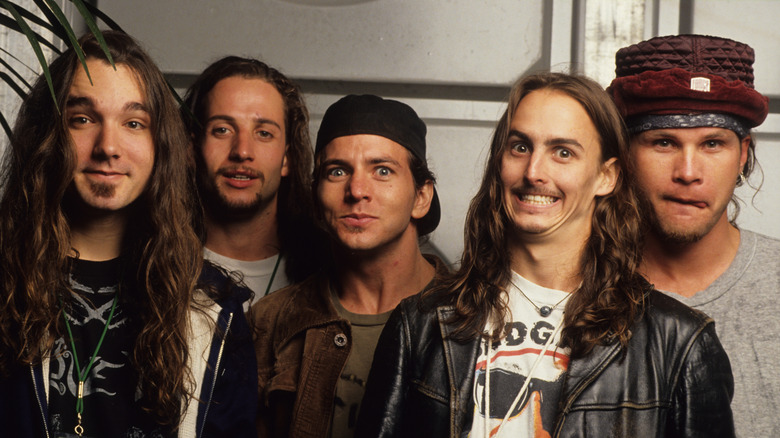
For Gen X music fans, alternative rock tended to spin out songs that landed like a slap in the face. These tunes didn't play coy with their emotional heft; they were clear-eyed and daring, a challenge to rock norms where sex, drugs, and rock 'n' roll were a lifestyle to be celebrated. Alternative rock took a more enlightened angle, exploring topics like betrayal, loneliness, and outright angst, all without flinching or pulling punches. The results were songs from artists who weren't afraid to dig in the emotional dirt rather than cover the tired tropes of living large and partying on a tour bus.
We fanned out the most paradigm-shifting alternative rock songs from the most noteworthy bands of the era and picked out the five we think were eye-openers for Gen X music lovers. Foundational alt-rockers Nirvana and their grunge-sparking classic "Smells Like Teen Spirit" and underground acts like Red Hot Chili Peppers, who broke through with "Under the Bridge," made the grade, as did the electrifying Alanis Morissette and her angsty anthem "You Oughta Know," and Pearl Jam, with the shocking schoolroom violence of their song "Jeremy." And the sobering psychological turmoil of Hole's "Doll Parts" is a revelation we couldn't overlook. Each of these tunes delivered a sonic gut punch both musically and lyrically, fundamentally bending the curve and opening the eyes of an entire generation.
Smells Like Teen Spirit - Nirvana
Nirvana sprang "Smells Like Teen Spirit" on Gen X music lovers like an audio guerrilla attack, sneaking new aggression into a scene where hairbands and heavy metal had dominated. The bracing torrent of razor-blade power chords announced that rock was back with a post-punk vengeance. Alternative rock fans were wondering what the next play would be, and Kurt Cobain's screech answered with a snotty attitude and a wealth of angst to exorcise.
The lyrics were acerbic and impressionistic, adding an artful layer that more commercial rock had been missing. Verses like "And I forget just why I taste / Oh, yeah, I guess it makes me smile / I found it hard, it's hard to find / Oh, well, whatever, never mind" hardly line up with a chorus of "With the lights out, it's less dangerous / Here we are now, entertain us." And yet, it flipped a switch in rock fans and turned the compass toward alternative rock as a torchbearer, with grunge in particular as a beacon that signaled a rock music evolution.
With this bolt of early-'90s sonic lightning, grunge became a staple of the mainstream music scene. The song reached No. 6 on Billboard's Hot 100 and Nirvana became a musical force to be reckoned with, giving Gen X an alternative-rock upswell they'd never forget.
Jeremy - Pearl Jam
The hidden meaning of Pearl Jam's "Jeremy" didn't surface immediately for casual listeners, but once it did, it shook Gen X-ers to their roots. A melodic rocker that told the tale of a 15-year-old boy who dies by suicide in front of his high school class, "Jeremy" helped introduce the grunge pioneers to the world of alternative rock. The band's grunge leanings provided a backdrop for this shocking song, which never overtly described the incident, but instead sketched an outline of a troubled youth prone to violence.
Having a band as cutting edge as Pearl Jam tackle such a dark real-world scenario introduced alternative rock fans to what would become a pattern for the band. Lyricist and singer Eddie Vedder's complicated and painful childhood provided inspiration for many of the group's earliest and most emotionally raw material. Although Vedder had a similar personal experience with a schoolmate, "Jeremy" wasn't autobiographical. He was inspired to write the song after reading an article about the real-life Jeremy Delle, merging the details from both into a single narrative.
While "Jeremy" may not have charted on Billboard's Hot 100 as a single upon its original release, it sent shockwaves through Gen-X music lovers. Moments of school violence may have seemed like isolated incidents in the pre-Columbine years, but they were happening more and more. "Jeremy" resonated with an audience who'd felt the shift; the song portended a looming trend of teens in turmoil whose emotions would turn tragically destructive for the generations that followed.
Under the Bridge - Red Hot Chili Peppers
It sounds like a lovely, lilting tune about loneliness in LA, until you discover "Under the Bridge" is describing the heroin habit of lead singer Anthony Kiedis ... and then the darkness encroaches. How many Gen X-ers sang along thinking the elegant melody and gentle guitar work were describing a lost soul who only feels attached to the city he calls home, hoping to avoid the pain and longing he's felt in the past? It all seems simple on the surface; even Kiedis' vocals take on an unexpected softness on a song that comes as close to a real ballad as anything these punk-funk players had created at the time. It was also their first mainstream hit.
Sadly, the tragic real-life story of Red Hot Chili Peppers includes the untimely death of Hillel Slovak, the Peppers' guitarist whose 1988 heroin overdose was a stark wake-up call. Kiedis got clean and eventually wrote a poem about his experiences, which producer Rick Rubin thought would make an excellent song (though Kiedis was doubtful, and the song almost never happened). "Under the Bridge" dropped as a single in 1992 from the band's breakthrough album "Blood Sugar Sex Magik" and became their biggest chart success, ascending to No. 2 in June of that year and sticking around on the charts for 26 weeks.
Once the meaning was revealed, the song took on an even greater significance for the D.A.R.E. generation, who were raised with glib "Just Say No" slogans but knew the issue of substance dependency was a much deeper issue.
Doll Parts - Hole
Nirvana fans who thought Courtney Love was just a Nirvana hanger-on learned how hard she could rock with this dual-persona power ballad. She proved to be a songwriter of gritty depth, exploring abuse and misogyny in tracks that rocked as hard as any male alternative rock band. She didn't need Kurt Cobain to escort her along a path to musical significance; she and her cohorts slashed through the stage curtain with their razor-sharp sound and stole the spotlight all on their own.
In "Doll Parts," Love softly rattles off a reductive list of components that make up her physical being. "I am doll eyes," she sings, "doll mouth, doll legs." She's savagely — and shrewdly — describing the way in which women are boiled down to their physical attributes, herself included. Self-awareness has become one of Love's defining characteristics, never clearer than when she sings, "I want to be the girl with the most cake," turned down to a menacing simmer you know is bound to boil over sooner or later. Sure enough, the emotional eruption comes as she rips into post-chorus howls of "Someday, you will ache like I ache." The pain is palpable as the static crunch of electric guitars rings out to challenge her cries. If you were tuned into alternative rock at all when this one dropped, you couldn't turn away.
You Oughta Know - Alanis Morissette
The Riot Grrrl movement of alternative rock was well underway when Alanis Morissette lobbed a musical Molotov cocktail with a commercial edge into the mix. "You Oughta Know" was a rocking explosion of rawness and rage, with lyrics Gen X-ers were stunned to hear played on the radio, even in the single's edited-yet-totally-discernible version. But they recognized the cathartic release of an artist who wasn't hiding behind clever metaphors or pretty poetry. Morissette twisted the singer-songwriter framework into a modern shape that served as a reaction to the more measured touch it had been given for so many years.
The quiet delivery of the opening lines, "I want you to know / that I'm happy for you / I wish nothing but / the best for you both," are an obvious false flag, served with asymmetrical syntax that only hints at the wreckage to come. Descriptions of betrayal by the mystery lover at the center of "You Oughta Know" unfurl as Morissette decries his moving on with an older, duller woman. Then, the curses come: "I'm here to remind you / of the mess you left when you went away / it's not fair to deny me / of the cross I bear that you gave to me / you-you-you oughta know." The rage peaks as she hexes the man who wronged her, signaling a sea change for female musical expression: Anger is in, and it comes with a thumping, melodic beat to back it up.
If you or anyone you know needs help with addiction issues, has been impacted by incidents of mass violence or is experiencing emotional distress related to incidents of mass violence, or is struggling or in crisis, contact the relevant resources below:
-
Visit the Substance Abuse and Mental Health Services Administration website or contact SAMHSA's National Helpline at 1-800-662-HELP (4357)
- call or text Disaster Distress Helpline at 1-800-985-5990
- Call or text 988 or chat 988lifeline.org