

In 1998, Bob Dylan Gave This Song To Sheryl Crow — And Her Version Was A Hit
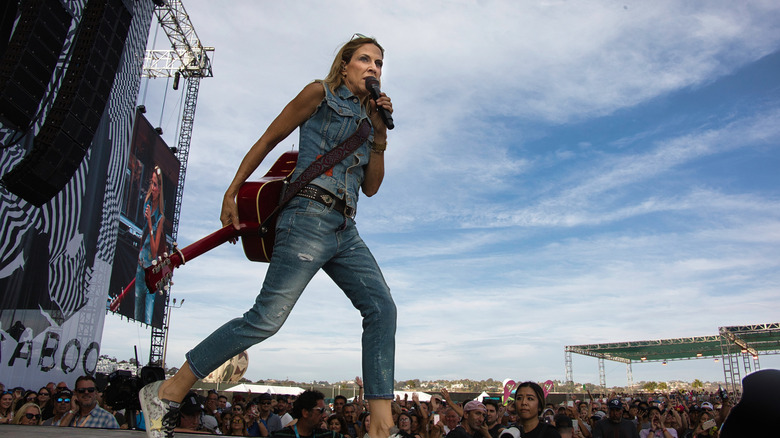
When Sheryl Crow burst out of the singer-songwriter gate in the mid-90s with 1994's "All I Wanna Do" (No 2. on the Billboard Hot 100), newfound fans weren't the only ones to notice. The OG of mid-60s folk-rock himself, Bob Dylan, decided to pass along a song that he'd written for himself: "Mississippi." Crow ran with the song and made it her own.
Granted, Dylan didn't pass along "Mississippi" out of sheer altruism. He'd actually taken the song cradle to grave and finished recording and producing it for 1997's "Time Out of Mind." But when all was said and done, he didn't like it. At the same time, Crow was in the process of recording 1998's "The Globe Sessions." As luck and inside who-knows-who relations would have it, Crow in a 2024 Guardian interview said that she and Dylan's managers knew each other at the time. Crow's manager approached Dylan's, the latter brought over the unwanted "Mississippi" for Crow to listen to, fast-forward a bit, and boom: Crow released her version of the song.
Crows' "Mississippi" never charted on the Billboard Hot 100 or anything, and it only got a respectable 800k listens or so on Spotify ("All I Wanna Do" has 308 million). Nonetheless, the song remains significant not only unto itself, but for how it passes the torch from one generation to another, especially coming from an artist like Bob Dylan.
A song that Crow made her own
Ultimately, it's strange and ironic in multiple ways that Dylan passed along "Mississippi" to Sheryl Crow. Not his most personal song by far, nor a song from his best year, Dylan released his version of "Mississippi" after Crow, anyway, on 2001's "Love and Theft." It surpasses Crow's version in terms of listens, at 5.4 million, and Atwood Magazine even goes so far as to call it Dylan's best song.
This doesn't mean Crow's rendition wasn't a hit in its own way. Dylan's take is much more low-tempo and country, while Crow's is up-tempo and rocky. Dylan was also in his late '50s when he wrote the song, while Crow was in her late 30s. This means that Dylan was writing with a fuller weight of time behind him, lending aged sorrow to lines like, "Well, the emptiness is endless, cold as the clay / You can always come back, but you can't come back all the way." But because of Crow's music, her version comes across as more devil may care, no matter that both versions have identical lyrics. Speaking with the same attitude that Crow adopted with lines like, "All I wanna do is have some fun / I got a feelin' I'm not the only one," Crow's "Mississippi" feels as though nothing can be done about the regret and loneliness the song describes, so you might as well live in the present.
And yet, Crow regarded Dylan's song with admiration. As American Songwriter quotes her, "You could take every line of that song and make a new song of it." Such mutual respect across generations, even as each side retains its own perspective, ought to make any song a hit.