

The No. 1 Beach Boys Song That Became A Hit Without Brian Wilson
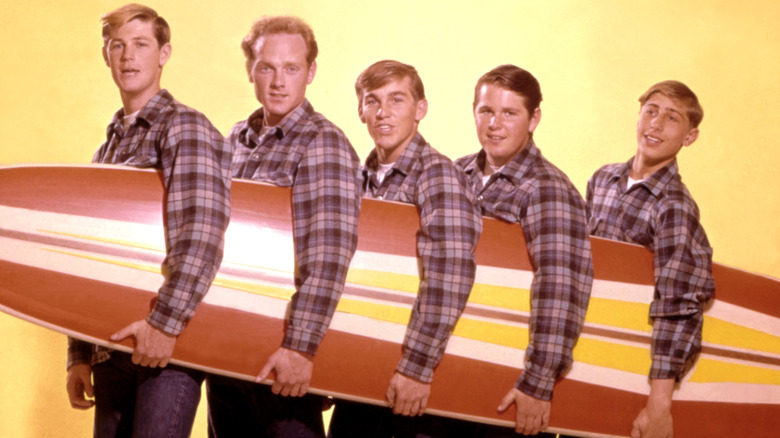
In the 1960s, the Beach Boys surfed their way into the hearts of America and to the top of the charts. The band was riding high on a wave of hit songs by their main songwriter and de facto leader, Brian Wilson. From the early sun-kissed success of "Surfin' U.S.A.," "Surfin' Safari," "I Get Around," and "Help Me, Rhonda" to the experimental foray of "Pet Sounds" (and its biggest singles, "Sloop John B," "Wouldn't It Be Nice," and "God Only Knows"), Brian Wilson earned the reputation of being a musical genius, and his work helped create an undeniable legacy for the band. However, in 1988, the Beach Boys had their final No. 1 hit without him.
For a moment, it seemed like the Beach Boys' fun in the sun would last forever. It did not. In the subsequent decades after the '60s, that wave crashed into the shore, and the tide rolled back. The Beach Boys barely had any chart success in the 1970s, and when 1980's "Keepin' the Summer Alive" failed to spawn any hit songs, it looked like that decade would be the same. But as the sun was setting on the Beach Boys' hopes of topping the Hot 100 ever again, they somehow caught another wave and rode it to No. 1 with a song that had everything: Tom Cruise, steel drums, a sax solo, and a surprisingly dark backstory. What the song didn't have, as previously mentioned, was Brian Wilson.
The Beach Boys scored their last No. 1 song in 1988 with Kokomo
"Kokomo" was written for "Cocktail," a film about bartending that starred Tom Cruise. The director, Roger Donaldson, wanted an original Beach Boys song for his movie, so he tasked the soundtrack's producer, Terry Melcher, to make that happen. Melcher knew the Beach Boys well, having played alongside them on the early surf pop scene as part of The Rip Chords and one half of the duo, Bruce & Terry.
Fast forward to '88: Melcher reconnected with the Beach Boys, and then recruited John Phillips of the Mamas and the Papas and his collaborator, Scott McKenzie. The two began working on a track that they sent off to Beach Boys' frontman Mike Love. "I told John that it didn't groove enough for me," says Love, per Huff Post. "So I came up with the 'Aruba, Jamaica' part." Love also changed the tense of the words, from "where we used to go" to "that's where you wanna go," to make it more inviting. The changes worked: "Kokomo" entered the Billboard Hot 100 in September and reached No. 1 two months later.
Why Wasn't Brian Wilson On 'Kokomo'?
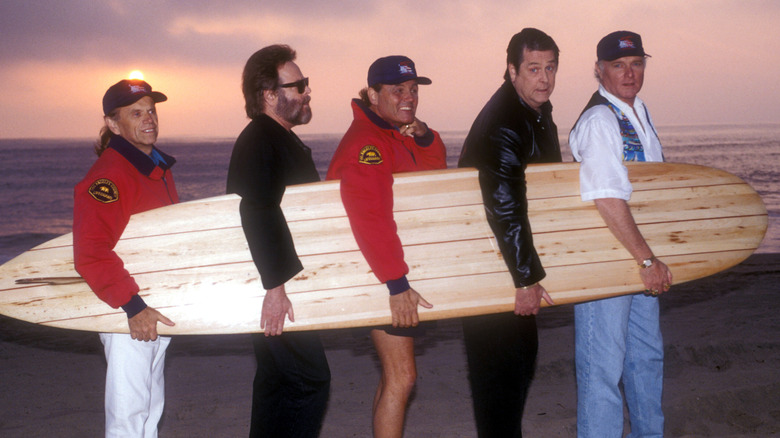
"The first time I heard [Kokomo] on the radio, I loved it, though I didn't even know it was the Beach Boys," Brian Wilson wrote in his 2016 memoir, "I Am Brian Wilson." "When someone told me who was singing, I couldn't believe it."
So, what happened? In 1975, Wilson was dealing with severe mental health and addiction issues. Wilson's first wife, Marilyn, enlisted Dr. Eugene Landy, a psychologist for the stars. Initially, Landy's 24-hour treatments were effective, if unorthodox, but he was fired over concerns about his methods and his fees. Wilson reconnected with Landy in '83 following an overdose, and from there, the therapist took over the musician's life and finances. Landy was credited as the executive producer on Wilson's 1988 solo album; Landy also had four songwriting credits on the Beach Boys' self-titled 1985 album.
The unconventional psychologist is why Brian Wilson isn't on "Kokomo." According to what Wilson's former lawyer, John Mason, wrote in his book "Crazy Lucky," Mike Love and Carl Wilson first approached Brian about doing the song, and he was excited to do it. "But later in the evening, Brian called and said, 'I shouldn't do that. Dr. Landy said I shouldn't do that," Mason wrote (via Fox News). However, Landy supported the idea if he could be credited be on the song as a writer. The band refused. Ultimately, Landy was forced to surrender his license in '89 for two years for unlawfully prescribing drugs to Wilson. He stayed in the Beach Boys' life for three more years, until Wilson's family secured a restraining order against him in '92.