

5 Iconic Guitars Every Classic Rock Fan Should Instantly Recognize
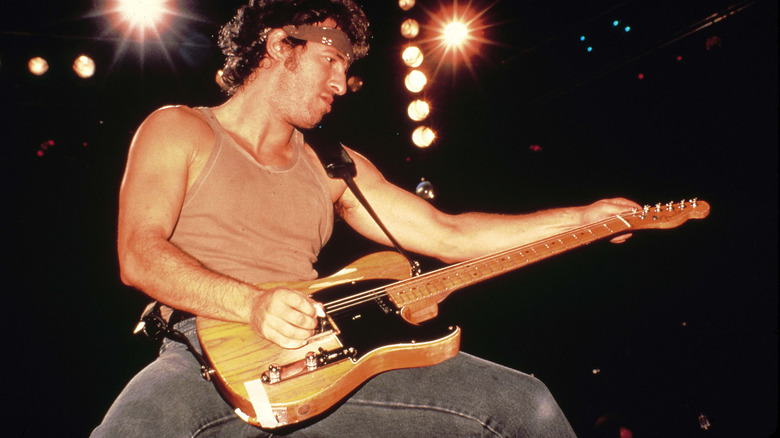
If there's any one recognizable symbol of the classic rock era, it's the almighty electric guitar, and many of the genre's greatest guitarists have their own favorite, even signature, models. Rock has always been a guitar-dominated genre, and those who play guitar in rock bands have always populated the list of the genre's greatest heroes. Likewise, the guitars they favor can become iconic in their own right, and certain models are spoken of with awe by musicians, collectors, and fans alike.
It's no secret that Fender and Gibson, guitar manufacturing's Big Two, dominate the market when it comes to rock music. This was especially true in the classic rock era, before the modern diversity of relatively affordable options became available. Accordingly, their most acclaimed and widespread models are responsible for most of this list, alongside their quirky, jangling cousin, the Rickenbacker. The models on this list are all united in recognizability, their use in legendary songs and performances, and in just how many great musicians played them. Here are five guitars we bet any true classic rock fan will recognize.
Gibson EDS-1275
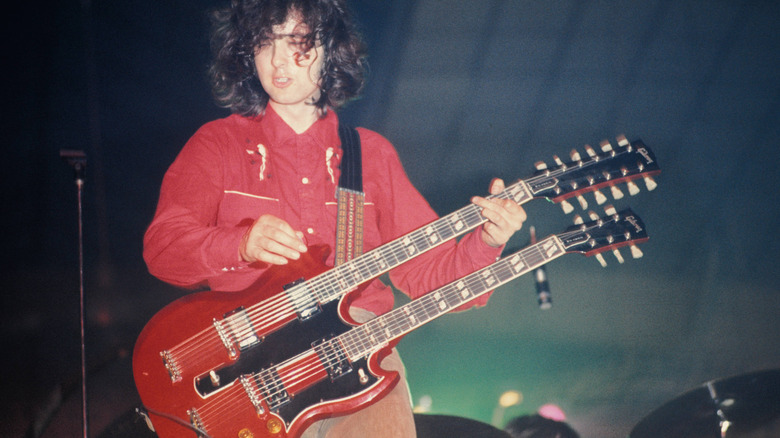
While double neck guitars in general aren't ubiquitous go-tos on the level of, say, a Stratocaster or a Les Paul, they make up for their relatively small catalog with a surplus of visual flair and almost mythological aura. There are many types of double necks, but by far the most common and recognizable is the 12/6 style, which is built from a 12-string neck on top and the standard six-string neck on bottom. The ability to instantly switch between the classic six-string sound and the high jangling of the 12-string is a handy feature for any guitarist whose parts oscillate between folksy and hard. That helps explain why a 12/6 like the Gibson EDS-1275 is one of the signature guitars of Led Zeppelin's Jimmy Page (pictured).
There are plenty of other guitarists who played the EDS-1275 to acclaim, like the Eagles' Don Felder, who uses a custom model to perform "Hotel California" live, and Slash, who has played one in live shows (like Guns N' Roses' famous 1992 Tokyo show) on and off for years. Page, however, is practically synonymous with the instrument. Images of him playing the guitar live on "Stairway to Heaven" and other Led Zeppelin standards are some of the band's most iconic. Page's finish of choice was cherry red, which, combined with the devil horns from its SG base design, added to the band's dark, Satanic mystique — though we can confirm, Led Zeppelin did not actually sell their souls to the devil.
Fender Blackguard Telecaster
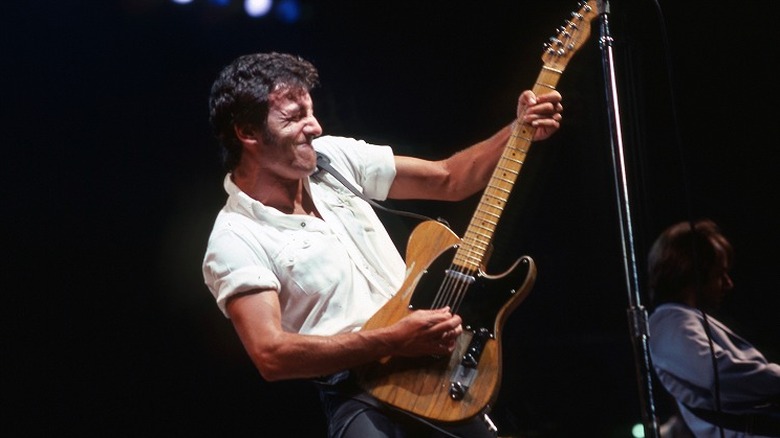
The Fender Telecaster is associated with a range of artists across genres, and as one of the first electric guitars ever mass-produced, its impact goes back to the earliest and most foundational rock 'n' roll guitarists. During those early years, approximately 1950 to 1954, the Telecaster was actually known by a few names. It was first called the Broadcaster, then for a time by the nickname "Nocaster," until finally settling on Telecaster, but all the models in that early '50s period were eventually united under a single moniker, based on their jet-black pickguards: the Blackguard. They also shared the same butterscotch blond finish (aside from customs, of course), and even now, the default image of a Telecaster for many is the contrasting yellow and black of the Blackguard.
It's possible that the single most famous image of a Telecaster in the world is the cover of Bruce Springsteen's magnum opus "Born to Run," in which Springsteen wears a Blackguard around his neck (though it had been modded into a Frankenstein well before that point). The same guitar can be seen on the covers of his albums "Human Touch," "Wrecking Ball," and "Live 1975-85," and the Boss is not alone in his love of the classic instrument. Keith Richards uses a '54 Blackguard as one of his signature guitars, and country guitar legend Vince Gill prefers a '53. As Gill told Foo Fighters guitarist Chris Shiflett on his "Shred With Shifty" podcast, Gill even turned down a signature Blackguard line of his own, asserting that "you can't make a guitar as good as my old [Blackguard]."
Rickenbacker 360/12
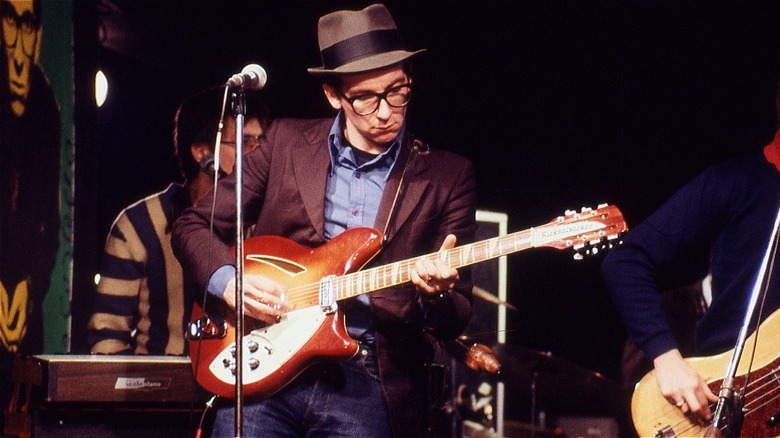
It's strange to think of Rickenbacker guitars and basses as Californian, which they are, given how tightly wound up with British music they've been since the '60s. During the Beatles' iconic first appearance on "The Ed Sullivan Show," John Lennon played a Rickenbacker, specifically a Rickenbacker 325, and although Harrison didn't play one that day, he soon would consistently. In particular, he played a Rickenbacker 360/12, a 12-string version of their famed hollow body model, the 360.
Rickenbacker itself describes the model as "the world's most popular 12-string electric guitar," and Guitar World once labeled it "the most iconic 12-string you can get your hands on." Harrison's early adoption of the instrument played a large part in that acclaim, but he was far from its only devotee. Everyone from the Beach Boys to the Rolling Stones to The Who used the guitar for its combination of warmth from its hollow body and brightness from its 12 strings during its initial '60s heyday. More recent acts such as Tom Petty, Elvis Costello (pictured), and Radiohead have done the same. In addition to its distinctive look and sound, the 360/12 (like many Ricks) also has the option of stereo output, a remarkably handy feature for recording, as it allows recording of the same take through multiple pickups into multiple receivers at once, a feature the company calls Rick-O-Sound.
'57 Fender Stratocaster
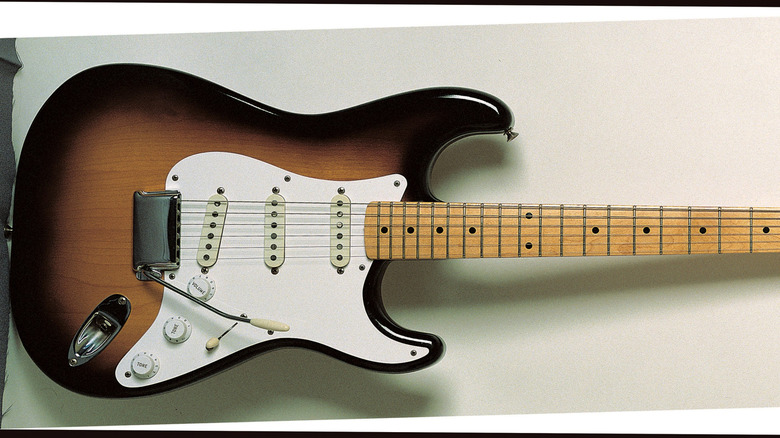
The Fender Strat is one of the most popular and renowned guitar models, period, and has been since its inception in 1954. Over the course of its 70-year-plus reign as one of the best-selling and most beloved guitars in almost any genre, a few different models have been hailed as the holy grail of Strats. Some will cite the '54 for being the original, or the '62, which introduced the first veneer fretboards, but the consensus is in favor of the '57 model. It has been hailed by many for its not-too-soft and not-too-hard V neck profile. Its champions include Eric Clapton, who used the neck for his Brownie and Blackie signature guitars.
The V neck might only be recognizable by playing or in extreme close-up, but the '57's paint job is more visually distinct at a glance (and not just custom paint jobs like Clapton's Blackie). 1957 was the last year Fender used two-tone sunburst patterns (the gradation from orange to black) before switching to three-tone, which extended the gradation to include more reds and hues in between. The '57's look is simpler and classic, and is recognizable on album covers like "The 'Chirping' Crickets" by Buddy Holly and the Crickets, Clapton's eponymous 1970 solo debut, and more.
'59 Gibson Les Paul
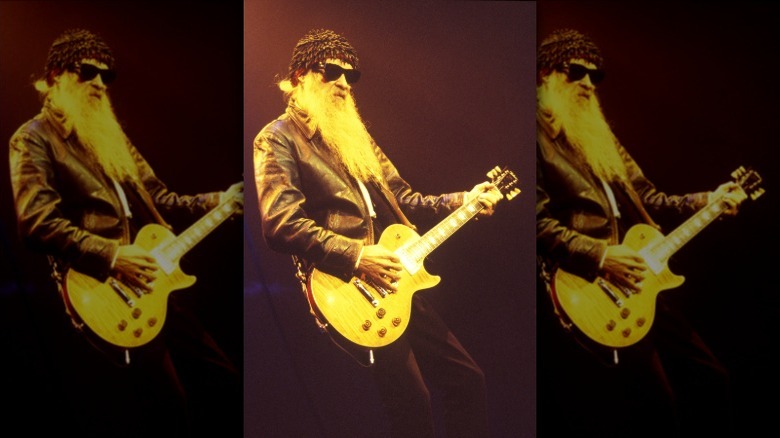
With all due respect to the Strat (and that is quite a lot of respect), there is simply no guitar more classic rock than the Gibson Les Paul, and to a great many collectors and players alike, there isn't a finer Les Paul than the '59 model. Forbes once proclaimed the 1959 Gibson Les Paul "the holy grail of electric guitars," mainly due to the instrument's rarity and value — they are some of the most expensive guitars in history. Accordingly, fake '59s are common, and a lot of money has changed hands in desperate searches to acquire an authentic piece. But the value of '59s began accruing long before they were recognized as rare. This was primarily because of their exceptional tone, which led to their use on more classic rock recordings than you could imagine.
Jimmy Page used a '59 he dubbed Number One for almost every Led Zeppelin album. Robert Fripp used one on almost every King Crimson album. Billy Gibbons (pictured) used one on every ZZ Top album. Kirk Hammett has played one consistently throughout his tenure in Metallica. One specific '59 was a favorite of Aerosmith's Joe Perry in the '70s and then Slash through the '80s and '90s. You can also hear the '59 on legendary albums from Lynyrd Skynyrd, Fleetwood Mac, the Allman Brothers Band, Kiss, the Rolling Stones, Eric Clapton, and countless others. Both of its finishes — the goldtop and sunburst — are about as storied and recognizable as instruments can get.