

In 1969, Creedence Clearwater Revival Made This Song With No Known Author A Classic Cover
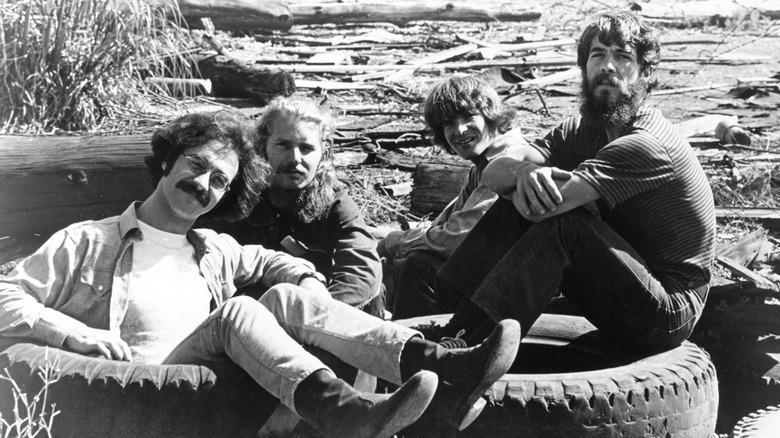
The evocative country blues song "Midnight Special" is now considered an American standard, having been performed by a wide number of musicians throughout the 20th century and beyond. The song received a huge increase in visibility in 1969, when the California swamp-rock band Creedence Clearwater Revival released a cover version of the song that proved to be highly popular. But the truth is that the authorship of the song is still debated, and to this day who actually wrote it remains a mystery.
In 1969, CCR were busy solidifying themselves as one of America's most popular bands, releasing three platinum albums in that year alone, along with some of their most popular songs including "Proud Mary," "Bad Moon Rising," and "Fortunate Son." Their version of "Midnight Special" appeared right in the midst of this, on the classic album "Willy and the Poor Boys," and today is by far the best-known version of the tradition of the song. But what is the story of "Midnight Special," and how did it get into the hands of CCR bandleader John Fogerty?
The early life of Midnight Special
Traditional songs can often be passed around from performer to performer for decades before they find a wider audience through either publication as written music or as a recording. It is a tough task for folklorists to trace the roots of a song back to its exact origin, especially when those who are responsible for a particular song are long dead.
However, while the exact authorship of "Midnight Special" is now possibly lost forever, researchers have found very early lyrical fragments of the song going back to 1911 – though musicians typically recycled lyrics, and recognizable lines from "Midnight Special" may have appeared in countless songs. Full versions of the song began to emerge in the 1920s, printed in magazines and released as recordings as early as 1927, at which time it was widely sung across America, particularly in the South.
The artist most closely associated with the song in the first half of the 20th century, however, is undoubtedly Lead Belly. The blues and folk singer recorded his first version behind bars — he was given prison time for his violent behavior — for ethnomusicologists Alan and John Lomax in 1934, and his second in 1940. It is believed that Lead Belly would have heard the song sung by prisoners, who found solace in the image of the Midnight Special, a passing train that they dreamt of taking to freedom.
CCR's Midnight Special – a tribute to a musical hero
Lead Belly is considered one of the most influential figures in American music, whose powerful vocals and expressive fingerpicking style on his 12-string acoustic guitar inspired generations of musicians that came after him, not least the iconic folk singer Bob Dylan. But it is likely that another musician was responsible for getting "Midnight Special" into the ears of a young John Fogerty: Pete Seeger.
A prominent folk singer and champion of other artists — who indeed was once a close friend of Dylan before the two grew apart over creative differences – Seeger shared the work of Lead Belly with wider America through his television appearances, even going as far as to imitate the musician by using a 12-string guitar himself when performing his songs. Fogerty has expressed how influential Seeger was to him as a young musician, and how the D-tuning used by both musicians influenced him to use the same tuning when writing his classic song "Bad Moon Rising" (via Fogerty's official YouTube channel).
Seeger himself recorded two versions of the "Midnight Special," and Creedence Clearwater Revival's version of the song can therefore be seen as a tribute to him. His influence, along with Lead Belly's and the anonymous musicians who shaped "Midnight Special" over many years before it was finally recorded, has helped define the sound of one of Creedence Clearwater Revival's biggest hits.