

The 6 Best Harmonica Solos In Rock History
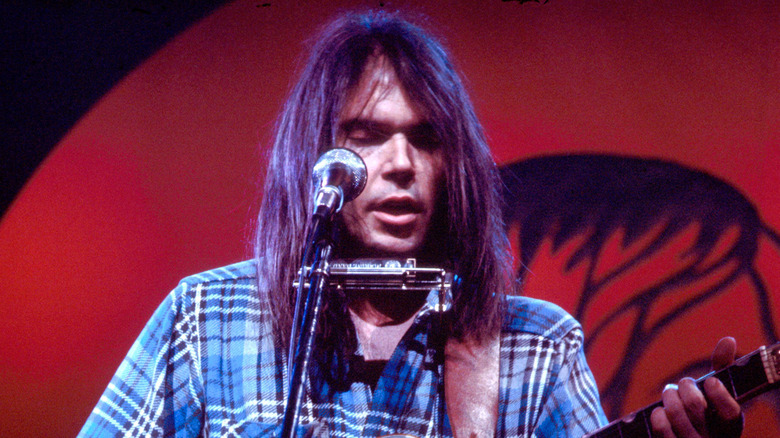
The harmonica is known for bringing a level of emotion to genres like country, blues, and bluegrass, but perhaps it's less associated with rock 'n' roll, despite the instrument being a part of its early stages — like on The Beatles 1962 song "Love Me Do." But there are some rock songs with a harmonica that stand out from the rest, and the six we've chosen are the best harmonica solos in rock history.
We selected these songs, not only for the unforgettable melodies of the solos, but their placement and how they're used, as none of them are sandwiched into the track with mindless force. Instead, these solos bring texture, beautiful aural colors, and added emotion to the songs. Of course, it's one thing to throw a solo into a song just to add another sound and instrument, which doesn't do much, but it's another for the artist to carve out just the right amount of space and time to highlight whatever was said before or after.
These songs were also chosen by us due to the artist using more than one solo in the track, while changing the pace and melody throughout. Meanwhile, the other rockers who made this list use their harmonica solo as a launching pad at the start of the song, pulling listeners in before blasting them off into sonic beauty.
Mary Jane's Last Dance — Tom Petty and the Heartbreakers
Oftentimes, when a solo is mentioned, it's safe to assume that it happens just once in the song. But Tom Petty's short, catchy, whistle-along harmonica melody lands in three different parts of "Mary Jane's Last Dance," allowing fans to be treated multiple times. The first solo, which lasts for just 10 seconds, can be heard at the start of the 1993 single, right after Petty's lyrics about the Indiana girl who grew up around boys and an absentee mother.
The second solo lives in the middle of the song, coming right after a nifty-sounding drum fill — and like most effective solos, it provides a break to either ponder Petty's haunting chorus, or to sink deeper into the instrumentation. The harmonica solo comes in for the last time toward the close of the Rick Rubin-produced hit, and is layered over a soulful, head-nodding electric guitar riff that brings the cut home.
Life Is a Highway — Tom Cochrane
Tom Cochrane's 1991 hit, "Life Is a Highway," is a song about being prepared and willing to face whatever comes, while embracing the highs, lows and everything in between in life. But it's not only the song's concept and lyrics that make the cut such a standout — it's various harmonica solos that float in and out. The first one can be heard at the beginning of the song, almost serving as a musical onramp before the listener rolls onto the highway.
In fact, all of the solos add a country vibe to the rock tune, which blend perfectly with the punchy guitar riffs. Later, another harmonica solo comes after the bridge, with Cochrane seemingly playing it harder and faster with added passion. Then he really lets the harmonica sing toward the end of the song, which makes for an epic climax before the harmonica fades out like the sinking sun. Clearly, "Life is a Highway" wouldn't be the same ride without the stellar harmonica solos.
Cochrane once talked about why he finds harmonica solos so useful in his songs, telling CTV News in 2015, "It was kind of a saving grace because it was a good way to extend a two-minute song. It's got a real visceral thing to it ... plus kids can play it. There's something childlike about it."
Smile — Pearl Jam
With Pearl Jam being one of the major faces of the '90s grunge movement, it's easy for them to just be associated with loud, distorted, electric guitar riffs. But on "Smile," off their 1996 album "No Code," frontman Eddie Vedder's harmonica solos bring a bluesy feel to the mid-tempo rock tune, which first comes in at the 12-second mark, then again at 1:52.
For those who've ever seen Pearl Jam perform "Smile" live, then they probably can't forget seeing Vedder strut to the microphone, with his hands cupped around the instrument, belting out the solos with passion and intensity. Not only do the solos bring short bursts of brightness to the dark guitar riffs, they take take listeners into another musical direction, before bringing them back to a pure rock sound.
Over the years, Vedder hasn't just become associated with his gravely vocal delivery — he's almost just as well-known for his harmonica playing, and "Smile" is far from the only song he's played harmonica on. Other cuts include Pearl Jam's "Drifting," off their 2003 "Lost Dogs" album and Vedder's cover of The Beatles' "You've Got to Hide Your Love Away" for the "I Am Sam" soundtrack.
Piano Man — Billy Joel
Billy Joel's harmonica solo at the beginning of his 1973 masterpiece, "Piano Man," is nothing short of iconic, and it perfectly leads the listener into his story of playing piano in a piano bar and getting to peek into the lives of its patrons. Despite the solo just being 15 seconds long, it's as vital to the story as the lyrics itself, and it sets up the scene like the opening music one hears in a theater before a film starts.
But even though the harmonica solo is nothing short of brilliant (as is the song), in 2014 Joel told Howard Stern that he finds "Piano Man's" melody redundant. "I think it's a decent song, but it doesn't change too much," he told Stern.
Maybe that's why the harmonica solo stands out so much, because it adds some musical variety to the piano melody, which repeats in different octaves throughout the song. Either way, it's safe to say the harmonica is at least part of the reason why "Piano Man" is so memorable and has such a timeless feel.
Run-Around — Blues Traveler
"Run-Around" was Blues Traveler's first hit, spending a whopping 49 weeks on Billboard's Hot 100 chart in 1995 and peaking at No. 8. The song also gave the group their first Grammy, winning the Best Rock Performance By A Duo Or Group With Vocal in 1996.
Singer John Popper — who began playing the harmonica in high school after first being a trumpet player — starts the song with the harmonica, before singing about a woman he pines for, someone who doesn't seem to share the same feelings as he does.
Another solo comes in during the middle of the song, where Popper lets it all hang out, and listeners are treated to a masterful, cascading melody that shoots out of the instrument at a swift pace. If anything, the solos, especially the second one, shows just how many hours the Blues Traveler frontman put into learning the instrument, and how much ownership he has over it. Surely, the commercial and critical success of "Run-Around" is at least partially due to the harmonica solos.
Heart Of Gold — Neil Young
The first harmonica solo in Neil Young's "Heart of Gold," a song from his 1972 "Harvest" album, comes in like a soft whisper, playing slightly below the drum beat and acoustic guitar. However, despite its quiet presence, it still serves as a major and memorable part of the song, initially coming in at the 13-second mark, before coming in again after the first verse. Young then brings it back toward the end of the cut, at the 2:15 mark.
Some might notice that all of the solos melt seamlessly into the track, as opposed to coming in abruptly with force, which compliments the soft, folk feel of the cut. But toward the end, the solo comes in louder and stronger, bringing the song to its zenith.
One possible reason that Young used the harmonica on the "Harvest" album was because he was unable to stand and play guitar because of his back, telling Rolling Stone in 1975, "I was in and out of hospitals for the two years between 'After the Gold Rush' and 'Harvest' ... I could only stand up four hours a day. I recorded most of 'Harvest' in the brace. That's a lot of the reason it's such a mellow album. I couldn't physically play an electric guitar." It's said that everything happens for a reason, and of course the upside of Young's back problems back then resulted in one of the most famous harmonica solos in rock history.