

5 Songs That Prove 1979 Was The Best Year For Cheap Trick's Career
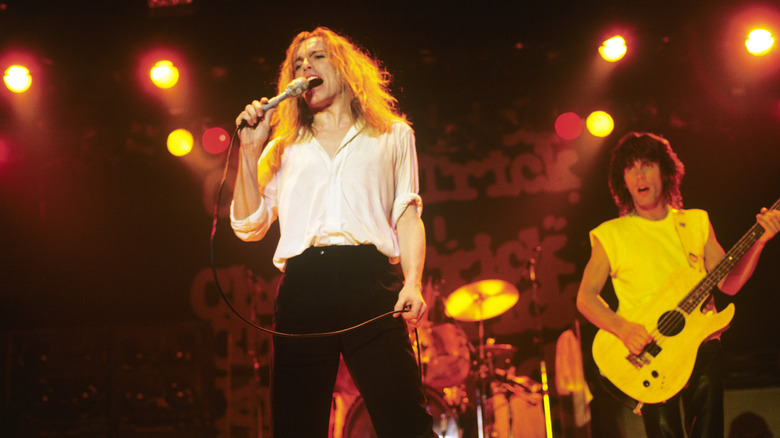
To say 1979 was Cheap Trick's finest year would be something of an understatement. The band was a genre-flexing mash of power pop, new wave, and glam rock, with some spiky punk-lite edges that poked out here and there. Their fourth release, the multi-platinum live album "At Budokan," launched in Japan in 1978 before hitting the rest of the world in early 1979. It became a high point in the realm of live rock albums, showing off the band's peppy in-concert energy and producing a rousing single version of "I Want You to Want Me," which became the band's first top-10 single.
The surprise success of "At Budokan" gave the band chart hits throughout the following year and forced the rescheduled release of their next L.P., "Dream Police," a power pop collection that went all the way to No. 6 on the album chart. It was another platinum record and showed the band sharpening its tools for a tighter, more modern version of their sound. We rounded up five songs from these two exemplary releases that show how Cheap Trick's peak year of 1979 helped put the band on the map, with a bit of a lead-off in 1978 to get things rolling — plus a long tail that took them into 1980 in strong form.
Surrender
The pop perfection of "Surrender" makes the song a standout among Cheap Trick's early catalog. The singable masterpiece was one of their earliest basement rehearsal songs and had originally been included on the band's third album, 1978's "Heaven Tonight." Though it was released as a single in June 1978 and topped out at No. 62 in September 1978, it became their first single to hit the Billboard Hot 100, a milestone achievement that would be repeated throughout the following year. A popular live version included on "At Budokan" gave it presence on two albums in less than a year, extending its lifespan into 1979 and offering a scorching new take for fans to adore.
The tune helped define the more commercial version of Cheap Trick's sound, throwing all the band's clever tricks into a deceptively subversive song about finding out how cool your parents used to be — and still are, when the kids aren't around. "Mommy's alright, Daddy's alright / They just seem a little weird," as vocalist Robin Zander calls out in the tune's timeless chorus, supported by Rick Nielsen's unmistakable guitar licks. It still has the power to get Gen X dancing to straight-up rock music wherever the song shows up these days. No wonder Amazon named it No. 56 on the site's playlist of the greatest 100 classic rock songs.
I Want You to Want Me
"I Want You to Want Me" turned out to be one of Cheap Trick's defining songs, providing the band's first ride into the Billboard top 10. The song originally appeared on the band's second album, 1977's "In Color," and the live version was released as a single from "At Budokan." That version was more energetic than the dialed-down studio recording and became Cheap Trick's biggest hit at the time, a No. 7 smash in July 1979 that gave Robin Zander and the band a midsummer home run. It was like hearing the band's best live tunes in concert without having to score a ticket, complete with iconic '70s guitar solos that let guitarist Rick Nielsen cut loose throughout the tune.
Bassist Tom Petersson recounted to Louder that the song began as a silly response to the glam pop that had taken over the radio when Nielsen was writing it. What came about instead was one of the most unabashed versions of crunchy power pop the '70s ever produced, an infectious sing-along jukebox classic that popped with joyous energy. It was a high point that made 1979 Cheap Trick's true year of arrival, even though they'd been on the scene for more than half a decade by then.
Ain't That a Shame
A cover of the Fats Domino hit from 1955, "Ain't That a Shame," showed off Cheap Trick's affection for the classics. Rather than heading into the studio for a cleaned-up version, the band had a live take on "At Budokan" that served as the single. Screams from the crowd and a more improvisational spirit, courtesy of the spirited drum work of Bun E. Carlos, gave the song a crackling energy that made it feel fresh. There was no attempt by the band to imitate the original; they simply took the framework and added their own sinew for a fun rock callback that hit big with their audience.
There was no lack of Billboard presence for this single; it debuted in early August 1979 and ascended to No. 35 by the end of September, keeping Cheap Trick present and accounted for on the charts as fall rolled in. Having a mix of originals and covers in both studio and live recordings showed that the band had the juice no matter what format they chose. It would have made for a solid close to 1979 for any act on a winning streak. But that wasn't the end of Cheap Trick's banner year ... the hits just kept coming.
Dream Police
The new studio album from Cheap Trick, "Dream Police," appeared in September 1979, while their previous singles from "At Budokan" were still lighting up the airwaves. The album would be their fourth studio-recorded L.P. released in the course of a three-year span — in addition to the live album — a staggering run for any band. The title track was a melodic chunk of new wave paranoia, complete with cheesy surf punk organs and crackling power chords. It was the band at the peak of their talents, spinning out singable melodies and surrealistic imagery that made their configuration a unique package in the pop-rock world. It also gave them a chance to tap into the video market, creating a promo clip for the song years before MTV would become a phenomenon that helped push the band's quirky image and roll their successful musical career into a new and powerful marketing format.
"Dream Police" dropped in October 1979 and peaked at No. 26 on the Billboard Hot 100 in November, closing out a top-tier year for the band. For a song about someone who thinks their dreams are being spied on by a band that wasn't afraid to add humor and big ideas to their music, it turned out to be a fantastic addition to the Cheap Trick songbook. And the year wasn't over yet.
Voices
"Voices" would be the last song Cheap Trick released in their stellar year of non-stop success, before a new decade dawned and led the band into the future. It gave Cheap Trick more than 18 months of solid chart and radio presence, a wraparound feat with a buzzy and busy 1979 squarely in the center. Lyrically, this one was nothing more than a song about someone realizing they're in love, and it came with a different vibe than the band's other songs: subdued and controlled, a suitable release for both rock and mainstream radio, with sugary harmonies and Beatles-esque melodies that felt like Cheap Trick had matured a bit.
The single appeared in December 1979 and ended up at No. 32 in February 1980, a strong showing for a band that had saturated the music industry with nearly non-stop material for more than a year. Though it would be more hit-or-miss for the band through the rest of the '80s, Cheap Trick could count 1979 as a career high, with the hit-making musical roadmap that proved it.