

The 3 Best Folk Rock-Influenced Supergroups Of The '80s
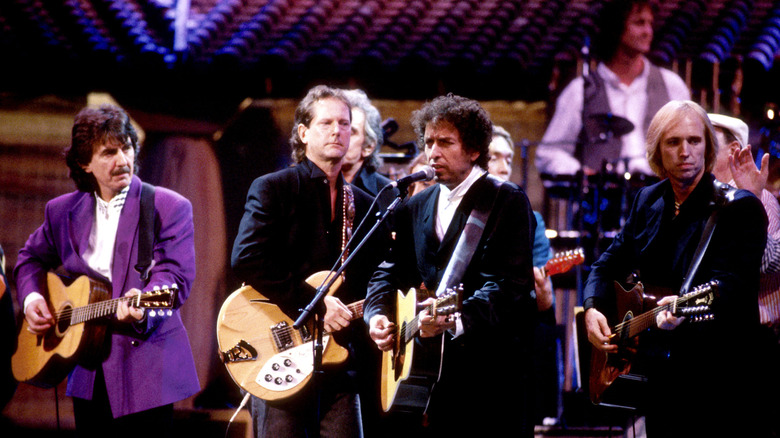
By the time the 1980s rolled in, it had already been close to two decades since the mainstream emergence of the music genre we've come to know as folk rock. With many of the early musical acts strongly associated with folk rock (such as Simon & Garfunkel, Peter, Paul & Mary, and the Mamas & the Papas) exploding in popularity in the mid-'60s – and as folk rock evolved and influenced other musical styles like country rock and progressive folk music with the passage of time — the folk rock scene wasn't quite as prolific in the '80s as it used to be. However, that didn't stop some of the most talented folk rock and folk-rock-inspired music superstars of that era from coming together as superbands and creating some memorable music.
Due to the blending of folk rock elements into other styles and subgenres in the United States and beyond, strictly categorizing rock supergroups under the banner of folk rock can be a rather herculean task. With that said, while there were more actual folk rock supergroups in the '70s, the superbands mentioned on this list all have undeniable folk rock roots. One of these supergroups even included the musician whom many argue was the instigator of the unofficial "birth" of modern folk rock in the 1960s. Additionally, all of these groups received recognition for their musical prowess, as well as released songs or albums that ranked on at least one U.S. Billboard chart.
The Traveling Wilburys
For music history buffs, rock legend Bob Dylan's 1965 Newport Folk Festival performancewas a watershed moment in the popularization of folk rock. Thus, it should come as no surprise that in 1988, he became part of what was arguably the premier folk rock supergroup of the decade: the Traveling Wilburys. Made up of Dylan, the Beatles' George Harrison, Electric Light Orchestra's Jeff Lynne, Tom Petty, and Roy Orbison, the five came together when the "quiet Beatle" enlisted the four to help him put together a B-side for his solo album.
Separately, these superstar musicians had already crossed paths or worked with each other; for example, Petty had a friendship with Harrison and Lynne prior to the quintet's fateful get-together. Apart from being individually talented, it was likely their mutual respect and admiration for one another that helped these already-successful musicians reach new heights. The all-star band released "Traveling Wilburys Vol. 1" in October 1988, climbing to the third spot on the Billboard 200 chart and even winning best rock performance by a duo or group with vocal at the Grammy Awards in 1990. Tragically, Orbison died just two months after the supergroup's debut. The remaining members finished a second album, intentionally misnamed "Vol. 3," and dedicated it to Orbison.
The Highwaymen
The country-rock collaboration known as the Highwaymen began when Kris Kristofferson, Willie Nelson, and Waylon Jennings worked with Johnny Cash for a Christmas TV special in Switzerland in 1984. As the story goes, the musicians, who had already been friends with each other since the early days of their respective careers, thoroughly enjoyed their sessions. This helped them realize that they could literally make beautiful music together.
In 1985, the supergroup (which was initially referred to as just "Nelson, Jennings, Cash, Kristofferson") released their first album, "Highwayman." The eponymous single was their version of a song released by Jimmy Webb in 1977 and covered by Glen Campbell in 1979, with each member of the quartet singing a different verse. The song nabbed the top spot on the Billboard Hot Country Songs chart and even earned Webb the 1986 Grammy for Best Country Song.
The smash success of their single led the four to eventually call themselves the Highwaymen while touring in 1990, the year they released their sophomore album, "Highwayman 2." This prompted a '60s-era folk band of the same name to file a lawsuit against the quartet, which was amicably resolved. Their final album, "The Road Goes on Forever," didn't quite reach the levels of success their earlier offerings did. Still, the four remained friends even after they went their separate ways in the '90s.
The Cherry Bombs/The Notorious Cherry Bombs
In 1980, when singer-songwriter Rodney Crowell exited country rock superstar Emmylou Harris's Hot Band and establish himself as a solo artist, he promptly assembled a backing band to become his own "Hot Band." Calling his ensemble the Cherry Bombs, Crowell recruited guitarists Vince Gill and Richard Bennett, keyboardist Tony Brown, and drummer Larrie Londin, as well as two other former Hot Band members, bassist Emory Gordy Jr. and steel guitarist Hank DeVito.
The band joined Crowell and his wife at the time, fellow country musician Rosanne Cash, on tour. While Crowell and the Cherry Bombs received praise for their talents, Crowell's early solo efforts didn't exactly soar. Moreover, as the Cherry Bombs were meant to be a backing band and not really their own thing, they didn't release an album of their own. Midway through the decade, the Cherry Bombs went their separate ways. Over time, most of the members achieved moderate levels of success either as performers or producers; Gill, in particular, skyrocketed to country rock superstardom himself, with multiple Grammys and Billboard Hot Country Songs chart-toppers under his belt.
In 2003, the supergroup — with the exception of Londin, who died in 1992, and Gordy, who declined to return — reunited at the ASCAP Awards to perform once again. Joined by bassist Michael Rhodes, drummer Eddie Bayers, and pianist John Hobbs, the band renamed itself the Notorious Cherry Bombs. They released their self-titled (and quite well-received) debut album in 2004, which managed to claim a spot on Billboard's weekly 200 chart.