

Born 100 Years Ago Today, This Rock Pioneer Set The Stage For The Beatles And The Stones
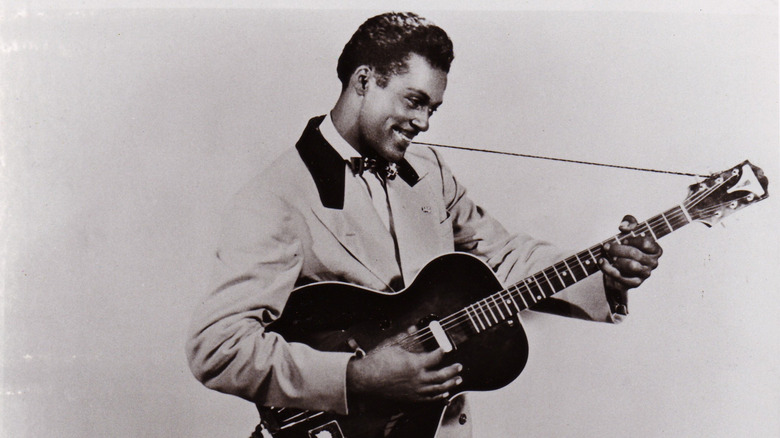
In rock 'n' roll, there's one musician that garners almost universal praise for his pioneering musicality, genre-blending, and almost uncanny ability to tap into the cultural zeitgeist. That would be Chuck Berry, a man so fundamental to the form that, without him, it's possible we would have never heard of the Beatles or the Rolling Stones. Sounds hyperbolic? Just ask other musicians, who fairly trip over each other to sing Berry's praises and build upon his work. The group includes other greats, from the Beach Boys to Bob Dylan to AC/DC to Bruce Springsteen. In the wake of Berry's 2017 death, Paul McCartney took to his website to write a glowing tribute, praising his songwriting and musicianship. "To us, he was a magician," McCartney said. "We learnt so many things from him which led us into a dream world of rock 'n' roll music."
Born on October 18, 1936, Berry grew up in a starkly segregated St. Louis, Missouri. He began his musical path by singing in a church choir, eventually performing a blues song in a high school talent show that had teachers shaking their heads but fellow students singing his praises. He later dropped out of high school, headed to California, but engaged in an impromptu string of robberies on the ways that landed him a 10-year jail sentence. Berry served three years and, upon release, went back home and worked odd, jobs, got married, and began to build his music career. As he grew in popularity and traveled for gigs, he met blues legend Muddy Waters, who gave Berry the idea to reach out to Chess Records. Chess signed him and released Berry's first single, "Maybellene," which hit No. 5 on the pop charts soon after.
Berry's influence can't be understated
Berry became a legend for many reasons, including his early entrance into the rock genre, his energetic guitar riffs, and a charismatic stage presence that included the now-iconic "duckwalk," in which he shuffled across the stage in a squat, playing all the while. His witty lyrics spoke to the growing teenage culture of the era, drawing excited fans from many backgrounds, whether they listened to his records or visited his desegregated venue, Berry's Club Bandstand.
That sound readily crossed oceans, too. In the '60s, the Beatles would regularly cover Berry songs live and even were so bold as to include a couple on studio albums. The feeling was mutual, with Berry calling out "Yesterday" as his favorite Beatles song. He also particularly liked their rendition of his own "Rock and Roll Music."
Not to be outdone, the Rolling Stones — whose first single was actually a 1963 cover of Berry's "Come On" — also wrote effusively of Berry's influence. In response to Berry's death, Mick Jagger released a statement that said, "He lit up our teenage years, and blew life into our dreams of being musicians and performers. [...] Chuck, you were amazing, and your music is engraved inside us forever" (via Rolling Stone). Keith Richards has also said that he cribbed many guitar lines from Berry and recalled getting punched by Berry in the '60s. Richards, visiting backstage, touched Berry's guitar without permission and received a blow in response. "Quite right, Chuck! I would have done the same," he later told the Guardian.
He left behind a complicated legacy

Though he was enjoying increasing fame and success by the close of the '50s, Berry's troubles didn't end there. In 1959, he was convicted of violating the Mann Act after transporting a 14-year-old girl across state lines for what had been deemed "immoral purposes." As a result, he served a 20-month federal prison term. Though he returned to recording and performing upon his release, with hits like "You Can Never Tell" and "Nadine," things were different. Rockabilly guitarist Carl Perkins, who toured with Berry in the U.K., said he "never saw a man so changed." Berry had become, in his words, "cold, real distant, and bitter" due to both the jail time and years of touring (via History). Others have also noted the malign influence of racism on his career, which sometimes restricted how and where he performed, who played his music, and, as some argue, the way he was treated in the legal system.
In 1989, Berry was accused of placing a camera in the women's restroom of a Missouri restaurant he owned, with police investigators finding recordings from those devices in Berry's home. He settled a class action suit, which included 59 women, out of court. Though practically no one disputes his stature as a musician and figure of rock 'n' roll — "Johnny B. Goode" even went to space on the Golden Record launched aboard Voyager 1 and 2 — these incidents deeply complicate his legacy, balancing controversy with his status as a legendary rocker.