

5 Classic Rock Album Covers That Became Dorm Room Staples

We may receive a commission on purchases made from links.
One of the more satisfying aspects of purchasing classic rock on physical media, such as vinyl, is being able to enjoy the wonderfully designed covers while taking in the music, a benefit sadly lacking when solely listening to digital LPs. In fact, many classic rock covers are so memorable that they were mass-produced into posters for commercial gain, and many of them found their way onto the dorm room walls of students across the globe.
The visual gems we've chosen can easily be stand-alone works of art, and they're so well-crafted that students didn't even need to be a huge fan of the featured bands to proudly hang them on their walls. Nonetheless, the fact that they're all covers from classic albums was reason enough for college kids to showcase them. Of course, plenty of classic rock album covers make a perfect backdrop to student life, but from the Velvet Underground to the Beatles, we consider these to be the top five.
The Velvet Underground — The Velvet Underground & Nico
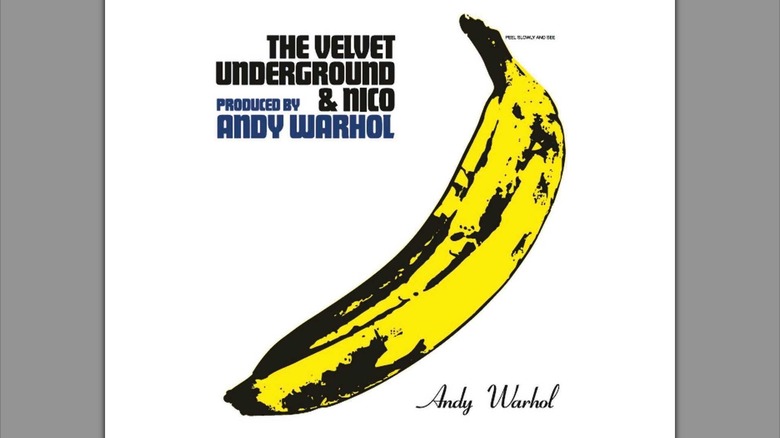
Putting up a poster of a banana on a dorm room wall might appear strange and completely random, but not if the banana was created by pop art legend Andy Warhol, who managed the Velvet Underground and used an image of a banana for the cover of their debut album, "The Velvet Underground & Nico." The silkscreened banana is on its way to rotting on the cover, hence the black shading that Warhol used. Above the banana are the words, "Peel slowly and see," and indeed the first versions of the cover actually allowed one to peel the skin, revealing pink colored flesh underneath.
The image was said to be a reminder that everything in society, regardless of how aesthetically pleasing or useful, will eventually perish; a message that resonated with many college students. So, by hanging up the "The Velvet Underground & Nico" cover, they got to express an opinion about the current culture, while also getting to display an iconic Warhol piece.
The Dark Side of the Moon — Pink Floyd

Graphic designers Storm Thorgerson and Aubrey Powell created the iconic cover for Pink Floyd's 1973 album "The Dark Side of the Moon," which is a simple, clean, yet powerful image of a ray of light passing through a prism and coming out the other side as a rainbow. The members of Pink Floyd wanted Thorgerson and Powell to create something basic rather than busy-looking, an approach that was different for the design team.
Thorgerson — who first drew a picture of the Marvel character Silver Surfer for the cover, an idea the band vetoed — told Rolling Stone in 2011 that the beam of light was added to commemorate Pink Floyd's elaborate light shows, where colorful lights and lasers shot across the stage in coordination with the music. Thorgerson also explained that the prism relates to Roger Waters' writing, saying, "I think the triangle, which is a symbol of thought and ambition, was very much a subject of Roger's lyrics ... the prism belonged to the Floyd."
Not only is the cover legendary, but college kids also connected with the minimalist approach. On top of that, they were able to express an opinion that less is more; simplicity can be just as beautiful as a piece that's visually complex.
Axis: Bold as Love — The Jimi Hendrix Experience

If there's an album cover that was ever ideal for turning into a dorm room poster, it's the Jimi Hendrix Experience's "Axis: Bold as Love," released in 1967. Its surreal-looking, multicolor appearance perfectly captures the psychedelic art styles that grew in popularity during the '60s, and the students who adorned their walls with it back then were very much on-trend. Even today, college kids hang them up to give their dorm room a retro, throwback look, announcing that they're fans of the late rocker's style by hanging a poster that captures his trippy, colorful, out-of-the-box image.
But that doesn't mean Hendrix was fond of the cover, stating (via Johnny Black's book, "Jimi Hendrix: The Ultimate Experience") that it should've celebrated his American Indian background — his grandmother was Cherokee — and not the Hindu god Vishnu. Still, posters of the "Axis: Bold as Love" cover will forever adorn dorm room walls, for both fans of the legendary guitarist and those who just admire a well-made art piece.
Rumours — Fleetwood Mac
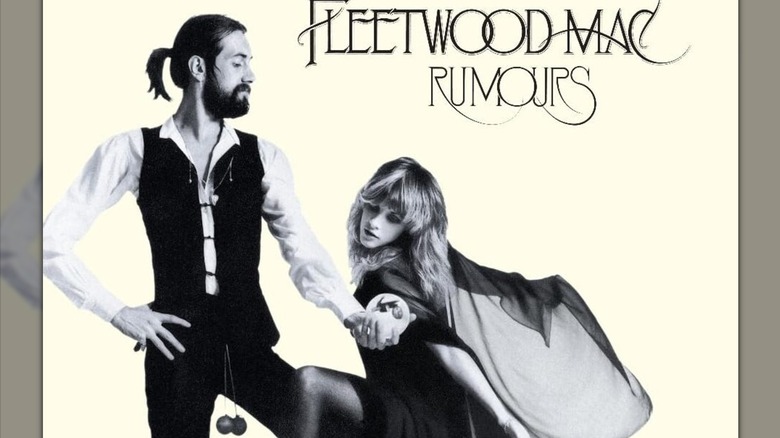
Sometimes an album cover's most interesting and attractive quality is its vagueness and odd appearance, and the rather peculiar-looking cover for Fleetwood Mac's 1977 "Rumours" album certainly falls into that category. The image shows just two of the band's members, Stevie Nicks and Mick Fleetwood, with the former sporting witch-like attire and draped over the latter while holding a crystal ball. Meanwhile, Fleetwood rests one foot on a stool and has two wooden balls hanging from his waistline, which he took off a public toilet, of all places.
The album cover is unique from other, heavier rock covers of the late '70s, making it the perfect choice for the student who wants to have something ambiguous-looking on their wall — which is why it's regularly seen on college campuses. The cover also adds a nice touch of elegant weirdness to a dorm room and has probably sparked plenty of discussion.
Abbey Road — The Beatles
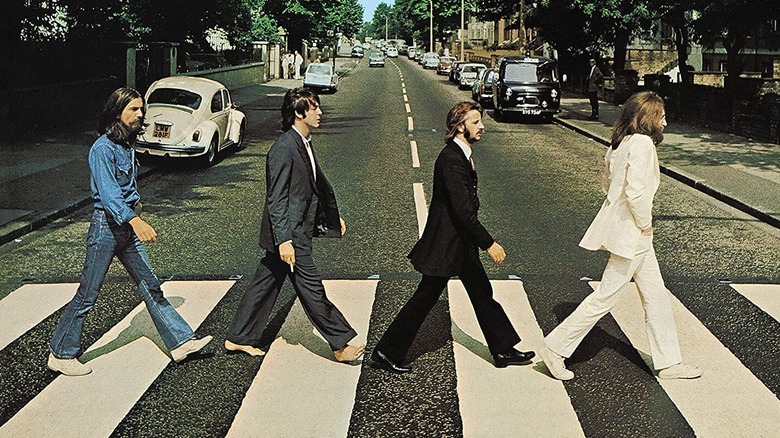
There may not be a more iconic image in rock history than the photo on the Beatles' "Abbey Road" album, which famously shows the Fab Four midstride — with Paul McCartney barefoot — walking across Abbey Road in North London. For decades, many college students hung a poster of the cover to proudly show they have some knowledge, or at least an appreciation, of rock history and classic albums. When the album was released in 1969, plenty of those students would have been the first Beatles enthusiasts, who were swept up by Beatlemania when the group first began making TV appearances in the early '60s.
Considering how famous the image is, it actually came about after the band discussed much loftier ideas for the cover, like heading to Egypt to take photos in front of the pyramids. Instead, Paul McCartney came up with the idea of the image, first sketching it out on paper. It's pretty safe to say that he had no idea it would become the most famous rock cover ever.