

One Of The '70s Best Live Albums Turned An Overlooked Rock Band Into Superstars
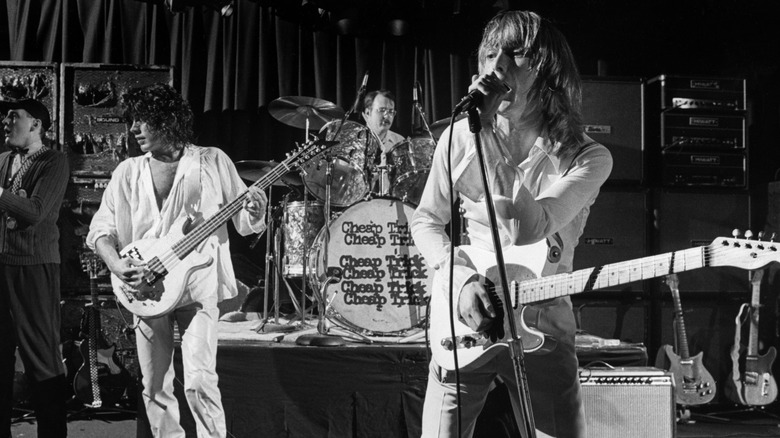
In the 1970s, live albums helped extend the reach of giants like Led Zeppelin and transform mid-level acts like Peter Frampton into superstars. But for Cheap Trick, who'd been largely flying under the radar, the stunning success of their live album, "At Budokan," came as a shock that no one expected.
In 1978, long before Cheap Trick would sell more than 20 million records, the band wasn't doing all that well, at least in the U.S. The power pop quartet from Rockford, Illinois — singer and rhythm guitarist Robin Zander, lead guitarist Rick Nielsen, drummer Bun E. Carlos, and bassist Tom Petersson — had three albums under their belt and had been endlessly touring without much to show for it. "We were in debt by about a million dollars," Zander told Classic Rock in 2024. But in Japan it was a totally different scene.
That spring, the band had a sold-out Japanese tour that included a two-day stint at Tokyo's Nippon Budokan stadium and another in Osaka, among other stops. In Japan, the band were full-fledged rock gods and were mobbed by fans wherever they went. In the fall of 1978, Columbia, the parent company of the band's label, Epic, released a live album, "At Budokan," in Japan. Soon, fans in the U.S. began snapping up imported copies, even though they were selling for about four times the normal cost of a record in the U.S. The label took notice, released an American version, and suddenly everything changed for Cheap Trick.
From Japan to the world
In February 1979, the U.S. release of "At Budokan" hit record store shelves and radio, and Cheap Trick returned from a second tour of Europe and Japan to suddenly find themselves bona fide rock stars. They made the cover of Rolling Stone, and their live version of "I Want You to Want Me" reached No. 7 on the Billboard Hot 100, their highest charting single at the time. Another tune, a cover of Fats Domino's "Ain't That A Shame," reached No. 35 a few months later.
The album itself went to No. 4 on the Billboard 200 (the highest Cheap Trick ever charted) and "At Budokan" sold over 3 million copies. In 1979, the band also released the album "Dream Police," solidifying their stature and making 1979 one of the best years of Cheap Trick's career.
"At Budokan" went on to be hailed as one of the best live albums ever, with Rolling Stone ranking it No. 13 out of their 50 greatest live albums. Interestingly, the bulk of the album's material didn't come from the Budokan shows, but instead from the Osaka concert, since the recordings from Budokan were so poor that they were virtually unusable. Nonetheless, "At Budokan" showcased Cheap Trick in all their live musical glory and turned them from a struggling band into superstars.