

The 5 Best Folk Rock Trios Of All Time
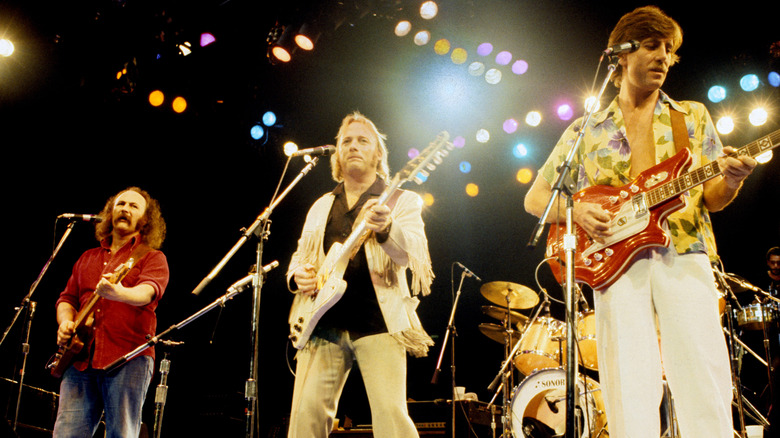
You could make the case that folk music has been around for as long as someone's been able to pick up an instrument and sing, but the modern resurgence of this genre began with the 1940s folk music revival. By the 1960s, quite a few people were looking to mix things up, and that's where folk rock came in, mixing the acoustic character of folk music and its deep storytelling traditions with rock-infused musicality. You can surely name some of the biggest acts, from solo artists like Bob Dylan to larger groups such as the Byrds, but attention is also due to the folk rock trio.
The very best folk rock trios of this sub-sub-genre that we chose showcase close, carefully calibrated harmonizing, unique artistic visions, bold creative statements, and a willingness to transcend petty genre boundaries. A tight group of three musicians also allows for close creative work and often collaborative environments. Done right, three-part harmonies can also create unique sounds, be they balanced or, in the case of some acts, beautifully haunting or even eerie. From the Stone Poneys to the Lone Bellow, all of our chosen entries took the format of a pared-down group and took it to beautiful musical places.
Crosby, Stills & Nash
You may know them as Crosby, Stills, Nash & Young (CSNY), but this legendary folk rock supergroup started out as a trio sans Neil Young. Given the tumultuous relationships involved, it occasionally reformed as a three-person act over the years. It all began in 1968, when David Crosby, Graham Nash, and Stephen Stills reportedly met via the intervention of Cass Elliot and subsequently formed the original trio of Crosby, Stills & Nash (CSN). These weren't newbie musicians, though. Crosby had been in the Byrds, while Stills played with Buffalo Springfield and Nash the Hollies.
Yet CSN already had thunderclouds hanging over it. David Crosby had basically been kicked out of the Byrds: In a 2018 documentary, Crosby himself baldly stated that "They threw me out of the Byrds because I was an a**hole" (via Far Out), an assessment borne out in difficult interactions with bandmates over the decades. Meanwhile, Stills was free because Buffalo Springfield had crumbled after a mere two years.
Neil Young, also formerly of Buffalo Springfield, would soon join in 1969 and then periodically leave for solo work. But, for all the tumult that preceded and followed, the original CSN trio was foundational to folk rock. Together, they emphasized intricate, deeply felt songwriting that went beyond niceties and bland statements. They also focused not just on musicality and unique trio harmonies, but also, ironically enough, considering all the in-fighting, songs that centered on political advocacy, positive change, and love.
America
Okay, you might admit that America has a bit of a black mark against it — namely, that you often found it on top of the easy listening charts. But while it made for pretty inoffensive radio listening back in the day, America deserves more recognition. Its members took advantage of their early trio setup to create lush harmonies, engaged in deep songwriting, and were tremendously hard workers, putting out five studio albums at a dizzying pace from 1972 until 1975.
The original trio that formed America in 1970 included Dewey Bunnell, Gerry Beckley, and Dan Peek, all children of U.S. servicemembers stationed in the U.K. Peek would depart the band in 1977, leaving Beckley and Bunnell to carry on as a duo, but it was the trio that released some of the band's most memorable songs, including the very Neil Young-esque "Horse With No Name," "Sister Golden Hair," and "Ventura Highway." Their early influences included, like everyone else, the Beatles, but also big names in folk rock such as CSN and Buffalo Springfield.
Bunnell is the lyricist behind some of the band's best-recognized hits, with his quasi-mythical take on California in "Ventura Highway" and the group's foremost single, "Horse With No Name," with its mysterious, dreamy imagery and smooth groove. Inspired by time spent in nature near Vandenberg Air Force Base in California, Bunnell also took cues from folk greats David Crosby and Joni Mitchell in his use of open tuning on the guitar. Bunnell told American Songwriter that their process was pretty straight-laced but that "I'm intoxicated by writing songs. That, in and of itself, is a meditation."
Stone Poneys
With the Stone Poneys, you can't ignore the participation of one very key person: Linda Ronstadt. Kenny Edwards and Bobby Kimmel, who both provided guitar, vocals, and songwriting, deserve plenty of credit, but Ronstadt's powerful and deeply emotional voice is undeniably the standout factor amongst their harmonies. The group first formed in 1965 in Los Angeles, releasing their self-titled debut album a couple of years later.
Their biggest single, and the one that will have you nodding along in recognition, is "Different Drum," a cover of a Michael Nesmith song, written before he joined the Monkees. Ronstadt heard another band's cover and thought to sing it with the Stone Poneys. Only, well, the track you hear isn't precisely the original trio. Instead, Ronstadt recorded it with session musicians, though it was issued under the Stone Poneys name.
As a single, their take on "Different Drum" reached No. 13 and pushed the trio's second album, "Evergreen," just over the finish line into the Billboard top 100. Though the Stone Poneys proved to be folk rock one-hit wonders who never had massive commercial success, they did earn warm reviews for their gentle, layered sound supported by Ronstadt's indelible voice. Yet the band couldn't quite hold it together. Their third and final album rather bluntly put the focus on their lead singer, coming out as "Linda Ronstadt, Stone Poneys and Friends, Vol. III" in 1968. Years later, with Ronstadt's star really on the rise, their debut album would be reissued ... as "The Stone Poneys featuring Linda Ronstadt."
Hearts and Flowers
Never heard of Hearts and Flowers? It's understandable, given that this group only released two studio albums in the late '60s, with "Now is the Time ... For Hearts and Flowers" in 1967 and "Of Horses, Kids, and Forgotten Women" the following year. The trio did bring some psychedelic rock to their songs, but it was more subtle and blended with many other genres. Singer Larry Murray was even part of a bluegrass band with a to-be-Byrd, Chris Hillman, delightfully called the Scottsville Squirrel Barkers. Eventually, Murray formed Hearts and Flowers with Rick Cunha and Dave Dawson, intending to blend the country sound of his Georgia childhood with folk rock and Hawaiian music, echoing Cunha and Dawson's backgrounds.
After signing with Capitol Records, the three produced an album that showcased the unique opportunities to be had by merging mind-bending, future-facing psychedelic rock with countrified folk (their cover of "10,000 Sunsets," which rounds out their debut album, contains eerie descending autoharp lines and lyrics evoking a superpowered narrator). The album included both original material and covers of artists as varied as Donovan (whom boomers are still waiting on young'uns to discover) and Merle Haggard.
The trio's general vibe didn't always land, with some critics unsure of what to do with their sound and promoters not always knowing how to book them. Still, Hearts and Flowers gained a place in folk rock history for their fearless drive to blend whatever genres they wished. Plus, it turned out that Dawson could play a mean autoharp. That wasn't quite enough, though; facing disappointing sales, the band folded in 1968.
The Lone Bellow
The Lone Bellow, still very much touring and recording well after its 2013 debut album, has been steadily growing its fanbase with serious musicianship. The Lone Bellow's harmonies are no joke, with beautiful fluidity and tight control even in purposefully weird settings. The trio, consisting of Zach Williams, Kanene Donehey Pipkin, and Brian Elmquist, may have first come together in Brooklyn, but that hardly dents their folk rock cred, with Pipkin in particular bringing that folk edge with her mandolin playing (along with the deeply felt songwriting and stirring melodies everyone brings to the stage). Williams, the lead singer and main songwriter, also draws on folk and country music rooted in his Georgia childhood.
Like other trios, they're known for their ability to hit unique harmonies while also blending elements of rock — Elmquist is unafraid to bring out the electric guitar, and Pipkin a plugged-in bass, too. Williams and the band's opposition to social media, the use of AI, or chaining themselves to traditional notions of success links them all the more deeply to earlier folk rockers (Neil Young hasn't exactly become a fan of generative AI, for one).
They're also focused on building more positive things, from art to audience connection. That was sharply illustrated when fans helped turn things around after a 2023 theft saw the trio bereft of much of their equipment, along with the hard drive that held their latest unreleased album. A tremendous fundraising response allowed the Lone Bellow to get back into the studio, thanks to its community.