

5 Unusual State Laws About Death And Burials

For many, disposition of a body boils down to burial or cremation — that's it. In fact, the National Funeral Directors Association reports that cremation has surpassed burials in the United States as the most common body disposition method, expected to reach 63.4% cremation and 31.6% burial by the end of 2025. Other options exist, though, like composting a body in soil or having an exuberant New Orleans jazz funeral along the way to interment. But depending on the state, you might have more or less options available. You might even have unusual options available for execution if you're on death row.
Worldwide, there are tons of burial customs far, far more unconventional than anything that might get authorized in a U.S. state. Tibetan sky burials involve leaving a body out in the open for carrion birds, a practice related to belief in reincarnation. The "hanging coffins" of the Bo people in China involved raising coffins to a high elevation along a cliff face, held in place by wooden pegs. Ma'nene burial practices in Indonesia involve exhuming the dead, dressing the person up, and maybe even sticking a lit cigarette in a mummy's mouth. On and on it goes, from the fantasy coffins of Ghana to rewrapping the dead in fresh clothes in Madagascar, and many more.
You might not be able to do all this in the U.S., but you've still got options. In Florida, you can have your cremated remains transformed into an artificial reef. In Colorado, you can be burned on a giant, open-air pyre. And in some states, you can even be shot into orbit. And if you're awaiting execution in a state like Idaho, the firing squad is back in business.
A new execution option in Idaho

No matter any moral debates about capital punishment, discussions about death row inmates using up resources, or how attention-grabbing executions are, executions in the U.S. aren't that common. Kansas hasn't put anyone to death since 1965 even though the death penalty was reinstated in 1994 in that state. Connecticut has executed one person since 1974, same as Colorado. Texas has carried out the most death sentences of any state since 1974, at 591 out of 1191 people court-ordered to be killed. But no matter the relative rarity of executions, state laws regarding execution methods are very, very precise. Lethal injection is easily the most common method across the board, with electrocution and gas following a distant second.
In 2025, however, Idaho became the first and only state in the U.S. to choose firing squads as its default execution method. Firing squads got approved in 2023, and all executions paused to construct firing squad rooms. Now, Idaho firing squads are set to lock and load starting July 1, 2026. Starting then, Idaho's death row inmates, including its nine current death row inmates, will face an array of .30 caliber rifles seconds before death. As Associated Press reporter Jeffrey Collins wrote based on first-hand viewing experience, the riflemen will open fire on the condemned person, a doctor will check the body, and then everyone will simply walk out of the room.
While Idaho is the only state to soon default to firing squads, Utah, Oklahoma, Mississippi, and South Carolina also allow them, generally. Arizona, meanwhile, is trying to push firing squad legislation through.
Become an artificial coral reef in Florida
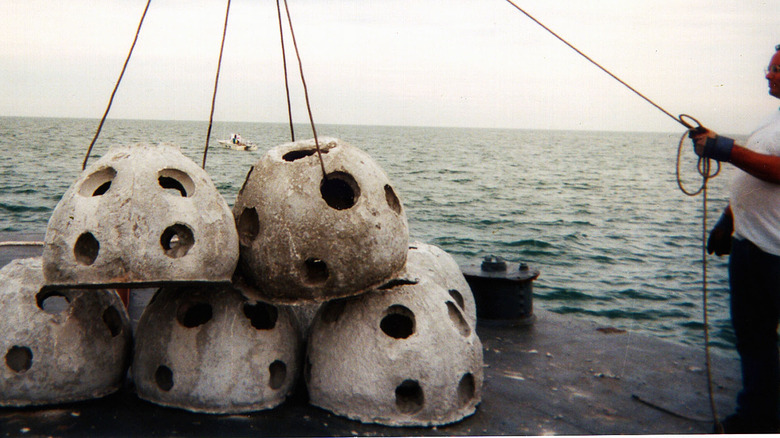
While we're on the topic of death, have you ever considered becoming a coral reef? Not while you're alive, of course. We're not talking about "aquamation," i.e., dissolving your body in a tank of water via alkaline hydrolysis. This is legal in 28 states, and was first adopted in Minnesota back in 2003. We also don't mean having your corpse deposited into a coral reef. This kind of sea burial is also legal, provided you go three nautical miles from land and dump in water at least 600 feet deep (barring exceptions along the gulf). We also don't mean having your cremated ashes scattered on the waves. We do, however, mean having your cremated ashes sculpted into a ball upon which future coral will perch. Your ashes mixed with concrete, that is.
But let's back up. This somewhat out-there idea comes from Florida-based company Eternal Reefs. This company is basically conservationist in nature and seeks to combine coral reef preservation with memorialization of the dead. Instead of a loved one simply deteriorating in a box, they can take part in the renewal of life. To do so, Eternal Reefs makes what are called reef balls, smallish underwater domes pocketed with holes and suitable for marine life to inhabit or grow on. Eternal Reef's textured concrete is designed not to damage the ecosystem, be inviting to microorganisms, and yes, mix with human ashes.
So far, Eternal Reefs has largely appealed to people with connections to the ocean, like fishermen and sailors. There's a variety of reef balls to choose from, of varying prices, and come with coordinate data in case you want to pay a visit.
Get incinerated on a giant pyre in Colorado
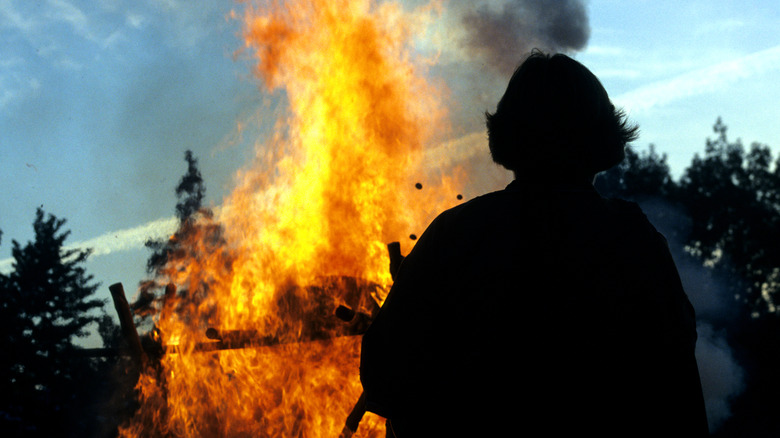
Visitors to the Indian city of Varanasi will likely be soul-struck at the sight of pyre after pyre burning along the edge of the Ganges River. The holy city is essentially a 24-hour open-air cremation site where bodies are burned minute after minute along the city's 88 ghats (riverside cremation sites), with all ashes tossed onto the river. As harrowing as this might sound, open-air cremation isn't exactly a new thing. Ancient Romans burned their bodies outside of the city, as did the pre-Christian peoples in Scandinavia, folks in Ireland, Poland, and other Hindu countries besides India. So then, how does Colorado sound as place to renew this very ancient tradition? In Crestone, that is.
That's right: tiny Crestone, Colorado (population: 140) is the one place in the entire United States where you have your body incinerated right under the open sky. No crematory, no furnace reaching temperatures of about 1,800 degrees Fahrenheit, no mechanical crushing of any final bones or components into dust, just a body wrapped in a sheet and covered in branches, foliage, and other things that burn with it.
This open-air cremation comes via the Crestone End of Life Project, a spiritually-driven non-profit established in 2022 that "returns the body to its original fire and air elements." There's a central pyre, an adjacent altar, a connected Natural Burial Ground where people can be buried in shrouds without caskets, and more than a heaping handful of Native American iconography. The only sad downside to the whole, ritualistic, admittedly very reverent-seeming operation is that the Crestone End of Life Project is only available to residents of the greater Saguache County.
Buried amongst the stars
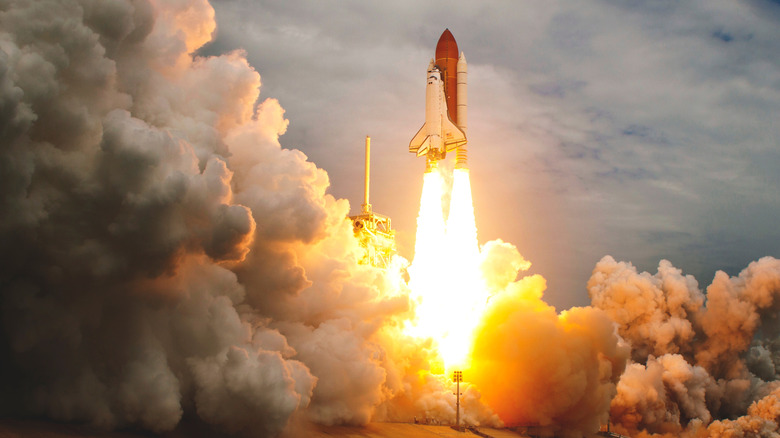
In 1992, the ashes of "Star Trek" creator and "The Great Bird of the Galaxy," Gene Roddenberry, were shot into space on a Columbia shuttle mission. His ashes stayed in orbit for a few days before descending to Earth. Another portion of his ashes were shot in space in 1997 on Celestis Founder Flight 1, along with a handful of other individuals of various walks of life. That time, his ashes stayed in orbit for five years. That company, Celestis, is still in operation and offers "space funerals," as they call them. And while notable public figures like Roddenberry opted for this route, as did "Star Trek" alums James Doohan, Nichelle Nichols, and Roddenberry's wife, Majel Barrett-Roddenberry, anybody can sign up — provided they can pay.
Celestis offers four different types of space funerals, with each one getting further from Earth. Their Earth Rise Service sends shuttles skirting the upper atmosphere and hanging in orbit for either minutes or hours, depending on launch conditions. Earth Orbit Service shuttles stay in orbit for months or years and eventually careen back to Earth and incinerate on reentry, like Earth Rise shuttles. Celestis' Luna Service sends remains to the moon, while its Voyager Service — like the Voyager space missions — sends remains out of our solar system. In all cases, you can not only shoot your ashes into space, but samples of your DNA — you know, so the aliens can clone you.
Although Celestis is based in Texas, it launches from various sites in California, Florida, and New Mexico. They've also operated internationally out of the Marshall Islands and Canary Islands.