

9 Banger Rock Songs Made Famous By TV Series
For those who've seen 1985's "The Breakfast Club," try to imagine its final, iconic scene without Simple Minds' "Don't You (Forget About Me)" playing in the background. John Bender walks across a football field, raises his fist into the air, the shot freeze-frames, and ... what? Everything is silent, and the credits roll? That final shot and that song go so hand-in-hand that it's impossible to imagine them without each other, the same as lots of other famous films and songs. With that said, lots of TV shows also elevated certain songs to legendary statuses.
Who, for instance, could think of the opening to "CSI: Miami" without The Who's 1971 "Won't Get Fooled Again" (and a slew of glorious David Caruso sunglasses memes)? What about Massive Attack's superb and moving — if sadly overplayed at this point — "Teardrop" played during the opening of "House"? Heck, is it even remotely conceivable to imagine the still-running "Cops" without "Bad Boys"? Absolutely not. "Won't Get Fooled Again" is full-on classic rock but was popular long before CSI: Miami came around. The latter two songs were made famous, in large part, because of the shows that featured them. But, they aren't rock.
Other rock songs, however, came to fame and acclaim through TV shows. In a case like "I'll Be There for You" on "Friends," the song was made just for the show. In the case of "Woke Up This Morning" on "The Sopranos," it was a lucky find and fit. And in at least one case, a song was made more popular than it had ever been thanks to the show that featured it.
I'll Be There For You
It's not possible to think about the sitcom "Friends" without thinking about The Rembrandts' 1995 theme song, "I'll Be There for You." It's not even possible to watch the music video for the song without seeing Rachel and Monica swap sunglasses, Chandler and Joey agree that, yeah, it's cool to dance together, and eventually see the whole cast take over the band's instruments. Like the song or not, like "Friends" or not, or find yourself tormented by its incessant use like David Schwimmer, we can all agree: "Friends" made "I'll Be There for You" popular, no matter the musical value of the song itself.
As it turns out, it's no mistake that the cast of "Friends" showed up in the video for "I'll Be There for You," as the song and its "clap-clap-clap-clap-clap" bit (we agree with Courtney Cox that it's five claps) were written specifically for the series. More than that, it was so successfully composed, and "Friends" was such a smash hit, that "I'll Be There for You" resuscitated the very practice of using songs to open TV shows at a time when some execs wanted to can them. "I think it's an antiquated practice," then-ABC Entertainment president Ted Harbert said in 1994, the year "Friends" started airing (per Variety). "It gives the audience an opportunity to take the little remote and zap around. We really have to find ways to stop them from doing that." Joke's on you, Ted.
The Rembrandts' Michael Skloff wound up modelling the song after the Beatles' 1966 "Paperback Writer." His songwriting, plus Allee Willis' lyrics (especially the "Your job's a joke, you're broke, your love life's D.O.A." line) and "Friends" itself, made the song an instant hit.
Where Everybody Knows Your Name
We've got to dig into the vaults a bit for this one, but really: Could a theme song better fit a show than "Where Everybody Knows Your Name" did "Cheers"? The whole track (which largely consists of its chorus) is about Frasier, Norm, Cliff, Diane, and company congregating at Cheers, the pub, in Boston and coming together in some kind of community where everyone — wait for it — knows your name. And like "I'll Be There for You," "Where Everybody Knows Your Name" was written specifically for its show.
The creative behind "Cheers" hunted down "Where Everybody Knows Your Name" songwriters Gary Portnoy and Judy Hart-Angelo ahead of the show's release in 1982. The duo had caught the production team's attention because of their work on the musical "Preppies," particularly its song, "People Like Us." According to Portnoy via his website, their mission was to basically repackage "People Like Us" with different lyrics and make them "relate to a bunch of likeable losers" who hung out in a Boston bar. Like those likeable losers, the songwriting duo didn't think they were up to the task. That is, until the song came together in a flash one day when Portnoy was messing around at the piano. Not only did "Where Everybody Knows Your Name" perfectly sum up "Cheers," but it also became a beloved song in its own right. It keeps popping up on best theme song lists (including this one) to this day.
Woke Up This Morning
When Tony Soprano rolls down the New Jersey Turnpike on the way toward his job in "waste management," you know the song that's playing: "Woke Up This Morning," with its pulsing bassline and absolute, funky groove. For fans of "The Sopranos," nothing could so exquisitely capture the feeling of settling into an episode's mayhem. And for those "fans" who even skipped the song or thought it didn't fit? For shame! Even those who've never seen "The Sopranos" can sense the song's semi-demented, man-about-town swagger, especially given its opening line, "Woke up this mornin' / Got yourself a gun."
It's strange to think that 1997's "Woke Up This Morning" went nowhere before "The Sopranos," no matter how cool the song is. Even more strangely and improbably, the track is the byproduct of Welsh/Scottish London-based music group Alabama 3, with members that dress like cowboys decked in white. "The Sopranos" creator, David Chase, heard the song on rotation and tracked down the group, thinking it was comprised of "three Black kids from Brooklyn," as Rob Spragg, aka Larry Love, told The New Cue. The band members had no idea what they were in for and were stunned when they started getting phone calls from the U.S. and seeing James Gandolfini on billboards.
Even more strangely and improbably than before, Alabama 3 got a bad deal for "The Sopranos" because no one thought the show would take off when it aired in 1999. The trio got $500 for "Woke Up This Morning," a sum that would have left them kicking themselves for eternity if the song hadn't gotten licensed again and eventually rerecorded for 2021's "The Sopranos" prequel, "The Many Saints of Newark."
Running Up That Hill
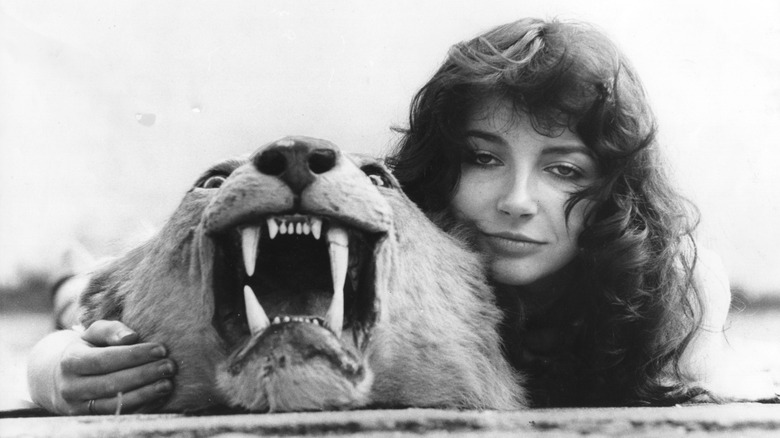
Yes, fans of Kate Bush will rightfully point out that she existed long before a new generation discovered her via Season 4 of "Stranger Things," the same as Metallica and "Master of Puppets." But because Metallica is metal, we're going to focus on Bush (not the band) for this choice. Kate Bush is art rock, pop rock, art pop — whatever the genre — enough for "Running Up That Hill (A Deal with God)" to be considered a "rock song" despite the lack of dudes with long hair strumming or shredding guitars.
Also yes, "Running Up That Hill" was a big song long before "Stranger Things." But, it received an absurdly enormous boost in popularity because of the show, more than "Master of Puppets" pushing past 1 billion listens because of character Eddie Munson shredding on a trailer in the Upside Down. When character Max Mayfield escaped from evil "Dungeons & Dragons" villain Vecna thanks to the power of Bush and friendship, "Running Up That Hill" went from about 102 million listens on Spotify to an absolutely unbelievable 1.5 billion current listens.
Because of this overwhelming surge in popularity, the now 67-year-old Kate Bush, who originally released "Running Up That Hill" on 1985's "Hounds of Love," made about £2.37 million as of August 2022. Bush was over the moon about the whole thing, calling it "extraordinary," "so exciting," and "quite shocking" on the BBC, saying that she'd been a fan of "Stranger Things" from the 1st season. "Running Up That Hill" even reached No. 2 in the U.K. and No. 8 in the U.S., higher than it ever was before.
Chasing Cars
What season of "Grey's Anatomy" are we on? 72? We're not even going to try and remember the myriad of spaghetti-stringed stories interweaving excessively — soap opera-like and soppingly sentimental— throughout the show's entire length. But you know what we will remember besides Dr. Grey's tequila obsession? That song. You know, the one with the two-note riff and the lines, "If I lay here / If I just lay here / Would you lie with me and just forget the world"? Yep, that's "Chasing Cars" by Snow Patrol, a song name and band name that you might have never heard even if you know "Chasing Cars" by sound.
We might actually have multiple shows to thank for elevating "Chasing Cars" to monumental, mega-hit status. The song was used in the 2nd season finale of "Grey's Anatomy" in 2006 and also the 3rd season finale of "One Tree Hill" that same year, mere weeks apart. "Chasing Cars" is so nebulous and generic in sound and meaning that it not only suited both shows but also any and all love stories and also loads of funerals.
Since 2006, "Chasing Cars" has been used in countless shows and movies, including other hospital-based shows like "House" and "ER." It's also been covered a quadrillion times, even by stars like Ed Sheeran, and sits at 1.67 billion listens on Spotify. That's pretty good for a song that singer Gary Lightbody wrote about something his father once told him. When Lightbody was interested in a girl, his dad told him that he was like a dog chasing a car. When he caught it, he wouldn't know what to do with it.
I Don't Want to Wait
Paula Cole's rock-enough soft rock song, "I Don't Want to Wait," is all but inseparable from the opening credits of the teen drama "Dawson's Creek" (1998 to 2003). Released as the second single off her 1996 album, "This Fire," the song was a big success. It followed on the heels of "Where Have All the Cowboys Gone?," and it was granted eternal life thanks to becoming the theme song for "Dawson's Creek." It was a matter of right place, right time, and, of course, right song. Cole even won a controversial Grammy for the number, beating out artists deemed more worthy.
Before long, no one could get away from "I Don't Want to Wait," Cole included. She described hearing it and its "Do do do do do do" as "a form of torture," per HuffPost. She was barely 30 years old at the time, "This Fire" was her second album, and "I Don't Want to Wait" was the album's final song and also the final one that she wrote for the album. Despite being a very personal portrait of family drama written mere months before her grandfather died, the song not only fit "Dawson's Creek," but it endures even to this day, decades later. (Even though Alanis Morissette's too-expensive "Hand In My Pocket" was the original, preferred theme song choice.)
"I Don't Want to Wait" endured so much that fans raged when Netflix aired "Dawson's Creek" in 2020 without Cole's song. The very next year Cole had rerecorded her famed track, and Netflix reintegrated that recording into the show's opening. But even by then, Cole had never watched a single episode of the show.
South Park Theme Song
"I'm goin' down to South Park / Gonna have myself a time," weirdo bassist extraordinaire Les Claypool sings during the opening of "South Park," followed by characters Stan and Kyle singing, "Friendly faces everywhere / Humble folks without temptation." It's simply not possible for fans of the now nearly 30-year-old Comedy Central show to not be able to recite this opening line and its slappy, funky bassline on cue. In retrospect, Claypool's one-of-a-kind playing, combined with Primus' off-kilter, semi-demented musical stylings, seems a no-brainer fit for "South Park." But that wasn't always the case.
In a recent 2025 YouTube interview with Rick Beato (i.e., friend of the entire music industry), Claypool described how "South Park" creators Trey Parker and Matt Stone approached him to write the theme song for their nascent animated show, which first aired way back in 1997. Back when Parker and Stone were physically cutting out paper figures for "South Park" and doing each animation by hand, the only music that they and their friend, Jason McHugh (co-creative on early Parker-Stone projects like "Cannibal! The Musical"), could agree on was Primus. At some point, something clicked, and the guys all realized, "Oh wow. What if we could get Primus to do this?," as Claypool tells Beato.
Claypool's original song for "South Park" actually sits at the end of the show and rolls during its credits. It's a little slower than the intro we all know and love, and Comedy Central thought it wasn't "peppy enough," per Ultimate Guitar. Claypool sped up the track, rerecorded the vocals, and the rest is animated and musical history.
Boss of Me
Remember when meth cook Heisenberg from "Breaking Bad" was just a simple, hapless dad, Hal, in "Malcolm in the Middle"? If you believe all the bizarre fan theories that take "Malcolm in the Middle" (2000 to 2006) to be a sequel to "Breaking Bad" (2008 to 2013), that is. In either case, the ska-adjacent, punkish theme song of "Malcolm in the Middle," "Boss of Me," works. Largely composed of the same line, "You're not the boss of me now" again and again, the song sounds precisely like what a kid might bark towards a parent. It looks like They Might Be Giants and their quirky musical stylings were an excellent choice to do the song, after all. "Boss of Me" even won a Grammy in 2002 for best song written for a motion picture, television, or other visual media.
But much like other songs in our list, there was no guarantee that "Boss of Me" would come to fruition as "Malcolm in the Middle's" theme song. Speaking to AV Club, one half of They Might Be Giants, John Flansburgh, described how Fox approached him and co-giant John Linnell to do a song for the pilot of a kid's show. Flansburgh had been noodling around with "Boss of Me" for a while as one of a bunch of "unfinished, half-baked ideas," but couldn't get it to work as a thorough, full-length song. As a TV theme song, though, it was perfect.
They Might Be Giants recorded a demo of "Boss of Me," and Fox loved it — especially its "boy energy," as Flansburgh told AV Club. At some point, the song's notable "Life is unfair" line came from "Malcolm in the Middle" creator Linwood Boomer, who used the phrase to summarize the show.
The History of Everything
Come on, '90s folks, sing it with us: "Chickity China, the Chinese chicken / You have a drumstick and your brain stops tickin'." Those who remember those most kooky of lyrics from the Barenaked Ladies' 1998 hit, "One Week," or who can take the song from there, we salute you. The band's prankster approach to songwriting might not seem like an obvious choice for a long-running sitcom featuring a bunch of nerds (mostly Sheldon), but the ladies were mischievous and odd enough to fit the bill. And indeed, their theme song, "The History of Everything," for "The Big Bang Theory" (2007 to 2019) definitely paid the band's bills.
"Big Bang Theory" showrunner Chuck Lorre also helped pay the band's bills when he saw the Barenaked Ladies live while developing "The Big Bang Theory." He'd been a fan of the group, and on the night of the show, the band happened to do an off-the-cuff rap about, well, the Big Bang and the origins of the cosmos. This bizarre bit of kismet happened about 2005. When Lorre contacted the band to do the theme song for his sitcom, singer Ed Robertson — the Chickity China guy — says he wrote "The Big Bang Theory's" theme song, "The History of Everything," in 15 minutes while showering.
That brief window of time didn't just resurrect the Barenaked Ladies' quadruple-platinum "One Week" fame, it surpassed it. "The History of Everything" was such a hit, and the payout to the band so huge, that Robertson says that his grandchildren's family are totally set for life. Not too shabby.