

5 Rock Songs From 1982 That Sound Even Cooler Today
In his 2019 song "LPs," indie legend Jeffrey Lewis recalls that back in the 1990s, you could pick up vinyl records for pennies, the now-trendy format then out of fashion thanks to the dawning of the CD era. The song contains the following observation when it came to picking up cheap records back then: "If the year was from the '60s, it was probably good bang for your buck ... If the year was from the 80s, it was guaranteed to totally suck" (via Genius).
But is Mr. Lewis' pithy writing-off of a whole decade's worth of musical output really true? Obviously not. Even purely in the world of rock — which, admittedly, saw its share of overblown sludge released in the 1980s — there is plenty that has overcome the passing years to sound fresh as a daisy in the mid-2020s.
The following tracks certainly reward modern listeners looking for an injection of early-'80s rock. Far from the hair metal and prog noodling that fails to hold up four decades down the line, these numbers — all of which were commercial and critical hits when they were first released — have justified their early acclaim, and are now considered classics that reward listening today.
The Clash – Should I Stay or Should I Go
It sounds strange to say that The Clash was a band that had reached a level of maturity in 1982. Having started out as one of punk's prominent trailblazers with the release of their debut album in 1977, it cemented its reputation as one of the movement's most ambitious outfits with the release in 1979 of "London Calling," an album that wove in a huge number of genres, growing the band's sound in all directions.
"Should I Stay or Should I Go" saw the band returning to its roots. It is a timeless punk tune that nevertheless goes beyond the genre's single-tempo, three-chord origins. Starting with a stomping rhythm built around a no-frills two-chord guitar part, the song, which employs equally simple lyrics to chronicle the potential end of a romantic relationship, builds in tempo towards a riotous finale that more than 50 years later remains an invitation to pogo on the dance floor with wild abandon. It's a simple, straightforward rocker in the style of The Trogg's "Wild Thing" and The Kinks' "You Really Got Me," which may go some way to explaining its timelessness.
Asia – Heat of the Moment
The commercial appeal of progressive rock may have taken a nosedive in the late 1970s as a result of the rise of punk, but that didn't mean the musicians in question were willing to go down with the prog ship in the early 1980s. Instead, some formed new groups that developed new ways to employ their virtuosic skills for chart success.
One of these was Asia, a supergroup made up of musicians from the respected prog rock outfits Yes, King Crimson, and Emerson, Lake & Palmer, along with Geoff Downes from the new wave duo The Buggles. Asia firmly established itself as an arena-filling live act in the early 1980s thanks to the success of radio-friendly tracks such as "Heat of the Moment," written by Downes and King Crimson's John Wetton.
The track, which peaked at No. 4 on the Billboard Hot 100 in June 1982 and stayed on the chart for 18 weeks, is a poppy number with an unashamedly stadium-rock chorus, which nevertheless makes full use of Asia's prog chops to offer a huge-sounding track made up of epic synth and guitar and a cacophonous rhythm section. It may not be as well-remembered as Survivor's "Eye of the Tiger" — which was also released in 1982 and became a chart phenomenon — but it deserves to be rated alongside such bombastic and party-pleasing early '80s classics.
John Mellencamp – Hurts So Good
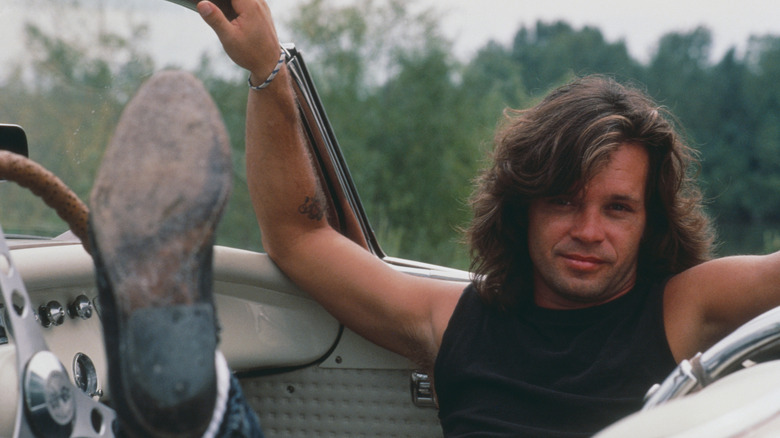
Still performing in the early 1980s under the name John Cougar, John Mellencamp's output during the period has proven to be the most durable of his career, helping him build an audience that has lasted right up until the present day. Having struggled in throughout the late 1970s to release work worthy of his potential, 1982's "American Fool" demonstrated that Mellencamp was finally at the height of his powers, with affecting songwriting accompanied by muscular instrumentation that still stands up alongside the work produced by his predecessors, such as Bob Dylan and Bruce Springsteen, who Mellencamp considers a brother.
The opening track, "Hurts So Good," was a No. 2 hit for Mellencamp in August 1982, spending 28 weeks on the chart. The song opens with an instantly recognizable drum beat which sounds utterly timeless. Its rhythm never lets up throughout its three-and-a-half-minute runtime, during which the listener is treated to battling guitars and keys that reflect Mellencamp's lyrical plea to embrace life in all its chaotic glory. It's fist-pumping stuff and can still send a chill up a modern rock fan's spine.
The follow-up single "Jack & Diane" was an even bigger hit for Mellencamp, climbing to the top of the Billboard Hot 100 later the same year, the only single Mellencamp has released to achieve that feat. However — and this, we concede, is debatable – "Hurts So Good" has emerged as the cooler to modern ears, thanks to Mellencamp's full-voiced but somewhat understated vocal and the effortlessness of that guitar part.
Eddie Money – Shakin'
Eddie Money may not be a recognizable name for younger music listeners, but the New York singer-songwriter and multi-instrumentalist had an enviable career in the 1970s and 1980s, when he rode the wave of album rock and also enjoyed a great deal of success in the singles charts, with 23 songs featuring on the Billboard Hot 100 over the course of his career.
Arguably the coolest of Money's hits, at least to modern ears, is 1982's "Shakin'," a track that undoubtedly boasts some of the biggest-sounding drums of the entire decade (the opening bars are irresistible enough by themselves). Featuring a smooth, yearning vocal from Money, spiky keys, wailing guitar, and, of course, outrageous drum fills, it's a big '80s tune to get your blood pumping.
The track shares many similarities with Daryl Hall & John Oates's "Maneater," another major hit released in 1982, most notably the repeated "whoa-whoa-oh-oh!" vocal refrains. However, Money's single has benefited by not attracting the same amount of radio play down the decades, and its relative unfamiliarity to the modern ear gives it an incredible freshness that proves early '80s production is still incredibly listenable.
The Psychedelic Furs – Love My Way
"Love My Way" by The Psychedelic Furs is one of those songs that sits perfectly at the intersection of many of the threads of pop music that were having a huge effect on the sound of the charts in 1982. To a modern ear, lead singer Richard Butler owes a great debt to David Bowie — however, nothing in Bowie's discography sounded remotely like The Psychedelic Furs at the time of the release of "Love My Way" — in fact, he would only land on a similar sound himself the following year with the release of "China Girl" from his "Let's Dance" album.
Such was the influence of The Psychedelic Furs, a British new wave band that hit its peak in the early 1980s and has continued to tour and record intermittently ever since. The band's music gained a huge boost in 1986 thanks to the inclusion of their song "Pretty in Pink" in the John Hughes movie of the same name, but "Love My Way" is the Furs song that has aged the best. Featuring a prominent, catchy marimba melody that sounds so quintessentially '80s that it has cultivated a new retro-cool aspect, "Love My Way" is a lush, infectious track that is danceable despite its restrained tempo.
It is considered one of the greatest queer anthems, a statement of allyship from Butler whose lyrics encourage the listener to embrace their sexuality without fear. Its use in the hit 2017 movie "Call Me By Your Name" has given the song, which charted internationally and broke into the Top 50 of the Billboard Hot 100 in the spring of 1983, a new audience, attracting hundreds of millions of streams in recent years.