

5 Songs From The '70s That Nail The Meaning Of Life
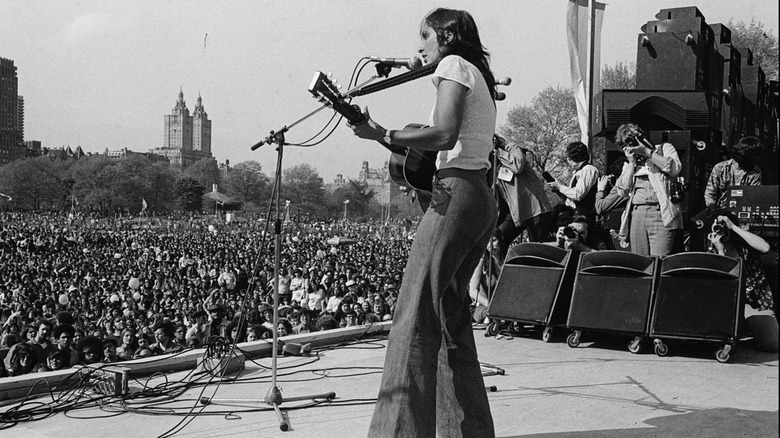
If any time in recent history represented a societal desire to analyze and reformulate life's fundamentals, it was the 1960s and '70s. Defined almost wholly by counterculture drives, Vietnam War protests, and the sweeping Civil Rights Movement and its aftermath, the '60s and '70s also produced some of the finest music of our time. The era's pressures and contrasts wrought immense artistic verve and creative vivacity in the form of classic rock, Motown and R&B, folk and country, bursts of musical waves like disco in the late '70s, and much more. Out of all this music, certain songs nail the meaning of life better than others.
But firstly, we've got to outline the goals. The "meaning of life" is such a grand, potentially overreaching topic that it's important to dig down to universal human experiences and sentiments while avoiding cheesy, overwrought clichés. This is true no matter how good the songwriting, which means we've got to omit songs like John Lennon's "Imagine." Proggy, highly architected tracks might also be very fulfilling to the musical ear but can easily devolve into abstract, detached rambles that miss the point when it comes to connecting to the wider human heart.
Speaking of that heart, we've also got to sidestep party-hardy music that's all about drinking, partying, and sex, even if some swear this is humanity's raison d'être. We're aiming higher, not just for the heart, but the soul, to tackle some serious subject matter. Whether talking about Carole King's "Child of Mine," Joann Baez's "Diamonds and Rust," or Bob Marley's "War," be prepared.
Carole King - Child of Mine
No matter that career advancement, material things, and "me time" have come to dominate the lives of so many people, none of us would be here without the care, energy, and sacrifice of our parents. Whether lovingly ideal or begrudgingly spare, the parent-child bond, specifically the mother-child bond, might just lie at the very heart of the generational chain that binds us all together and makes us human in the most universal way possible.
That's a grand statement but one that's rooted in the simplest, yet vastest, of moment-of-moment sentiments: love. It would take a poet of the deftest caliber to express such feelings in a manageable, communicable way. But thankfully, Carole King was more than up to the task when she wrote "Child of Mine" in 1970.
There's something unmentionable in "Child of Mine," so fragile and gentle, as though its sentiments will shatter if spoken. The song is achingly sweet, plaintive, and sounds very much like a lullaby sung to an infant. King wrote it for her first two daughters, Louise and Sherry, though no doubt the feelings extend to her later-born children, Molly and Levi. In fact, they extend to pretty much anyone who's a (good) parent, with lines like, "You don't need direction, you know which way to go / And I don't want to hold you back, I just want to watch you grow" and "The times you were born in may not have been the best / But you can make the times to come better than the rest." More than universality, though, King's song communicates the lessons, insight, and wisdom that come with being a parent, when you and your child learn hand-in-hand.
Bruce Springsteen - Born to Run
Like the next phase of life following birth and upbringing, Bruce Springsteen's 1975 "Born to Run" exquisitely captures the restless yearning that smolders in the souls of young people. Yearning for what? That's exactly the question. The desire to wring from life all it has; to dive headlong into its ocean, craggy shoals included; the fear that dreams will wilt before they're realized; the absolute sorrow underpinning each and every joy, knowing that those joys, too, will fade, but craving them anyway: All this and more lives in the lyrics and volcanic energy of "Born to Run." This is a true lightning-in-a-bottle musical poem that conveys a moment of life that's easily forgotten amidst the milieu of later, mid-life household bills, stuffy meetings, and pedantic adherence to prescriptive social norms.
Notice that we conveyed the feelings of "Born to Run" through a strand of high-level summaries hinging on vibrant words like "wring, "dive," and "wilt"? Springsteen does the same thing in "Born to Run," which expresses itself not through a direct description of feelings, but a series of vivid, lyrical vignettes, like, "The amusement park rises bold and stark / Kids are huddled on the beach in a mist" and "Just wrap your legs 'round these velvet rims / And strap your hands across my engine." These vignettes collectively convey the song's meaning.
This is singer-songwriter storytelling at its finest, and it came directly from Springsteen's life. He was in his 20s when he wrote the song, living in a very modest home, and couldn't get his career off the ground. Now he's one of the most successful rock 'n' roll artists of all time. That's also the story that "Born to Run" tells.
Joan Baez - Diamonds and Rust
With time comes resentment and the inevitable baggage of deteriorated relationships and hopes. Not to put a completely harsh spin on the story that we continued with "Born to Run," but who could live — truly live — if they managed to wholly avoid strained love, entangled circumstances, and lost magic? This is where 1975's "Diamonds and Rust" by folk singer supreme Joan Baez comes into play, an honest depiction of what it feels like to have something broken beyond your ability to control it or do anything but react and perhaps grow bitter. The opening lines alone convey the song's meaning, saying, "Well, I'll be damned / Here comes your ghost again," and it ends in, "You were so good with words / And at keeping things vague / 'Cause I need some of that vagueness now / It's all come back too clearly."
It's well known by now that Baez wrote this song specifically about Bob Dylan, with whom she was once in a relationship. As the story goes, Baez wasn't initially writing her song about Dylan but pivoted toward him when he called one day from a phone booth in the Midwest — same as she writes in "Diamonds and Rust." Every line of the song disassembles all the things about Dylan that upset her. But, those things also produced diamonds along with rust, i.e., the gems of art and the corrosion of love — the good and the bad, both.
Though Baez was writing a very personal song in the moment and recites a litany of things specific to her relationship with Dylan, her feelings are so understandable and well conveyed that she created something truly universal. For this particular chapter of life, "Diamonds and Rust" fits more closely than any other.
Bob Marley - War
The same year that Bob Marley was shot twice in an attempted assassination and then performed at Smile Jamaica, a peace-focused concert sponsored by Jamaica's People's National Party (PNP), he released 1976's "Rastaman Vibration" and its powerful, stand-out track, "War." Folks might not know it, but the song is actually a sung version of a 1963 speech given to the United Nations by later-deposed Ethiopian emperor Haile Selassie I, who ruled from 1930 to 1974. He was overthrown in a military coup by Marxist leader Mengistu Haile Mariam, who himself fled to Zimbabwe following the collapse of the Soviet Union in 1991. In between both falls from power, Marley died in 1981 of a rare type of cancer called acral lentiginous melanoma.
Is there a chain of power-driven, violent, sometimes absurd and tragic events that more fittingly portrays another unavoidable facet of life and human nature? When Marley put Selassie's speech to words on 1976's "War," he might not have had such high-concept things in mind. And yet, he sang a song that not only encapsulates its human rights-based topic, but also his specific moment in time and war, writ large. As he sang, "Until the colour of a man's skin / Is of no more significance than the colour of his eyes / Me say war."
"Me say war" isn't an exhortation to war but a cry of despair and a plea for peace. But war has continued, along with vicious mud slinging, foolish group-versus-group pettiness, and endless diatribes spewed by an equally endless stream of conniving talking heads across the globe. All such happenings occur despite the shared commonalities that "War" implies we all want: happiness, freedom, and a lack of suffering.
Kansas - Dust in the Wind
Last in chronology on our list, both as a '70s song and phase of life, rests 1977's "Dust in the Wind" off of Kansas' aptly named "Point of Know Return." No doubt many people who've come to the same conclusions as "Dust in the Wind," independently of the song or otherwise, have done their best to stow those conclusions out-of-mind while going about their daily business. Lines like, "Just a drop of water in an endless sea / All we do / Crumbles to the ground though we refuse to see" couldn't more accurately describe the meaning of life, especially on top of lines well suited to modernity, like, "And all your money won't another minute buy." All human wrath, ambition, and passion amounts to dust in the wind blown away in a handful of years. And when we consider that lines like, "Nothing lasts forever but the earth and sky" aren't even remotely true on a long-enough, galactic timescale, the song arguably hits home harder than any other on this list.
Plenty of people must feel similarly, as "Dust in the Wind" is Kansas' most popular track. It almost didn't see the light of day, though, because guitarist Kerry Livgren didn't think the band would want to record an acoustic-only song. However, his bandmates heard the potential, and the rest is history.
There's no need to take "Dust in the Wind" as a purely hopeless song, however. Life isn't simply about coming to terms with its brevity, but also coming to terms with its brevity while crafting meaning. For that, we just might have to repeat life's cycle and point the reader back to Carole King's song about love for a child and Bruce Springsteen's song about yearning to get the most from our time here. `