

The 12 Best Johnny Cash Collaborations Of All Time
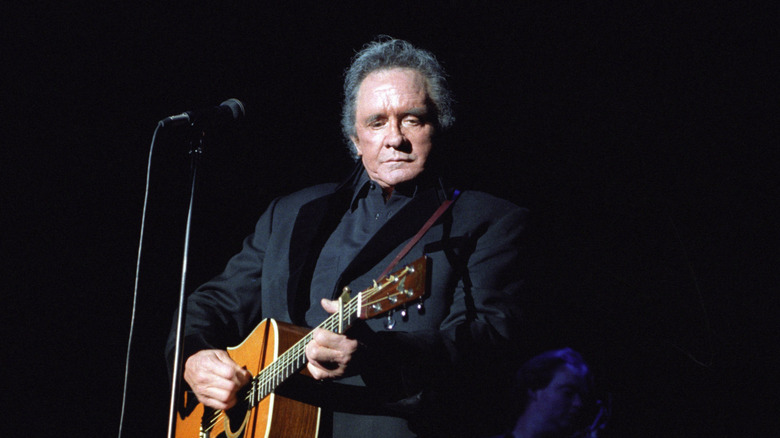
Johnny Cash was country music's original outlaw. When looking back on Cash's tragic, real-life story, his affinity for tortured souls and the downtrodden, particularly prison inmates, was at the heart of such hits as "Ring of Fire," "I Walk the Line," and "Folsom Prison Blues." Yet beyond those favorites, Cash also joined forces with some of the biggest stars in music — and not just from within the country genre.
In fact, Cash's musical collaborations reflect the immense respect he earned from his peers, and among those who recorded with him were rock icons such as music legend Bob Dylan, Tom Petty and the Heartbreakers, Joe Strummer of The Clash, and many others. As the years passed, Cash evolved from an angry young rebel to country music's elder statesman, while fans looked beyond the dark side of Cash that everyone likes to ignore, and he remained a creative force to be reckoned with. That was evident in his final act, when he partnered with producer Rick Rubin for his extraordinary series of "American Recordings."
When he died at 71 in 2003, and fans grew to understand what the final 12 months of Cash's life had been like, he'd left behind a rich and unparalleled musical legacy, including his numerous collaborations with other artists. These are the best of those team-ups, in terms of their prominence and the sheer quality of the music.
Jackson — June Carter Cash
The love story of Johnny Cash and his longtime wife, June Carter Cash, began backstage at the Grand Ole Opry in 1956. Their attraction was as immediate as it was complicated, given that both were married to others, while Cash's addiction issues added a further level of difficulty. The truth about Cash and Carter's relationship, however, was that their love really caught fire when they began touring together.
The two were already in the midst of untangling themselves from their respective marriages when they recorded "Jackson" in 1967. The call-and-response duet told the story of a couple who'd gotten "married in a fever, hotter than a pepper sprout," with Cash excitedly preparing to go "mess around" in the titular town while Carter warns him that he'll "wreck your health."
Not only did the song become symbolic of the couple's epic love story, it gained mythic status when, after a 1968 performance of "Jackson" in Canada, Cash popped the question onstage. "He proposed to me in front of about 7,000 people in London, Ontario ... he just stopped the whole show," she recalled in a 1996 TV interview. Admitting she was taken aback, reluctant to answer in such a public setting, Cash would not be refused. "And he said, 'No, I'm not moving. You have to give me an answer right now, you have to tell me right now.' So I said yes and I told him I would," she said.
Girl from the North Country — Bob Dylan
When Bob Dylan emerged from the Greenwich Village folk scene, Johnny Cash quickly became a fan, even recording a 1965 cover of Dylan's "It Ain't Me, Babe." To say their admiration was mutual is an understatement. "Johnny Cash was more like a religious figure to me," said Dylan in the documentary "No Direction Home: Bob Dylan." "Meeting him was a high thrill of a lifetime, and just the fact that he had sung one of my songs was just, was unthinkable."
The two forged a friendship that resulted in a duet on Dylan's 1969 "Nashville Skyline" album, a countrified take on Dylan's "Girl From the North Country," which had first appeared on 1963's "The Freewheelin' Bob Dylan." Cash's booming baritone contrasts with Dylan's honey-toned voice, which, on that one album, sounds unlike it ever did before or would again. It also marked the only time Cash and Dylan would record together (another duet they'd recorded during that session, "Wanted Man," wasn't released until 2019, in Dylan's "Travelin' Thru, 1967 — 1969: The Bootleg Series Vol. 15").
Shortly after the release of "Nashville Skyline," Dylan joined Cash in the inaugural episode of his new TV variety show, "The Johnny Cash Show." "It goes without saying that Cash fans are as baffled by Dylan's emergence here as Dylan freaks were startled at the news of this new axis," reported Rolling Stone at the time.
Redemption Song — Joe Strummer
While Johnny Cash worked with producer Rick Rubin on "American IV: The Man Comes Around," The Clash's Joe Strummer was a frequent presence in the studio. In awe of Cash, Strummer had been hanging around to watch his idol at work. "When we were recording 'The Man Comes Around,' Joe was coming every day, because he loved Johnny Cash, and he just happened to be in L.A. on vacation," Rubin explained in an interview with Billboard. "And he actually extended his trip a week longer just to come every day and be around Johnny."
That ultimately led Strummer to join Cash on a haunting cover of Bob Marley's "Redemption Song," with the two men trading verses as Rage Against the Machine axeman Tom Morello accompanied them on acoustic guitar. In addition to the duet, there are also versions of the track featuring separate performances of Strummer and Cash.
"Originally, the song was supposed to be a duet, and we recorded it as a duet," Rubin explained. "But, just in case, both Johnny and Joe sang the whole song several times." Reportedly (via Thunderstruck), Rubin suggested that Cash change a lyric that wasn't grammatically correct, but Cash balked, insistent that altering one word of a Marley song would be akin to sacrilege. Not long after cutting that record, Strummer died at age 50 in December 2022, among the tragic details about The Clash.
The Wanderer — U2
When U2 released its 1993 "Zooropa" album, a surprise awaited listeners when the album's final track, "The Wanderer," didn't feature the vocals of frontman Bono, but the unmistakable boom of Johnny Cash. In the track, backed by electronic drums and synthesizer, Cash's voice takes on an apocalyptic voice-of-doom quality as he sings about how he "went out walking with a bible and a gun."
The song is a genre-bending masterpiece, yet when Bono had prepared to record the song he'd written — inspired by the biblical book of Ecclesiastes — he wasn't sure how to approach it. "And out of the blue he said, 'Hey, y'know, I think Johnny Cash is in town, maybe we could get him to come and sing on this ...'" U2 guitarist The Edge recalled in an interview with Hot Press (via U2.com).
While attempting to contact Cash, Bono laid down guide vocals, doing his best Cash impersonation. However, producer Brian Eno felt Bono had delivered a home run and insisted they didn't need Cash. "So anyway, almost against Brian's advice, we had Johnny come down and he sang on the song and it was unbelievable the way it came to life. It got a bit surreal," said The Edge. "Everyone completely got into the spirit of what he was doing ... There was a little element of giddiness in the room. After he left and we'd said our goodbyes, everyone just looked at each other and went, 'What just happened?!'"
Why Me, Lord? — Ray Charles
Johnny Cash appeared on Charles' 1984 album "Friendship" for a duet on "Crazy Old Soldier." Cash takes the first verse, Charles the next, until this slow-build ballad reaches its peak as two of the most familiar voices in 20th-century music blend majestically, while a steel guitar drones beneath them. It wasn't until years later, however, that a second song they'd recorded together during that 1981 session emerged, released years later and after both men had died. That track was a cover of Kris Kristofferson's "Why Me, Lord?" Why it wasn't released sooner remains a mystery, but it finally saw the light of day in "Rare Genius," a 2010 Charles compilation.
Compared to "Why Me, Lord?" their recording of "Crazy Old Soldier" seems downright tame. Considering the life challenges the two men had faced, they embraced the gospel-steeped refrain of "Lord help me, Jesus, I've wasted it" with the fervor of those who'd been through the darkness and made it through to the other side. Driven by Charles' electric piano, he adds soulful funk to the gospel song, ultimately creating a satisfying duet that does both legends proud.
The Running Kind — Tom Petty and the Heartbreakers
Tom Petty and the Heartbreakers backed up Johnny Cash for "American II: Unchained," his second album to be produced by Rick Rubin. While the album itself is chock full of gems, the box set "Unearthed" — a five-disc collection of outtakes, covers, and other tracks from his "American Recordings" sessions — produced a far more satisfying collaboration between Cash and Petty: a raucous cover of Merle Haggard's "The Running Kind." Boasting a laconic country jangle, the song features Petty providing harmonies to Cash's lead vocals.
As Petty recalled in a 2000 interview with Oxford American, serving as Cash's band was a high point for him and the Heartbreakers. "I loved doing that record with him," Petty said. "I think it was our best ever — I mean, I think that's the best we've ever played." Cash further honored Petty when he recorded his anthemic "I Won't Back Down" for "American III: Solitary Man." Interviewed by NPR's "Fresh Air" in 2006, Petty explained that he continued to be proud of himself for having written the song. "And I was very, very proud when Johnny Cash did it," he declared.
Highwayman — The Highwaymen
Rock music has had its fair share of supergroups over the years, but the country genre didn't get its supergroup until 1985, when Johnny Cash joined forces with Willie Nelson, Waylon Jennings, and Kris Kristofferson to form The Highwaymen. The group's signature song was "Highwayman," originally written by Jimmy Webb and released on his 1977 album, "El Mirage."
In listening to the song, it's clear that this quartet was more than just the sum of its impressive parts, but also four friends who genuinely enjoyed each other's company. That sense of camaraderie can be heard throughout as each carried a verse before the four country icons blended their distinctive voices together in all their ragged glory. It was clear how much they all admired each other when the four men sat down for a New Zealand television interview, with each asked to single out what they felt to be the best country song ever written. Kristofferson gave that honor to "Big River," which flattered its composer immensely. "Well, I'm overwhelmed, 'cause I wrote that song," said Cash humbly.
Ghost Riders in the Sky — Willie Nelson
A cover of the haunting country classic "(Ghost) Riders in the Sky," recorded during a 1990 performance by The Highwaymen at Long Island's Nassau Coliseum, technically involves all four of the singers in the supergroup. However, the song is essentially a collaboration between Johnny Cash and Willie Nelson, with the latter's reedy vocals contrasting dramatically with Johnny's booming baritone as they trade verses.
In watching the men together, tackling that country music chestnut, it's clear that they are having a ball performing together. In fact, that duet was reflective of their long friendship, which Nelson described when interviewed for NPR's "Fresh Air." "So John and I have always been friends, and whenever — you know, he'd call me up several times when he was having a bad day just to hear a joke," Nelson recalled. "So I'd tell him my latest dirty joke, and I tried to make it as dirty as possible so he would laugh louder."
There Ain't No Good Chain Gang — Waylon Jennings
A single from Johnny Cash's 1978 "I Would Like to See You Again" album, "There Ain't No Good Chain Gang" features Cash collaborating with old pal Waylon Jennings, several years before they'd work together in The Highwaymen. The album was something of a comeback for Cash, boasting a stripped-down sound that referenced his early material, and received favorable reviews from the media after its release.
The song — told from the regretful point of view of a prison inmate — finds the two former outlaws having mellowed, sharing the wisdom they'd acquired in verses such as "you don't go writing hot checks down in Mississippi," and "I ain't cut out to be no Jesse James." Meanwhile, their close friendship — they'd even been roommates at one point — comes barrelling through in the performance, a genuine reflection of how much they enjoyed performing together.
By then, the wild days were in the past for both of them. They'd both been lucky enough to survive the excesses of their respective pasts, which rest at the heart of "There Ain't No Good Chain Gang" and its theme of recalling past misdeeds. "Me and Johnny Cash made the rock and rollers look like sharecroppers and choirboys," Jennings said in an interview.
The Long Black Veil — Joni Mitchell
Following its premiere episode in 1969, "The Johnny Cash Show" ran for just 58 episodes, yet in hindsight can be seen as one of the most culturally influential variety shows ever aired on television. Among Cash's guests was Joni Mitchell, who enjoyed her experience on the show so much that she appeared in three episodes. During her first appearance — in the series' debut — she joined Cash for a duet on Lefty Frizzell's "Long Black Veil."
A dark tale of a mysterious woman visiting her lover's grave, the narrator in "Long Black Veil" reveals he was executed after being found guilty of a murder he didn't commit, due to his refusal to admit that at the time of the homicide, he'd been "in the arms of my best friend's wife."
Performing with Cash, Mitchell's soaring harmonies take the song to a whole new level of transcendence. According to the show's musical director, Bill Walker, Mitchell instantly melded with Cash when they tackled the country classic. "Joni Mitchell didn't need much help; she was a pretty capable musician," Walker told Ultimate Classic Rock. "Joni was real professional and she was sweet and she was really nice to work with."
Get Rhythm — Stevie Wonder
Beyond rock and folk acts, Johnny Cash's network TV show welcomed guests from a variety of genres, including Stevie Wonder, who lent a hefty slice of funky soul to "Get Rhythm" when he joined Cash on his country-stomp classic. It's a fascinating version of the song, with Cash kicking things off with a traditional take before throwing it to Wonder after the first verse, who responds with a blistering piano solo, punctuated by a horn section. The pattern repeats, transforming the song into a showcase for Wonder's extraordinary musicianship on multiple instruments as he switches to organ, then harmonica, and then finally unleashes a drum solo.
In his later years, Cash remained a fan, and had wanted to record one of Wonder's songs while recording with Rick Rubin. Sadly, Cash died before that was able to happen. "One song I really was excited about Johnny singing that we never got to record was Stevie Wonder's 'Place in the Sun,'" Rubin told Rolling Stone. "I imagined it as a sad, slow yearning piece. More wanting than Stevie's hopeful rendition."
I'm So Lonesome I Could Cry — Nick Cave
Hank Williams' "I'm So Lonesome I Could Cry" is a country classic that has been recorded by numerous artists. Johnny Cash recorded the song for his Rick Rubin-produced "American IV: The Man Comes Around" album, as a duet with Nick Cave, delivering a spare and haunting take on "I'm So Lonesome I Could Cry."
Remembering how the recording came together when he appeared on "The Late Show with Stephen Colbert," Cave recalled that Cash, nearing the end of his life, had numerous health issues, including glaucoma that had diminished his eyesight. "When I saw him, he was sort of a terrifying apparition of a man, so different than the man I thought him to be," Cave said. "He was essentially blind, walking down these stairs towards me with his hands out ... going, 'Are you there, Nick? Are you there?' And I'm looking at him, thinking, 'How is this man going to perform?'" Cash told Cave that a recent bout of laryngitis had left him without his voice, but revealed he'd fervently prayed for his voice to be restored in time for their session. "And then he goes, 'I woke up this morning, and I'm singing like a bird,'" Cave added.
When they prepared to begin, Cave witnessed a stunning metamorphosis as Cash mustered his strength. "And then he sat down, this depleted man, and just transformed ... from this sort of suffering individual into something really extraordinary," Cave remembered.