

'70s Songs That Nail What It Means To Be Young And Free
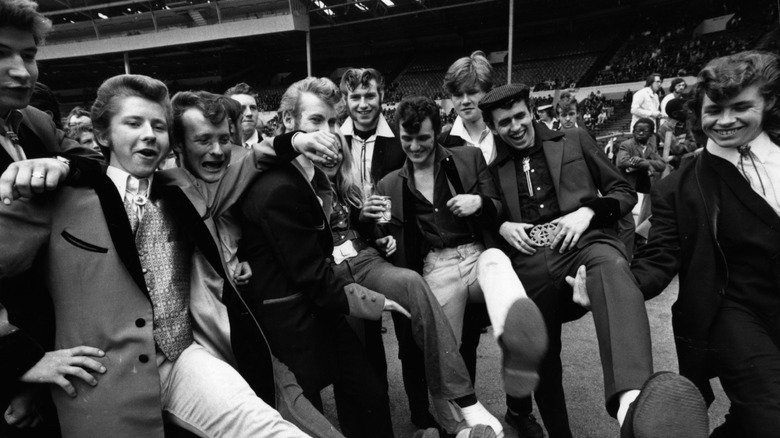
Music is an important part of growing up. You find your own music, separate from whatever your parents listen to, and you make friends based around shared tastes. For most people, it's an early exercise in identity formation: this is what I think is cool, so this is the kind of person I am. The music of the 1970s, with the emergence of punk and disco and the maturation of rock, offered that era's young people a wide range of tunes and selves to try on, and the best music of that wild decade continues to earn fans (and royalties) to this day.
This list brings together five of the songs of the '70s that most capture the feeling of being young, right on the edge of adulthood. They all pass the sing-along test: even if you can't quite make out the words, you can "ba ba ba-ba" along to them because they're that catchy. There's nothing obscure or sad here either; just good, honest jams that have stood the test of time.
Dancing Queen — Abba
The Scandinavian pop quartet ABBA absolutely ruled the European charts in the mid-to-late '70s, with success also spreading to North America and Australia. While many of their songs have become lodged in the American subconscious due to their niche of "cool enough for bars, gentle enough for elevators," they only had one song hit No. 1 in the States, but that song was "Dancing Queen." If lyrics describing a 17-year-old as a "teaser" haven't aged enormously well, the rest of the song has, a timeless ode to youth, dancing, and placing oneself at the center of attention.
In later statements, the members of ABBA would say they knew "Dancing Queen" would be a hit, especially once it was shorn of its original title, "Boogaloo." Since the band had shot into fame with the Eurovision-winning single "Waterloo," a change was probably best, though we can only mourn that the band, despite its Australian fanbase, never got around to writing a song called "Kangaroo."
Don't Stop Me Now — Queen
Any number of Queen songs might fit this list. Queen songs are optimized for singing (yelling) along to in the car with your friends, and in some cultures, you haven't reached adulthood until you've stripped your vocal cords to "Bohemian Rhapsody." But for that special almost-adult age, that last-summer-before-college energy, there's nothing like "Don't Stop Me Now." The lyrics never let up on their excitement and what the night and the future might hold: supersonic, shootin' star, burning through the sky, rocket ship, sex machine. And even if backseat singers can't really match the astronomical pipes of the late, great Freddie Mercury, showcased here as they are in every Queen recording, even the most limited of singers can carry most of the tune.
The song was, apparently, inspired by Mercury's own love of the good times. In the late '70s, Queen was only getting bigger, and so was the lead singer's appetite for rock-star-style living. While his bandmates initially hesitated to embrace the song — Brian May worried it was too hedonistic, and Roger Taylor thought it was just middling — both have come around to embrace the tune's fun-loving legacy, as well as the memorial to Mercury's brief, big life it's become.
Ça Plane Pour Moi - Plastic Bertrand
One of the best things about youth is that you don't really have to make sense yet. Running around, experimenting, seeing who you are, and testing which parts of the grey adult mortgage-and-insurance world you really have to follow are part of the process of growing up, and the sort-of-French, sort-of-gibberish energy of Plastic Bertrand's "Ça Plane Pour Moi" rode that vibe up the charts. The lyrics, mostly in French but not making much more sense when you know that, are secondary to the frenetic energy of Bertrand's delivery. The song is sort of punk, sort of New Wave, but very, very much itself, and this idiosyncratic wackiness made it a hit.
If "Ça Plane Pour Moi" reminds you of something but you can't quite think what, it's because it has a secret twin. The same backing track underpins Elton Motello's "Jet Boy, Jet Girl," which had the same producer as "Ça Plane Pour Moi." The Motello song, lyrically grimmer with its description of sexual abuse and violent jealousy, is nonetheless as much a classic as its less complicated sibling tune.
Sheena Is a Punk Rocker — The Ramones
Like any genre, punk means different things to different people, and for the Ramones, an important part of punk was sounding (and having) fun, and this joie de vivre is plain in the catchiness and poppiness of their most famous songs, especially "Sheena is a Punk Rocker." You can hear the early '60s in the rhythm and in Joey Ramone's delivery of the lyrics. "Sheena" is rougher and edgier than you'd have heard 15 years before the song's 1977 release, but the bones of early rock 'n' roll and Motown aren't far below the surface. There aren't many lyrics, but they talk about breaking away from home and heading for New York: not everyone does this, of course, but almost everyone thinks about it, and the fantasy is important for a lot of kids who feel stuck in unremarkable little towns.
"Sheena" is a reference to the comic book heroine Sheena, Queen of the Jungle, a female Tarzan equivalent who existed at least partly as an excuse to draw a shapely woman in skimpy equatorial garb. Her friends were a monkey and a witch, and in a reversal of the usual roles of the heyday of comics, she usually had to rescue her boyfriend — so yeah, it's easy to imagine Sheena would have loved punk.
Teenage Kicks — The Undertones
Crushes are a huge part of youth; gathering the nerve to do something about a crush is an important step in growing up. The Undertones' "Teenage Kicks" perfectly nails how it feels to be hormonal, but sweet. It's about liking a girl, seeing her, thinking about her, and almost ... almost ... almost being ready to talk to her. These lyrics play out over music that has all the simple, lo-fi charm of early punk: yeah, maybe you could have written this song in three hours noodling over a guitar, but you didn't, these Northern Irish kids did.
"Teenage Kicks" so blew away BBC Radio 1 DJ John Peel that he played it twice in a row when he first heard it (an unheard-of endorsement) and had the lyrics "Teenage dreams so hard to beat" inscribed on his tombstone. (He died at 65, no teenager but still very much under the Undertones' spell.) Peel is far from the immortal little tune's only die-hard fan, with the song having been covered by obvious heirs Green Day, the novelty act the Ukulele Orchestra of Great Britain, and dozens of artists in between.