

5 Neil Diamond Songs From The '70s That Are So Underrated
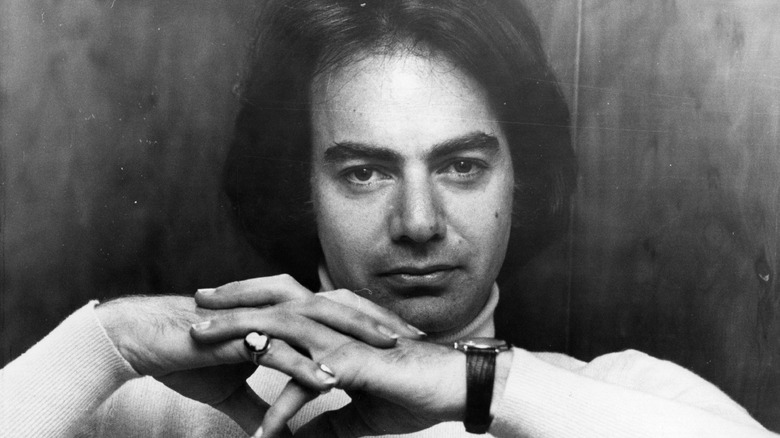
If you know anything about Neil Diamond, you know "Sweet Caroline." The quintessential karaoke song currently sits at nearly 900 million listens on Spotify, with its "Hands / Touchin' hands" pre-chorus and its three "Bah, bah, bah" trumpet notes during the refrain. But, Diamond's second-most listened to song, "Cracklin' Rosie," drops sharply to about 143 million listens. In and of itself, this doesn't mean that Diamond's catalogue is underexplored, but it does indicate that out of 48 total albums across 60 years of time, he's got some unappreciated gems waiting to be heard.
Choosing underrated Diamond songs is challenging, though. Much of Diamond's discography is samey in tone, tempo, rhythm, and sentiment, so it's hard for songs to stand out. We're not going to go out of our way to cherry-pick songs that run 100% counter to the typical, oozy, schmaltzy Diamond vibe, but we do have to narrow our choices to songs that are easy to qualify as "underrated" because they're different from their peers. Sadly, some of these songs show up on Diamond's '60s albums, like 1969's "Brother Love's Travelling Salvation Show." And of course, a song like the 1967 spaghetti western pastiche, "Girl, You'll Be a Woman Soon" — famously redone by Urge Overkill for the "Pulp Fiction" soundtrack — has such high grit and coolness factors that it's a shame we've got to pass it over since we are only looking at his 1970s music.
Nonetheless, our choices demonstrate that the "Song Sung Blue" singer isn't only cheese heaped upon cheese with a side of glittering suit jacket. Since Diamond isn't really around anymore, underrated Diamond songs are truly worth a listen, no matter your musical preference. This includes the stand-out, tribal beat track "Soolaimon" from 1970's "Tap Root Manuscript," "Crunchy Granola Suite" from 1971's "Stones," and the 1972 gospel rocker, "Walk on Water" off of "Moods."
Soolaimon
Sitar, congas, gospel-like background singers, Hammond organ, piano, acoustic guitar: "Soolaimon" is so imaginative, vibrant, and left-of-field for Neil Diamond that once the song kicks in, you'll likely be wondering who in the heck you're listening to. That being said, "Soolaimon" — which sits in the middle of Diamond's nearly 20-minute-long "The African Trilogy (A Folk Ballet)" suite on 1970's "Tap Root Manuscript" — does retain one key feature that makes it very Diamond: singability. Its hook is still eminently understandable and followable to the general listener, despite the song's musical window dressing.
There's loads of anecdotes online regarding Diamond's composition of "The African Trilogy," many of which veer into unsubtantiated legend territory, like the song being inspired by a missionary to the African continent. What we can say, though, is that Diamond took an interest in music from the African continent, in general, and by all accounts, Kenya, specifically. As odd as it sounds, this means that Diamond was something of a pioneer when it came to the poorly-labelled "world music," along with notables like Paul Simon.
Later in life, Diamond revisited "Soolaimon" and amped up the production values to 11. His 2012 rendition of the song at the Greek Theater in Los Angeles includes ambient rain-and-thunder sounds, horns and flutes, and is even more up-tempo and forward-driven. It's as though Diamond was inviting listeners to partake in the most realized version of "Soolaimon's" musical journey. At this point, the song's lyrics truly match the ambition of its music: "God of my want, want, want / Lord of my need, need, need / Leading me on, on, on / On to the woman, she dance for the sun."
Crunchy Granola Suite
First up: No, "Crunchy Granola Suite" isn't about traipsing around the streets of Portland, Oregon in the 2020s. Neil Diamond was way ahead of the crunchy curve and modern slang when he released "Crunchy Granola Suite" on 1971's "Stones." Soaking up a bit of the experimental, ultra-cool musical stylings of the '70s era, "Crunchy Granola Suite" sounds like Led Zeppelin turned folksy, complete with prominent lead guitar licks and even some low-register, growly vocals. It's certifiably hip to the point that it'll confuse listeners who only know Diamond songs like "Sweet Caroline."
The tale of "Crunchy Granola Suite" becomes even more confusing and weird when you know that Diamond — hand to God, this is true — wrote the song as an ode to actual granola. Like, the stuff you eat. Not just granola, but an overall clean, healthy living style. As the lyrics say and literally mean (worth writing in full), "Drop your shrink and stop your drinkin' / Crunchy granola's neat / Sing it out / Alright / Da da da da / Da da da da da / Dee dee dee do / Deedle-ee dum dum / I'll have a double please." With lyrics like this, one might think that Diamond didn't mean what we wrote in his 1968 send-up of marijuana use, "The Pot Smoker's Song."
Like "Soolaimon," Diamond revisited the joyous, bouncy, highly danceable "Crunchy Granola Suite" later in life. At a 2008 concert at Madison Square Garden, he told the crowd that his 1972 live album, "Hot August Night," helped propel "Crunchy Granola Suite" to some degree of success. The song might have fallen off the cultural radar since then, but it's definitely crunchy enough to revisit.
Walk on Water
If you don't listen past the first minute or so of "Walk On Water," you might be tempted to wonder why we're including it on this list. The song requires a degree of patience not suited to a modern-day single or 10-second TikTok blip. But back when it was released as a single off 1972's "Mood" (there's Neil Diamond anticipated future slang, again), "Walk On Water" did alright. It reached No. 17 on the Billboard Hot 100. The song has since fallen by the wayside, but once you get past that one-minute mark, you'll hear why it ranks amongst one of Diamond's more overrated songs.
"Walk On Water" starts out very quietly with an acoustic guitar, bass, shaker for percussion, and Diamond singing. But when the doo-wop background vocals come in during verse two, you know the song's about to change. And when the song erupts into an uptempo, gospel-infused tune with bongos, jaunty piano lines, and even vocals that sometimes veer towards reggae, you know you're hearing a one-of-a-kind Diamond song. The song continues to evolve till its end, which comes at a mere three minutes, four seconds. It's impressive that the track accomplishes so much in such a short length.
As for the story behind "Walk on Water," Diamond once said in a Q&A on A Beautiful Noise, "I bet if you spoke to my psychiatrist, she could tell you if it is about my mother." Maybe it actually is, because as the song's lyrics say, "Walk on water, ain't it like her? / She leads the children" and "Light de light, we got de mornin' / Mornin' makes another day / Glory sight, got de dawnin' / Lordy, light the night away."
If You Know What I Mean
"If You Know What I Mean" off 1976's "Beautiful Noise" is probably the most typically Neil Diamond of our underrated Neil Diamond songs. But it's one of the most well-done versions of what it is. A voice-focused lament about bygone days and faded love, the song builds to an instrumental, string-flush crescendo that just about, but not quite, captures the bittersweet sentiments apparent in its lyrics: "And the radio played like a carnival tune / As we lay in our bed in the other room / When we gave it away / For the sake of a dream in a penny arcade." It's all a bit melodramatic and overwrought, but if you approach the song expecting just that, then you won't leave disappointed.
But despite the song's melodrama, "If You Know What I Mean" comes across as older and world-weary because it tells a story that can only be told by an older person looking back at life. Contrast "If You Know What I Mean" and its singer-songwriter, moment-to-moment vignettes — "Took a drink from a glass of old wine / I closed my eyes and I could make it real / And feel it one more time" — with the "Good times never seemed so good" line from 1969's "Sweet Caroline" seven years earlier.
This kind of authenticity makes "If You Know What I Mean" feel like a rare glimpse into Diamond's inner world, which arguably remains opaque across much of his work. Boilerplate lines like "It was another time / It was another place" somewhat ruin this authenticity with vagueness, but the song still remains underrated, on a whole.
Mama Don't Know
The least listened to song on our list, and also our last overrated '70s Neil Diamond song, chronologically, "Mama Don't Know" only has about 233,000 listens on Spotify at the time of writing. It might be an overstatement to flat-out say that "Mama Don't Know" doesn't sound like Diamond at all, but it's also easy to hear how the song sounds suited to some other artist, entirely.
The second track on 1979's "September Morn," "Mama Don't Know" is a foot-tapping, syncopated, electric guitar affair with bite, attitude, and vocal dynamics that push Diamond into rare falsetto territory. And then, when you think the song is over come the three-minute mark or so, the music reprises itself into a twangy, instrumental outro that adds character to the song, but isn't strictly necessary. This kind of creative flourish is par for course for plenty of other artists, but unusual for Diamond and elevates "Mama Don't Know" to highly underrated status.
As for what "Mama Don't Know" means, we've got the song's lyrics to guide us. In this case, the lyrics present what sounds like a cynical take on faith healers. "Mama don't know / What the preacher man know / But the preacher man know it all right," the lyrics say. The song ends in the repeated line, "Don't he touch you when he speaks?," which seems to imply some kind of creepy abuse of power on the part of the preacher. If this interpretation is true, then "Mama Don't Know" becomes especially interesting come 2006, when Diamond released the sincere, faith-based "Man of God" with lines like, "I'm thanking you, Lord, for giving me song / For making me strong." Either way, "Mama Don't Know" is worth a listen.