

These Are The Grateful Dead's Most Underrated Rock Songs, Hands Down
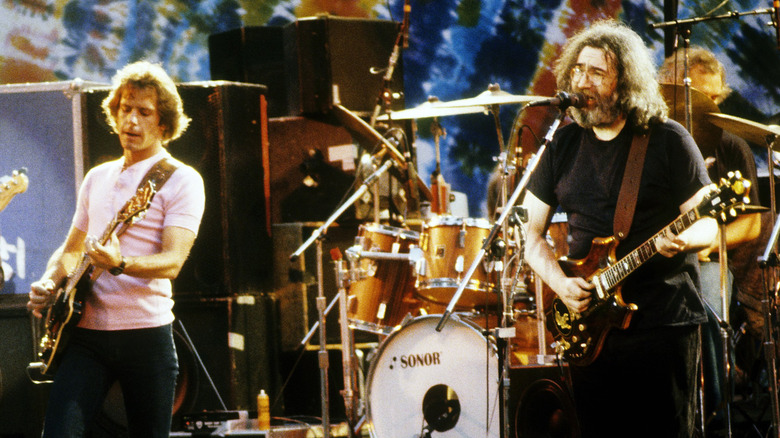
Deadheads worldwide felt a gut punch with the news that Grateful Dead guitarist Bob Weir had died at age 78. His part in the Grateful Dead's tragic real-life story ended on January 10, 2026, when Weir succumbed to pulmonary issues following a cancer diagnosis several months earlier; he started treatment shortly before taking the stage in San Francisco for three nights of concerts celebrating the Dead's 60th anniversary in August 2025. "Bobby will forever be a guiding force whose unique artistry reshaped American music," read a statement on Weir's website.
Co-founding the Dead when he was just 16, Weir was the musical glue that held it all together, his unique guitar-chording offering a counterpoint that allowed guitarist Jerry Garcia to soar. Following the tragic death of Garcia in 1995, Weir embarked on a variety of musical journeys, including offshoot projects such as Ratdog, Furthur, Kingfish, and Bobby and the Midnites. In recent years, he toured with Dead-adjacent group Dead & Company (with John Mayer channeling Garcia on lead guitar). He also performed with Wolf Bros, presenting pared-down, jazz-influenced versions of Dead songs, accompanied by famed record producer Don Was on bass and Jay Lane on drums.
As fans mourn by listening to their favorite Dead numbers, there will certainly be some diversions taken toward the group's deepest of deep cuts. While one listener's "underrated" is another's "overrated," the following five songs practically transcend that subjectivity thanks to their unforgettable lyrics, artisanal craftsmanship, and malleable nature, being reinvented on the live stage by Weir in surprising ways over the years. You won't find them on any "Best Of" compilation, but they're more than worth digging for.
Black Throated Wind
In May 1972, Bob Weir unveiled his debut solo album, "Ace." Accompanied by the rest of the Grateful Dead, the album produced several tracks that would become live staples for the Dead, including "Playing in the Band," "Mexicali Blues," "Cassidy," "One More Saturday Night," and the underrated "Black Throated Wind."
When the band hit the road for its now-legendary European tour that summer, "Black Throated Wind" began its life as a Grateful Dead concert staple. The song would remain a go-to for the rest of the band's existence, eventually becoming a favorite for Weir when performing with Dead & Company and Wolf Bros.
Like most Dead songs, the song tells a story, this one of a melancholy guy unsuccessfully trying to hitch a ride on a highway, while simultaneously recalling the failed romance that had sent him on the road. Musically, the song kicks off with a quirky, jerky guitar riff that is unmistakably Weir, the song continuing to chug forward — much like the hitchhiking protagonist. Yet it's the words of lyricist John Perry Barlow that really make the song memorable, culminating in the chorus: "The black throated wind keeps on pouring in / With its words of a life where nothing is new / Ah, Mother American night / I'm lost from the light / Oh, I'm drowning in you."
New Speedway Boogie
The release of The Grateful Dead's 1970 album "Workingman's Dead" was a major step in the band's evolution, shifting from the psychedelia that had characterized their sound to a more country-rock feel as the band reconnected to its roots as a blues-based jug band. The album is chock-full of songs that would go on to become Dead classics, including "Casey Jones," "Dire Wolf," and "Uncle John's Band." Also in that company is "New Speedway Boogie," recounting the band's 1969 experience at the disastrous and deadly Altamont Free Concert, marred by a tragic murder while The Rolling Stones performed.
Based on a simple blues progression, the song — written by Jerry Garcia and lyricist Robert Hunter — is a slow-groove rocker, hinging on the chorus, "One way or another, this darkness has got to give." The song came together quickly and was first performed by the Dead just two weeks after Altamont. Recording the track for "Workingman's Dead" was a breeze, with Garcia telling Rolling Stone that the band completed it after just one take. He described "New Speedway Boogie" as "one of those miracle songs. It's one of those 'once-through' ones. The words were just so right that it was immediately apparent, just bam! It came out right. Simple and straight-ahead."
The song was performed by the Dead about 20 times in 1970, and then taken off the set list. "New Speedway Boogie" remained absent from the band's repertoire for the next two decades, finally being revived in 1991.
West L.A. Fadeaway
For a band not known for chart hits, 1987's "In the Dark" proved to be an unexpected bonus for The Grateful Dead when "A Touch of Grey" became the band's highest-charting single by far, peaking at No. 9 on the Billboard Hot 100. While a few songs on the album were revived by Dead & Company, the album's other standout is "West L.A. Fadeaway."
With a slow, loping groove courtesy of the combined drumming of Mickey Hart and Bill Kreutzman, Jerry Garcia's funky guitar lick propels the song along, punctuated by eccentric solo bursts throughout. Lyrically, the track shines the spotlight on the sleazier side of the City of Angels and its drug-infested dark underbelly; there's even speculation that it's a cautionary tale of sorts about the tragic death of John Belushi at the Chateau Marmont. As Garcia sings, "I'm looking for a chateau, 21 rooms but one will do."
In the hands of Bob Weir's Wolf Bros, "West L.A. Fadeaway" was slowed down to a crawl, rendering the song darker and even more sinister. Weir's take on the guitar parts is significantly different than Garcia's, while the addition of horns adds a touch of R&B, demonstrating that even the most underrated Dead songs lend themselves to endless reinvention.
Greatest Story Ever Told
Another Bob Weir-written song from his "Ace" album, "Greatest Story Ever Told" is something of a shaggy dog tale. Kicking off with a classic rock 'n' roll guitar intro, the lyrics blend religious imagery with elements of Hollywood westerns and sci-fi flicks. "Moses come ridin' up on a quasar / His spurs were jingling, the door was ajar," Weir sings, with the chorus referencing "Abraham and Isaac sitting on a fence." Then comes the punchline: "You know the one thing we need is a left-hand monkey wrench," referencing a fool's errand, usually when a rookie is sent to fetch a nonexistent tool as a form of hazing.
The song has had enormous staying power over the years, becoming a Grateful Dead concert favorite that Weir also performed with Dead & Company and Wolf Bros. That's not surprising, considering that "Ace," despite being a Weir solo album, featured all members of the Dead playing on it, and is considered a de facto Grateful Dead record. In 2022, Weir was joined by singer-songwriter Tyler Childers, handling vocals for a sizzling Wolf Bros performance in NYC's Radio City Music Hall.
Interestingly, the song's origins lie with Dead drummer Mickey Hart, who recorded an embryonic version called "The Pump Song" for his 1972 "Rolling Thunder" solo album. The propulsive groove driving the track was actually a recording Hart had made of a pump on his ranch (hence the title), with both Weir and Jerry Garcia playing on the track.
Reuben and Cherise
"Reuben and Cherise" isn't technically a Grateful Dead song, first appearing on The Jerry Garcia Band's "Cats Under the Stars" album in 1978. However, it did join the Dead's concert repertoire — albeit performed just four times, all during 1991.
When considering the untold truth of The Grateful Dead, it's easy to make a case for "Reuben and Cherise" as one of the Dead's most underrated songs. In his lyrics, Robert Hunter tells an elusive tale of romance gone wrong during Mardi Gras in New Orleans. When Reuben is tempted by another woman, sweet Ruby Claire, the love triangle ends tragically when he is depicted in the final verse as walking the streets of New Orleans until dawn, carrying Cherise's seemingly lifeless body as "her hair hung gently down." Just before that final glimpse at the doomed couple, the song's omniscient narrator shares some words of wisdom: "The truth of love an unsung song must tell / The course of love must follow blind / Without a look behind."
While never quite becoming a Dead standard, the song has remained an underrated hidden gem. As Garcia told Rolling Stone, the song "took about three years to write ... maybe longer than that. I kept writing and writing versions of it ... Hunter would rewrite the lyrics ... I'd write a new melody. No, that isn't it.' ... It just went on forever." It'll last forever, too.