

5 Radio Hits From The '70s That Will Take Younger Boomers Back To Their First Car
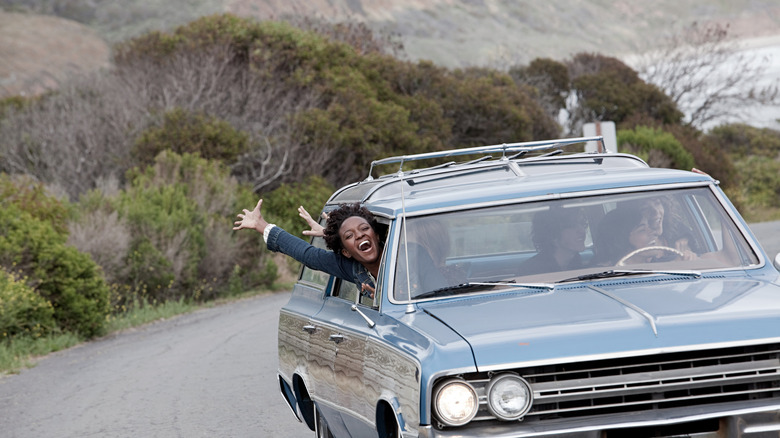
For young people in the United States, your first car, or at least the first car you have regular use of, is a major milestone in independence. Now you have control over where you go, who you take, and crucially, what you listen to on the way. Even after the rise of in-car tape decks (and Betamaxes!) in the mid-1970s, the car radio was how many people energized their drives. You could find new music, go beyond the same few tapes that lived in your car, and exercise veto power over a trash tune with a contemptuous flick of the dial.
All these songs spent at least three weeks atop the Billboard Hot 100 in the 1970s, a decade when boomers born in the last 10 years of the generational timeline for that cohort, from about 1955 to 1964, were having their first experiences with independence on the road. All of the songs can still credibly be heard in the car today, either on an oldies station (sorry, Dad) or a playlist. No "lost treasures," just songs you have absolutely heard in the car for decades, and (at least mostly) songs you turn up when you hear the first bars.
You're So Vain — Carly Simon
Carly Simon's "You're So Vain" is an unforgettable musical side-eye. Released in 1972, It was meta before meta was boring. Told from the point-of-view of a woman seeing an old lover swan into a party after a fews years apart, the song chronicles her reactions to the now hopelessly pretentious amour of her former years. Simon's lyrical barbs are flawless: the man enters with a "strategically" placed hat and immediately checks himself out in the mirror. The tune, easy to sing in the car if you don't try to follow the chorus up to the high echo of the song's title, is almost a scoff.
Since the song's release, the curious have wondered at the identity of the anti-muse who so thoroughly fumbled the young, pretty, talented, elegantly vengeful Simon. She eventually revealed to People that each verse is about a different vain man: the second verse is "for" Warren Beatty, but the identities of the first verse's apricot-scarfed prettyboy and the third verse's gambling playboy are not (yet) confirmed.
Play That Funky Music — Wild Cherry
Depending on your generation, you are likely either a father who has calmly and conversationally told his son to "play that funky music, white boy" or the son who received this instruction — some people are right in the sweet spot to have been both. This instruction comes, of course, from the Wild Cherry song "Play That Funky Music," a funk-rock song released in 1976 about a rock band trying to adjust to the rise of funk. And for a white-boy product, "Play That Funky Music" is indeed funky. The sassy bassline and prancing rhythm is perfect for actual dancing or driver's-seat shoulder-shimmying, and the whole song is playful without being asinine.
According to American Songwriter, Wild Cherry rhythm guitarist Bryan Bassett once said in an interview that the band was playing a gig at a disco club in Pittsburgh when, "Someone actually did say that to us — play that funky music white boy — insinuating that if we didn't, we probably wouldn't be working much longer." Being a rock band in a scene in which funk and disco were drawing crowds to clubs, they understood the assignment, and an inspiration was born, though admittedly an inspiration that jived well with frontman Rob Parissi's assessment of how Wild Cherry would need to pivot to do well in the mid-to-late '70's music landscape. It only worked once, though; this was Wild Cherry's only major hit, but it's had us bopping our heads in our cars ever since.
I Will Survive — Gloria Gaynor
From the first piano note of the introductory flourish, every gay ear in the room perks up like a terrier's, followed by the rest of the house when Gloria Gaynor begins "At first I was afraid, I was petrified...." "I Will Survive" is a double crossover gem: a gay anthem celebrated almost as intensely by people outside the community, and a disco song that came out in 1978 and is still widely beloved in the 2020s. The song's high-moderate tempo is energetic but slow enough to allow for truly impassioned lyric delivery during karaoke, and the occasional pauses before Gaynor keeps dressing down her ex-lover are perfect for catching a breath before diving back into one of the tell-off for the ages.
It's not just for romantic breakups: the song's "don't let the door hit you in the rump on the way out" message works just as well on work trouble, literal health problems you intend to overcome, or any other obstacle to living the big, happy life you and Gaynor deserve. It's just as empowering to sing in your car today as it was when you were enjoying your first freedom on the open road.
The popularity of the song transcends nearly any barrier. Dozens of artists have covered it, and Ivana Trump, a woman so in her world that she once ordered Chablis at a Taco Bell, reportedly pumped the classic screw-you-pal jam during her divorce from Donald, per CNN. The best music truly is universal.
My Sharona — The Knack
The phrase "My Sharona" is nearly impossible to simply say. We all know the classic stuttering delivery from the Knack's 1979 No. 1 single, deep in our brainstems with our most basic memories, along with "867-5309" and a thousand fast-food jingles. The sexily herky-jerky song shot right up the charts on its release, notching gold record-level sales in under two weeks and going platinum not long after that.
Knacks lead singer Doug Feiger delivers the lyrics, with their near-obsessive repetition of that unusual name, in a compellingly tense voice: You can practically see little hearts in his eyes and his tongue hanging out. And of course, Feiger's as revved up as a hot rod over Sharona, with lyrics referencing her "making [his] motor run" and gunning it. Most of us have had our own Sharona (or two), even if their names didn't always match a literally unforgettable pop-rock lick. If you were lucky enough to have your Sharona (Beatrice, Alvin, Georgette, whoever) riding shotgun when this song came on, a well-timed wink could get you places.
Stayin' Alive — The Bee Gees
You can't talk about '70s radio without the Bee Gees. The Bee Gees and their individual members absolutely dominated airwaves in the late '70s, when Americans simply couldn't get enough of three Manx-Australian guys singing falsetto. Their contributions to the "Saturday Night Fever" soundtrack meant they followed that film's smash success, with "Stayin' Alive," "Night Fever," and "How Deep Is Your Love" all hitting No. 1 in the U.S. (Over the band's career, they'd snag the No. 1 spot nine times.)
Any of a half-dozen Bee Gees hits of the era might qualify for this list, but 1977's "Stayin' Alive" has the strongest "it" factor. Other Bee Gees songs are recognizable, but if you mention the Bee Gees, someone in the room will do the "aht aht aht aht" hook of "Stayin' Alive." The song's strutting rhythm and cocky lyrics ("I'm a woman's man, no time to talk") capture a certain disco-era brashness: the song's unrepentant self-love is perfect for hyping yourself up in the car to get yourself ready to peacock in a club. If the rest of the lyrics are sometimes hard to parse through the brothers' inimitable delivery, the hook and refrain have carried the song into many hearts, car jams, and even more playlists.