

5 Classic Rock Songs That Were Once Banned From The Radio
In the not-too-distant past, when radio stations ruled the world of music, the people who controlled the airwaves held enormous sway over which songs would become hits and which would flop. That meant that program directors and their bosses could dictate whether to ban tracks that held the potential to offend viewers. That fate befell some songs that are now considered iconic, including Loretta Lynn's ode to reproductive freedom, "The Pill," and Van Morrison's "Brown Eyed Girl," which was banned by some stations for the lyric, "Making love in the green grass." (Morrison had, ironically, changed the lyrics and title from "Brown-Skinned Girl" in order to avoid radio bans in America's segregated South.)
Glancing back into the annals of rock history demonstrates that there have actually been several songs that received the old heave-ho from censors, only to be embraced by fans and now considered classics. There's a Beatles favorite that may or may not have been about drugs, a sea shanty with lyrics so garbled that the FBI spent years investigating whether they were obscene, and a legendary instrumental that sounded dangerous to the establishment. Here's a look at five classic rock songs that were once banned from the radio.
The Kingsmen — Louie Louie
"Louie Louie" was written and recorded by blues singer Richard Berry in 1957. A few years later, Berry's lament about a lovesick sailor desperate to get home and see his gal became a regional hit in the Pacific Northwest for Tacoma-based band The Wailers. In 1963, two other bands from that region recorded "Louie Louie," with competing versions released by Paul Revere & the Raiders and The Kingsmen. While the Raiders' version got the band signed to a record deal, The Kingsmen's single stirred up controversy due to parents' fears that its incomprehensibly sung lyrics were obscene. So scandalous was the song that Indiana's governor, Matthew Welsh, unofficially banned it from all radio stations throughout the state.
The controversy captured the attention of no less than FBI chief J. Edgar Hoover, who launched a federal investigation (one of many examples of music that triggered FBI investigations). Bureau agents were tasked with listening to the recording at various speeds in order to identify the supposedly filthy lyrics. The FCC also launched a probe, eventually dropping it when no profanity could be identified. The FBI ultimately came to the same conclusion, although the bureau's examination dragged on for two and a half years. All that investigating, utilizing the resources of the U.S. government, ultimately proved diddly squat. However, the notoriety wound up propelling the song to No. 2 on the Billboard charts as kids eagerly scooped up the notorious record that was so dirty it was investigated by the feds.
The Who — My Generation
Released in October 1965, "My Generation" represented a major evolutionary step for The Who, the four-piece London band that was previously known as The Detours and then The High Numbers. With its incendiary battle cry celebrating youth ("I hope I die before I get old"), Pete Townshend's powerful guitar riff has remained one of rock's most memorable. When the vocals kick in, frontman Roger Daltrey sings with an exaggerated stutter — most notably when he sings, "Why don't you all f-f-fade away," creating the brief anticipation of an f-bomb that never comes.
The song became an instant smash, even though the BBC initially refused to give the song any radio play — not because of the feigned swear word, but because officials were concerned Daltrey's stuttered vocals could offend stutterers. "But the BBC banned it," Townshend told Vulture. "I think the people who banned it were intelligent people. They were just being protective. He insisted that the intent wasn't to mock stutterers but to mimic teenage boys who'd popped so many amphetamines that they stuttered when they spoke. In any case, the ban didn't last long: When "My Generation" received heavy airplay on competing radio stations and the single flew off the shelves in record stores, BBC ultimately relented.
Daltrey — actually a stutterer himself — confirmed Townshend's recollection that the stuttering was intentional. "It was always in there, it was always suggested with the 'f-f-fade' but the rest of it was improvised," he told Uncut.
The Beatles — Lucy in the Sky with Diamonds
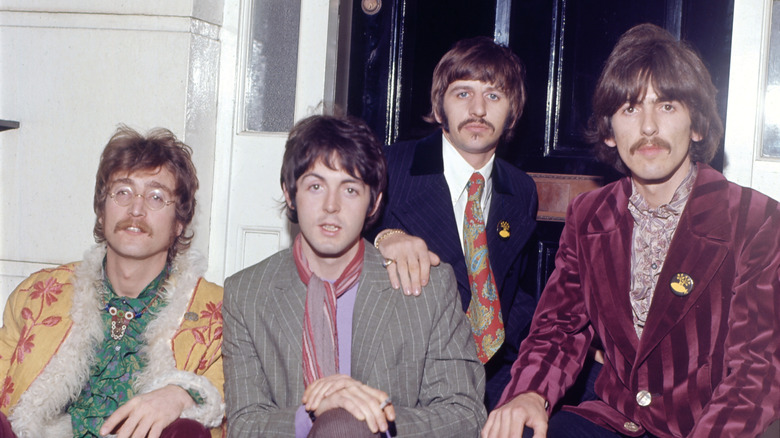
Among the many classics unveiled in The Beatles' trailblazing 1967 album "Sgt. Pepper's Lonely Hearts Club Band" is "Lucy in the Sky with Diamonds." Featuring lyrics about "tangerine trees and marmalade skies" and a "girl with kaleidoscope eyes," the psychedelic imagery led to assumptions that the hidden meaning of the song was about an acid trip, as the main words in the song title form the acronym "LSD." That speculation was enough for BBC executives to ban the song from radio airplay, with an internal memo (via Oxford University Press) fretting the song "could encourage a permissive attitude to drug-taking."
The song's writer, John Lennon, claimed he'd been inspired by son Julian's drawing, which he'd titled "Lucy in the Sky with Diamonds." "I thought, that's beautiful, I immediately wrote a song about it," Lennon said during a 1971 appearance on "The Dick Cavett Show," insisting there was no connection with LSD. "It wasn't about that at all," he added.
More than three decades later, Lennon's assertion was refuted by Paul McCartney, who stated that "Lucy in the Sky" actually was about acid — and wasn't alone. "'Day Tripper,' that's one about acid. 'Lucy in the Sky,' that's pretty obvious," McCartney told the Daily Mirror in 2004 (via Today). "There's others that make subtle hints about drugs, but, you know, it's easy to overestimate the influence of drugs on the Beatles' music."
The Kinks — Lola
"Lola" has remained one of the most memorable songs produced by The Kinks, and the group's only song to be banned by the BBC. In under three-and-a-half minutes, the 1970 classic tells the saga of a lovestruck guy who meets the titular Lola in a Soho bar, only to come to a surprising realization. "Well, I'm not dumb but I can't understand," frontman Ray Davies sings, "Why she walks like a woman and talks like a man."
Despite the controversial subject matter — Lola is either a male crossdresser or a transgender female — the song declaring, "Girls will be boys and boys will be girls / It's a mixed up, muddled up, shook up world," wasn't actually controversial. "It didn't inspire that much outrage," rock critic Jim Farber told NBC News. "People were more flummoxed by it."
In fact, the BBC's ban wasn't for edgy subject matter but over a lyric referencing Coca-Cola. "The BBC came down on the track like a bag of hammers, as they had a policy to ban anything that made commercial references," noted British college prof Carey Fleiner, author of "The Kinks: A Thoroughly English Phenomenon." Drastic measures were undertaken in order to get the record unbanned. "Famously, Ray had to fly back and forth from a Kinks tour in the USA to London and quickly re-record the lyrics and replace the drink with 'cherry cola' in order to get past the censors and to get the record out," Fleiner recalled.
Link Wray — Rumble
Of all the songs to have been banned from radio, Link Wray's "Rumble" holds a unique distinction. Unlike songs banned for salty language, sexual innuendo, or controversial subject matter, "Rumble" was pulled from radio play in certain parts of the U.S. — including Boston, New York, and Detroit — despite being an instrumental that doesn't contain a single lyric. The issue wasn't what "Rumble" said, but how it sounded — and that sound was menacing. With Wray's deliberately distorted guitar and its provocative title (slang at that time for a street fight), "Rumble" generated fears it would incite violence. That teenagers who listened to its languid riff would immediately transform into juvenile delinquents and begin slashing each other with switchblades. According to E Street Band guitarist Steven Van Zandt, it's not just the distortion of Wray's guitar but also the chord progression that makes the riff sound so dangerous. "It's the sexiest, toughest chord change in all of rock 'n' roll," Van Zandt declared in the documentary "Rumble."
Despite the ban, "Rumble" went on to crack Billboard's Top 20 while inspiring a generation of youngsters — including the likes of Jimmy Page and Pete Townshend — to pick up a guitar. When the single was inducted into the Rock & Roll Hall of Fame in 2018, Van Zandt joked about the rarified place the song holds in rock lore. "'Rumble' is the only instrumental in history to be banned for its lyrical content," he quipped when introducing the song.