

Classic Rock Songs That Deserved To Go No. 1, But Never Did
The No. 1 spot on the Billboard Hot 100 is no indicator of a song's quality — anyone familiar with Rick Dees and His Cast of Idiots' horrific 1976 novelty hit "Disco Duck" can attest to that. Nonetheless, plenty of songs have deservedly become — at least for a time – the most popular recording in the whole of the U.S., marking a cultural event that says something about the music landscape at that particular moment. But throughout the history of rock music, many tracks have become timeless classics despite never reaching the top spot on the Billboard Hot 100.
When making our choices, we've kept ourselves within the loosely bordered garden of classic rock from the mid-'50s to the early '80s, and all released as singles, either A- or B-sides. They also need to be held up by music historians as game-changing releases for the rock genre, or have been relatively overlooked in an artist's discography and grown with time to become signature songs beloved by fans and critics alike. Whatever the case, we think you'll definitely be surprised by some of the songs that made it onto this list, all of which didn't reach the peak they absolutely deserved.
Beach Boys – God Only Knows
The Beach Boys is considered one of the greatest American pop-rock bands of all time, with ambitious songwriting, flawless performances, and shimmering production that elevated the band far beyond its surf-rock roots, with The Beach Boys competing with The Beatles for the title of greatest band of the 1960s. The band's masterpiece is undoubtedly "Pet Sounds," the 1966 album that raised the bar for imaginative use of the recording studio and the widest possible array of instrumentation. Shockingly, none of the singles released from what has been described as one of the best albums of all time made it to No. 1, but surely the biggest commercial injustice belongs to "God Only Knows."
A gorgeous, harmony-rich ballad written by legendary songwriter Brian Wilson and Tony Asher, "God Only Knows" was relegated to being the B-side of "Wouldn't It Be Nice," meaning it only achieved its chart placing of 39 through airplay. It was also affected by the fact that the song was banned in some areas due to the use of "God" in the title, which some considered blasphemous. But over time, numerous artists and critics have lauded "God Only Knows" as The Beach Boys' greatest ever song.
Industry expert and musician Rick Beato has described it as Brian Wilson's "perfect song" while breaking down its complexity. Other critics have highlighted the ambiguous harmonics that underpin the song, which effectively mirror the uncertainty of its speaker and provide incredible emotional resonance. Paul McCartney once described "God Only Knows" as the "greatest song ever written" (via NME), seemingly admitting defeat in his once great songwriting rivalry with the Beach Boys mastermind.
Chuck Berry – Johnny B. Goode
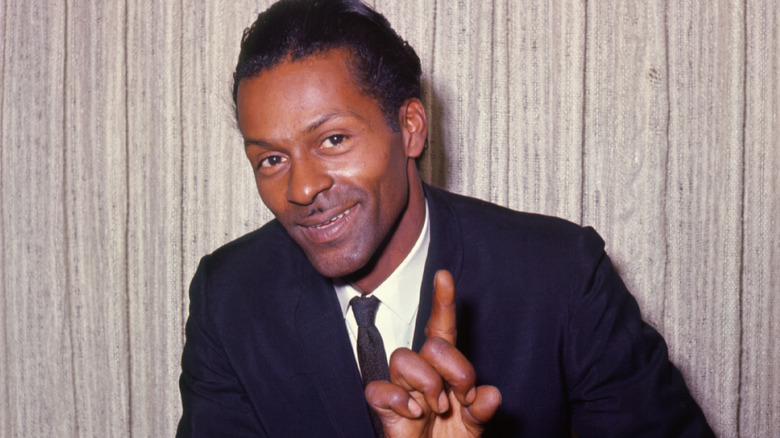
Chuck Berry is considered one of the great pioneers of rock 'n' roll, whose influence spans seven decades of rock music and its countless subgenres. The most enduring of his songs is "Johnny B. Goode," the 1958 classic that tells the tale of a poor boy from Louisiana who escapes poverty by becoming a rock 'n' roll star — a story based on Berry's own life — albeit with a number of biographical differences.
The song is famous for its galloping pace, innovative use of overdubbing, and the rousing "Go, Johnny, go, go" chorus that has made it an evergreen crowd pleaser at live events. The song has been covered countless times by legendary acts such as The Beatles, Jimi Hendrix, and the Sex Pistols, showing its wide appeal. It even played a starring role in "Back to the Future," as the song that Marty McFly plays to the bewilderment of a 1950s dance hall audience, a nod to its freshness upon its release.
However, despite being one of rock's most legendary songs, it failed to top the charts back in 1958, languishing at a surprisingly low No. 80, and staying on the Billboard Hot 100 for just one week. Berry would have to wait until 1972 to achieve a No. 1 hit, when his song "My Ding-A-Ling" took the top spot for two weeks. Unfortunately, that song hasn't aged anywhere near as well as "Johnny B. Goode."
MC5 – Kick Out The Jams
"Kick Out The Jams" is the signature song of riotous Detroit rockers MC5, and the title track of its live-recorded 1969 debut. The band is often overshadowed in rock history by its Motor City neighbor, The Stooges, but while MC5 may not be as big of a name as Iggy Pop's former outfit today, its music is considered by music historians to have been just as influential for the generations of punk and hard rock artists that would come in its wake. Furthermore, MC5 has the distinction of actually appearing on the Billboard Hot 100 with "Kick Out The Jams," though the track only peaked at No. 82.
The live-recorded track, which was censored by the band's record label Electra, was immediately divisive, yet it has been retrospectively credited with striking the tone of rebellion and revolt that would become the essential posture of rock music from the mid-1970s onward. The song was a call for action: "What do we mean when we say 'Kick out the jams'? If you're going to do anything, do it full measure, don't equivocate, be all the way in," explained guitarist Wayne Kramer (via Louder), although the title could also be understood as a commandment to do away with self-indulgent jam sessions that were by then the bread and butter of many psychedelic rock and progressive rock acts, again pointing toward punk's no-nonsense approach.
Undoubtedly ahead of its time, the song's classic status has only grown over the years, with cover versions appearing from acts including Rage Against the Machine, Blue Öyster Cult, and Jeff Buckley, among countless others.
Journey – Don't Stop Believin'
Journey's signature hit "Don't Stop Believin'" is arguably the ultimate arena rock song, an undeniable crowd-pleaser that has enjoyed sustained popularity since its release in 1981. Its opening bars feature an instantly recognizable bass line, distinctive synth textures, and spacey lead guitar parts that give the song a futuristic feel despite the inherent nostalgia of the "small-town girl" lyrics. However, while modern listeners may assume that "Don't Stop Believin'" was the band's biggest hit during its heyday, that was far from the case.
"Don't Stop Believin'" peaked at No. 9 in December 1981, which was, in retrospect, surprisingly equalled and beaten by a string of other Journey songs, such as "Who's Crying Now," which went to No. 4 in October 1981, and "Open Arms," which reached No. 2 in February 1982 — the highest chart placing of the band's career. In the years since, however, it has become clear that "Don't Stop Believin'" stands above Journey's other releases as one of the most successful classic rock songs of all time, going multi-platinum on both sides of the Atlantic.
It has also had a remarkable amount of success in the age of streaming, being one of the world's most-played 20th-century rock songs. At the time of writing, "Don't Stop Believin'" has been streamed almost 3 billion times on Spotify, whereas "Open Arms" has just over 300 million. It has featured prominently in other media, such as the finale of the HBO show "The Sopranos," and remains a karaoke favorite.
Bob Dylan – Like A Rolling Stone
Bob Dylan, who was awarded the Nobel Prize in Literature for his lyrics, utterly transformed the musical landscape during the 1960s. Six decades on, his biggest hits, such as the classic "Like A Rolling Stone," are unique in their ability to conjure the spirit of the rebellion that defined the age. "Like A Rolling Stone" tells the story of a character called "Miss Lonely," but it is impossible to ignore the biographical details that permeate it.
The 1965 track was penned around the time that Dylan famously "went electric," demonstrating that he was willing to move out of the furrow he had plowed to that point and blossom as an artist — a decision that maddened much of his former fanbase. The lyrics reflect Dylan's own desire to not be rooted to one creative spot, with the song demonstrating the fusion of all he had achieved in folk and the new rock influences he was beginning to infuse into his work.
Famed artists such as Bruce Springsteen, Frank Zappa, and Elvis Costello have praised the track as a game-changer that altered the direction of rock music. But surprisingly, despite being one of the most critically acclaimed classic rock songs of all time, and which enjoyed a huge cultural impact, it failed to hit the top of the charts, peaking at No. 2.