

Covers Of Radiohead's 1992 Megahit Creep That Rival The Original
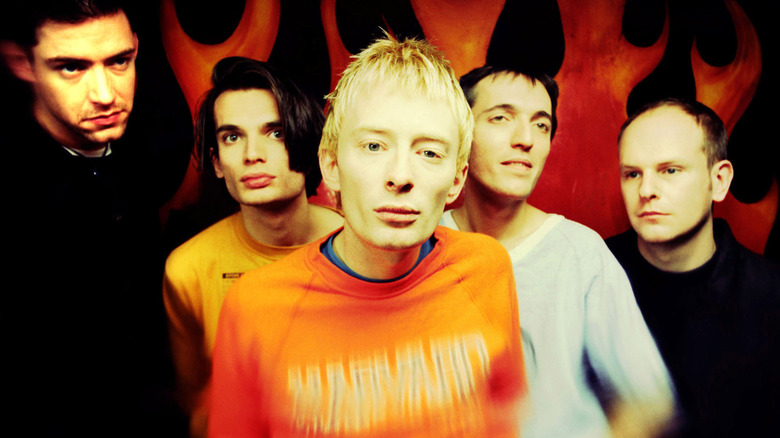
In 1993, British band Radiohead took its moody, heavy grunge song "Creep" to the top 10 in the U.K. and the top 40 in the U.S. The single quickly became a modern rock standard, and it's since been covered and reinterpreted dozens of times by a disparate group of musicians. Radiohead's "Creep" was inspired by frontman Thom Yorke's brief but intense obsession with a woman. That unhealthy fixation, along with themes of self-loathing, not measuring up, and not fitting in, is innate to the song. Together, these traits allow "Creep" to transcend its early 1990s production techniques and its similarity to so many other rock songs of the era.
A great song can handle and even be improved by new takes, twists, or genre treatments. An ever-changing and experimental Radiohead distanced itself from its breakout pop hit, but that hasn't stopped other musicians from covering "Creep" in interesting ways. Here are five "Creep" covers that are nearly as good as the original, all of them reinventing the song and making it so very special.
Arlo Parks
Winner of some of the most prestigious U.K. music prizes, including the Mercury Prize in 2021, Arlo Parks earns acclaim for her earnest, unflinching, and confessional compositions and performances. A singer-songwriter who also identifies as a poet, Parks' work is introspective, reflective, and self-critical. A song like "Creep" by Radiohead very much fits into her wheelhouse, and when she covered the song for the 2020 film "Shy Radicals," it very much felt like it could have been another daring, startling original from the artist.
While other musicians sought to unlock or expand "Creep" by adding elements, Parks broke the song wide open by taking away, stripping it down to its bare essentials. All she needs is her own expressive, emotionally evocative voice and a piano to perform a simple arrangement of "Creep." It lays bare the weight of the song — the honesty and the shame — and creates a new layer of empathy not present in Radiohead's '90s version.
Scala & Kolacny Brothers
Scala & Kolacny Brothers is a female chorale ensemble from Belgium that recorded its version of Radiohead's "Creep" live in 2001. That recording became globally popular in 2010, after it was used in the trailer for the Facebook origin film "The Social Network" (which is credited with starting a movie preview trend of utilizing spooky covers of well-known pop songs). And this stab at "Creep" definitely fits the bill of unsettling and haunting. Scala & Kolacny Brothers sound less like a choir of 200 voices and more like an army of ghosts, unable to affect events but able to comment on them from afar, from some unreachable spiritual plane.
All of the members of the chorus seem to carefully deliberate before delivering each syllable of every lyric. For this reason, "Creep" becomes both creepy and beautiful. The endless voices make for a haunting and otherworldly ballad with a sinister tone, reminding us that devotion gone unchecked can turn into something dangerous and toxic.
Diego Luna
The 2014 animated film "The Book of Life" is set largely in the afterlife, as suggested by and depicted in traditional Mexican folklore and customs. The movie co-stars Diego Luna as the voice of Manolo, the spirit of a bullfighter who desperately wants to abandon the family profession in order to be a musician. He totes a guitar everywhere and is prone to bursting out into emotive song to underscore plot developments. At one point, he delivers a show-stopping version of Radiohead's "Creep," all the more impressive because Luna performs it in a subtle and restrained fashion.
As Manolo, Luna's style is talk-singing, barely louder than a whisper for much of the rendition. Generally, "Creep" comes from the point of view of someone thinking the themes to themselves, all alone, but "The Book of Life" requires Manolo to sing it directly to and in front of the object of his affection. Luna turns a queasy song into a love song, and then he totally rocks it out with some acrobatic, thunderous guitars backing him up.
Weezer
Weezer and Radiohead broke through at about the same time, during the early 1990s alternative rock explosion. Initially, both sang about the same subjects: Unrequited love and feeling like a loser. It's a path that Radiohead more or less abandoned after "Creep," but Weezer stayed the course. The group's sound was far brighter than the dark, early Radiohead, however. After all, Weezer is a purveyor of short, hooky, pop-rock songs about romantic discontent. But when the band decided to cover its contemporary's best-known hit single, it got ambitious because the song required as much.
In 2008, Weezer embarked on the "Hootenanny Tour," which involved bringing as many as a few hundred musicians up on stage at any one time. With bassist Scott Shriner taking over lead vocals from regular singer Rivers Cuomo, Weezer, along with a slew of acoustic guitar and stringed instrumentalists, transformed "Creep" into a slow-building work of emotional catharsis. It begins as a string-heavy percussive shuffle of a song, with harmony and other instrumentalists slowly joining in. Eventually, "Creep" in Weezer's hands escalates into cacophony and chaos, reflecting the themes in the song and the thoughts in the narrator's head.
Prince
As preternaturally and explosively talented as he was, virtually anytime Prince covered a song, even a famous one closely associated with another act, he would make it his own and leave the original paling in comparison. Prince had a tremendous vocal range that allowed him to make the audiences deeply feel the emotion of any number. He could also absolutely shred on the guitar, and he used all those skills and more when he performed a surprise and devastating version of Radiohead's "Creep" at the 2008 Coachella Valley Music and Arts Festival.
Thom Yorke and Radiohead's original "Creep" seems unnecessarily subdued and restrained when compared to Prince's version. Anything subtle or hiding in the lyrics, Prince blows up to ensure that the audience gets it. He wails, cries, and hollers as he pines for a lover he'll never have — and he hates himself for it. But it's Prince's guitar theatrics that really sell this "Creep." Most covers don't even attempt that crunchy, feedback-based pre-chorus guitar bit because it's just so distinctive and probably tough to replicate. Prince, on the other hand, nails not only that but also contributes a moving, soul-quaking guitar solo mid-song and then another one at the end. In the end, he gets the "Creep" running time to around eight minutes, and it's so epic that it can't help but remind one of another Prince love lament, "Purple Rain."