

These 5 Songs By The Scorpions Define Rock History
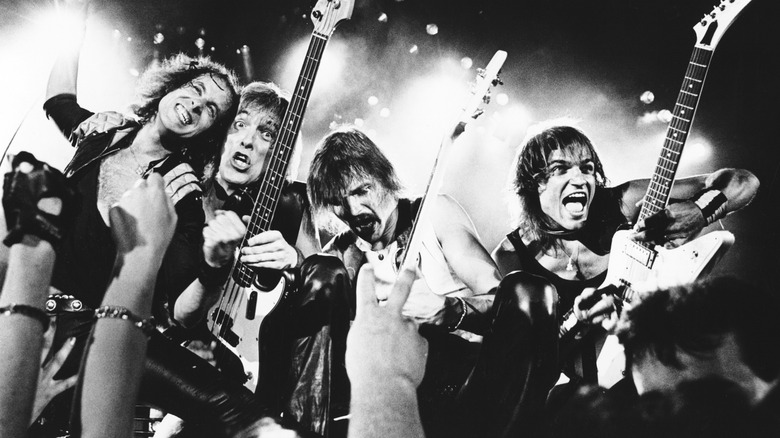
No list of the biggest names in rock history would be complete without Scorpions — the band, that is, not the arachnid. Formed way, way back in 1965 by guitarist Rudolf Schenker, the German-founded Scorpions have sold over 110 million albums worldwide and are known far, far better around the world than within the U.S. When Led Zeppelin's fame was at its height in the mid-1970s, Scorpions had already started adopting an arena rock sound. During the '80s, they rode that wave high. During the '90s, they eschewed trend-chasing grunge stylings and grew their audience in Asia. But in all cases, Scorpions' songs helped define rock history.
But first, when we say "define" rock history, we don't necessarily mean cause or influence it. Nor do we mean "the best of" rock of a certain era. Scorpions' songs define rock history by typifying some element of rock heritage, whether it be musical composition, lyrics, subject matter, or how songs depict the role of rock in the world as an art form and within the zeitgeist. Scorpions have come to be known for highly melodic songwriting that's just as emotionally moving as it is muscular. But even within this general description, they've evolved quite a bit over their career, lockstep with rock's evolution and defining rock along the way.
Of course, it's impossible not to mention the colossal Scorpions hit, "Wind of Change," written in the wake of the fall of the Berlin Wall. Other songs like "Rock You Like A Hurricane" and "Still Loving You" define '80s rock history through a big anthem and small ballad, respectively. Then there's that time that Scorpions bridged cultural and temporal divides by performed a rock rendition of a Japanese song in Japan in 1978.
Wind of Change
Scorpions' "Wind of Change" marked such a momentous, rock-defining moment — and history-defining — that we really can't start elsewhere. Remember when we said that Scorpions were a German band formed in the '60s? At that point, Germany had been split in two since 1949, following the end of World War II: the West-allied West Germany (the Federal Republic of Germany) and the Soviet Union-choked East Germany (the German Democratic Republic).
The Berlin Wall was built in 1961 to keep Germans from crossing between the two. On November 9, 1989, Germans on both sides quite literally tore the wall down and reunited their country. The following year in 1990, the West Germany-born Scorpions released the aptly-named "Crazy World" and its lead track, "Wind of Change," a whistle-filled ballad that builds into a swaying, moving chorus and resolution. The song had a powerful impact on Germany's psyche at the time and acted like an anthem of freedom and unity, with lyrics like, "The world is closing in / And did you ever think / That we could be so close, like brothers." It had such a big impact that some people believed that the song was part of an anti-Soviet CIA campaign.
In reality, Scorpions' lead singer Klaus Meine wrote the song's lyrics after an extremely rare opportunity to play a set of shows in Soviet Russia at the Moscow Music Peace Festival. This happened in August of 1989, mere months ahead of the fall of the Berlin Wall and about two years ahead of the collapse of the Soviet Union in 1991. Could there be a grander rock-defining musical moment than a single song marking a world-changing epoch and bringing people of various stripes together? We think not.
Rock You Like A Hurricane
On a far less lofty note than "Wind of Change," we have a Scorpions' song that exemplifies '80s rock so much that it even has the word "rock" in the title: "Rock You Like a Hurricane" from 1984's "Love At First Sting." If the song title and revealing album cover aren't obvious enough, lyrics include, "Desire is coming, it breaks out loud / Lust is in cages, 'til storm breaks loose." In short, "Rock You Like a Hurricane" is an exemplar of the type of party-hardy, spandex-clad music evident in sibling '80s hair band songs like Def Leppard's "Pour Some Sugar On Me" and Whitesnake's "Slide It In."
From the ground up, "Rock You Like a Hurricane" sounds like it's built to be a monstrous hit single. Fans in stadiums (or folks at karaoke) can belt the song's chorus, ignore all other lyrics, bop their heads around a bit, nod to the big snare drum on 2 and 4, make a stank face to the song's ultra-simple power chords, and ... That's it. Basically, it's the perfect '80s rock-out tune. Scorpions' agent knew it was, too, from the very first listen. It caught on big, especially internationally, and rode the wave of wider commercial success that started with songs like "No One Like You" off 1982's "Blackout."
Looking at Scorpions' entire discography, "Rock You Like a Hurricane" sits at the apex of a string of albums that coincides with rock's rollover from '70s post-countercultural, prog-and-psychedlic leanings to '80s hook-laden horniness and hedonism. This spans from about 1976's "Virgin Killer" to 1988's "Savage Amusement." But, it's "Rock You Like a Hurricane" that defines this branch of rock history the best.
In Trance
Even though Scorpions hitched a ride on the '80s arena rock trend at its peak, they also defined that trend at its very beginning. One year ahead of Boston's self-titled, 1976 debut (effectively a one-man project regarded as a turning point from '70s to '80s rock), Scorpions released 1975's "In Trance." Much like the era of rock itself, "In Trance" marks a transition in Scorpions' body of work, when they started sounding more like a slickly-produced arena rock machine of the future. And out of the entire album, "In Trance's" title track embodies both this sound and rock at this particular mid-70s junction of history.
Listening to "In Trance," you'd be forgiven for thinking it actually came from the '80s — listening to the chorus, that is. The verses and outro of "In Trance" sound infused with late '60s to early '70s psychedelia, and then boom: It's big hook chorus time with chunky guitar rhythm, doubled vocal layers, and wall-of-sound harmonies. Singer Klaus Meine's first "I wake up in the morning" lyrics could even be mistaken for Led Zeppelin's Robert Plant if you're not paying attention.
Whether intentional or not, "In Trance" positioned Scorpions right on the cutting edge of rock come the mid-70s. No matter some of its complexities, the song outlines the template of simpler rock to come, right down to presaging rock's future glitz and glam. Plus, even though the song's album isn't nearly as stuffed full of sexual content as later songs like 1988's "Rhythm of Love" ("An exploding shot of pleasure / Is what I've got for you"), it's at least steering Scorpions' work towards that eventual, uh ... climax.
Kojo No Tsuki
Now it's time for a Japanese audience to sing along to a German rock band singing a Meiji era (1868 to 1912) song written as one of Japan's first songs to incorporate a Western musical scale. Got all that? We already mentioned how "Wind of Change" symbolized German freedom and unity at a specific junction of history, but it might be Scorpions' 1978 rendition of "Kojo No Tsuki" from their live album, "Tokyo Tapes," that represents the best of how rock can bring together people of all types across time and space.
During the recording of "Tokyo Tapes," Scorpions performed two tracks specifically to say "thank you" to their Japanese audience. One of those was actually an instrumental-only, gorgeously shredded version of the Japanese national anthem, "Kimi Ga Yo." The other song was "Kojo No Tsuki" ("The Moon Over the Ruined Castle"), written in 1901 by composer Taki Rentarō (family name first). Taki wrote the song at a mere 21 years old, two years ahead of when he tragically died from tuberculosis at age 23. The song's lyrics, which are as beautiful as its music, describe the transience of life by way of scenes at a time-lost, feudal Japan castle.
Scorpions' rendition of "Kojo No Tsuki" is tasteful, soulful, and still emminently rock, especially when it reprises the song's main theme as an extended, instrumental guitar outro. The audience in attendance during the 1978 recording claps along, sings along, cheers, and is obviously happy with the performance. Singer Klaus Meine's pronunciation is actually pretty good, to boot. Ultimately, this cross-cultural moment couldn't constitute a more poignant moment in rock history.
Still Loving You
For our last entry, we again look at 1984's "Love at First Sting," but this time at the album's final track, "Still Loving You." Contrary to the album's earlier, arena rock hit, "Rock You Like a Hurricane," "Still Loving You" is surprisingly understated and melancholic, even gentle. While this is unusual for the album, the song also typifies rock in its personal ballad form, especially in the '80s. But, it does so in a way that's stripped of any of grandiose stage antics and silly pomp.
On the musical front, "Still Loving You" does what many rock ballads do, which is switch from electric to acoustic guitars. It also focuses on picking rather than strumming. But, its chord progression is haunting and emotional, particularly the chord shift on the "I will be there, I will be there" chorus line. The whole song feels sincere and genuine. It feels so sincere and genuine that other lyrics like "Try, baby, try / To trust in my love again / I will be there, I will be there" come across as far less boilerplate than they otherwise would.
Released during the '80s heyday of over-the-top, cheesy power ballads (rock or otherwise), "Still Loving You" defines the trends of its time as much as it defies them. It might just be one of Scorpions' best works, overall, and shows that, underneath their shifting veneer, there was some core that gave their work the depth it needed to last over time. Few things define "rock" as much as universality and long-lastingness.