

Rock Stars Who Tried To Reinvent Themselves But Flopped
In the music industry, reinvention is often the only means of survival in an ever-changing landscape, a constantly shifting world in which what was hot on Monday can become stale and tired by Friday. Within this competitive milieu, failing to maintain relevance can doom even the most promising act. Some artists, in fact, have made careers out of constant shape-shifting; David Bowie, for example, donned and discarded so many personas it's tough to keep track of them all.
Sometimes, rockers' embrace of a new version of themselves can prove wildly successful. For example, Tina Turner's shift toward rock in the 1980s ushered in the most successful chapter in her career, while there's an argument to be made that Madonna's constant musical rejuvenation likely extended a career that may have otherwise peaked in the 1980s had she stayed in the same lane.
Yet for all those success stories, there are also occasions when artists' attempt to reinvent themselves fell flat. Snoop Dogg's rebrand as reggae singer Snoop Lion was met with a collective shrug, while Vanilla Ice squandered the success of his rap hit "Ice Ice Baby" by pivoting to nu-metal with "Hard to Swallow," an album that was both mocked and ignored. To delve into some of the most classic missteps in rock history, read on for a look at rock stars who tried to reinvent themselves but flopped.
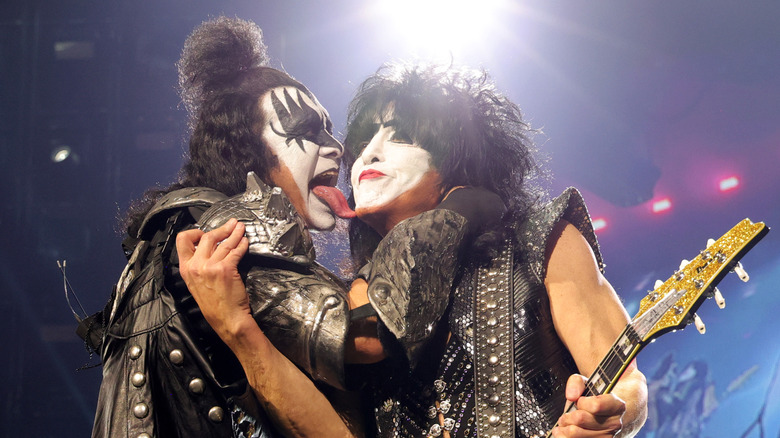
Kiss without makeup
After years of massive success, the messed up reality of Kiss found the band entering the 1980s with back-to-back career misfires. The first came in 1981 with the ambitious concept album "Music from 'The Elder,'" trading the band's hook-driven hard rock for pretentious prog. "We were convinced that we were making our 'Sgt. Pepper,'" bassist Gene Simmons told Classic Rock.
The album flopped hard, and in 1983 the band decided on a drastic pivot. Known for their comic-book costumes and kabuki-style face paint, after years of keeping their faces hidden, Kiss removed the makeup and ditched the costumes. "It feels good," Simmons said of finally baring his face when they made their makeup-free debut on MTV. "It feels very, very comfortable." The stunt proved successful, at least in the short term, sending sales of new album "Lick It Up" soaring. As the decade wore on, however, it was clear that the band's fans missed the fire-breathing, blood-spewing Kiss of the '70s. "Everybody hated it," Simmons told fanzine Porkchops and Applesauce of the reaction to the makeup-free band (via Yahoo! Entertainment). "People didn't want the paint to come off, but you know what? Tough. It had to happen."
In 1996, the original lineup of Kiss revived the makeup and costumes for a reunion tour. Any doubts that fans were hungry to see the Kiss of old were quashed when the first show — at Detroit's 50,000-seat Tiger Stadium — sold out within an hour.
Neil Young embraces a new wave synth sound
Part of the untold truth of Neil Young is that he became interested in electronic music in the early 1980s, while working with computers to communicate with his son Ben, who was born with cerebral palsy and couldn't speak. At the time,Young had been recording with his longtime backing band, Crazy Horse, but made a radical left turn while experimenting with a vocoder and Synclavier. "Next thing we knew, Neil stripped all our music off, overdubbed all this stuff, the vocoder, weird sequencing, and put the synth s*** on it," Crazy Horse guitarist Frank Sampedro said for the book "Shakey: Neil Young's Biography."
The result was "Trans," an album with a heavy synth sound and Young's vocals turned robotic via the vocoder. The album received decidedly mixed reviews, leaving many music critics baffled. The same held true with audiences when Young took "Trans" on the road, with the musician recalling "when I wore the vocoder and people booed me."
"Trans" was the first album Young made for his new label, Geffen Records, and it sold miserably. Label execs demanded he return to rock 'n' roll for his next album. Young did just that — albeit not in the way they'd imagined — with his follow-up, "Everybody's Rockin'," a collection of rockabilly covers and originals that sounded like they'd been recorded in the '50s. Geffen responded by suing Young for $3.3 million, accusing him of making Neil Young albums that didn't sound like Neil Young.
Sweet went from glam to prog
British band Sweet rode the glam explosion to success with the 1975 hits "Fox on the Run" and "Ballroom Blitz." By 1978, the band was seeking a new direction, and veered from glam to progressive rock with the album "Level Headed."
Whie the album yielded a big hit with "Love Is Like Oxygen," other tracks on the album went over the edge. "Anthem Number 1 (Lady of the Lake)," for example, begins with an Elizabethan harpsichord flourish and manages to become even more self-indulgent.
As guitarist Andy Scott told Goldmine, prog seemed like a good idea at the time. "But it was natural where we were going to go, because once we'd had a couple of hits with 'Fox on the Run' and 'Action,' you know, the logical step after 'Love Is Like Oxygen' is to be a band that is probably going to be more in the Genesis and Yes camp than in the glam rock area of the early '70s," he said. Sweet's next few albums ("Cut Above the Rest," "Waters Edge," and "Identity Crisis") found the band floundering while trying to define a new sound, and the hits stopped coming after that.
Yes transformed from prog to pop
During the 1970s, few prog-rock bands were proggier than Yes. Boasting complex arrangements and stellar musicianship — and ponderous album titles like "Tales from Topographic Oceans" — the Yes sound remained consistent until the 1983 album "90125," a radical departure for Yes that incorporated elements of pop and new wave. Produced by Trevor Horne (formerly of the Buggles), the album spawned the No. 1 single "Owner of a Lonely Heart," bringing the band its biggest commercial success to date.
What listeners didn't realize was that "90125" was more of a Trevor Horne album than a Yes album. Frontman Jon Anderson had quit Yes in 1980, but rejoined the band during the album's final stages. By then, the album was nearly completed, and Anderson's contribution was essentially adding vocals and harmonies to already completed tracks. "I went in and sang lyrics and melodies and I just got in there at the right time, just to embellish what was already very good, musically speaking, and production-wise," Anderson told Eon Music.
For the follow-up to "90125," Anderson was keen to push the band in more musically adventurous directions. That placed him at odds with Horne, who wound up banning Anderson from rehearsals for the next album, 1987's "Big Generator." "It never really had a direction," Anderson said of that record, which failed to capitalize on the momentum of its predecessor. Anderson subsequently quit; he rejoined in 1991 for "Union," a return to the band's prog roots.
Garth Brooks introduces Chris Gaines
In reviewing the untold truth of Garth Brooks, by the late 1990s he'd become the undisputed king of country music, gaining millions of fans with feel-good honky-tonk hits such as "Friends in Low Places." Who knew that lurking beneath that ever-present cowboy hat was a mopey alt-rocker? Yet that was what fans discovered in 1999 when Brooks introduced alter ego Chris Gaines, a grunge-adjacent, shaggy-haired Australian rocker with a soul patch beneath his pouty lower lip and a penchant for eyeliner.
Gaines — actually a bewigged Brooks — released a greatest hits album and was musical guest on "Saturday Night Live" when Brooks hosted. The launch included a hilariously pretentious music video for the single "Lost in You" (which inexplicably hit No. 5 on Billboard's Hot 100), and even a VH1 "Behind the Music" special recounting the fictional character's fake life — all with the goal of a Gaines-starring movie, "The Lamb." The film was abandoned when the whole thing became a pop-culture laughingstock.
Ultimately, Chris Gaines proved to be as popular as New Coke when it was introduced in 1985 and yanked off the shelves months later. "A lot of people misunderstood it, and my ribs are still sore from getting the s*** kicked out of me for it," Brooks told Yahoo! Entertainment.