

Guitarists That Hurt Their Own Legacy
There's no instrument more synonymous with rock music than the guitar, and accordingly, many of the genre's most enduring legends are its guitarists. Their ear-worm riffs, resounding chords, and artful solos have defined rock music for decades and transformed more than a few into veritable gods of the artform. Unfortunately, even the godliest among them are still human at the end of the day, and some have thoroughly demonstrated the fallibility that comes with it.
For better or worse, the music and the musicians themselves are often intertwined when it comes to their public perception and legacy, and for a handful of guitarists, that connection is decidedly for the worse. Whether due to controversial beliefs, criminal activities, or activities that perhaps should have been criminal in hindsight, rock has seen its share of tarnished reputations.
We chose guitarists whose musical legacies have started to become eclipsed by the controversies surrounding them. Though you'd expect a guitarist's enduring impact to come from their skill with the instrument and the music they created with it, especially the all-time greats, we nonetheless found some who have come to be known as much for their personal lives as anything musical. From the highest highs of rock superstardom to lowest lows of the media gutter, here are five guitarists that hurt their own legacy.
Eric Clapton

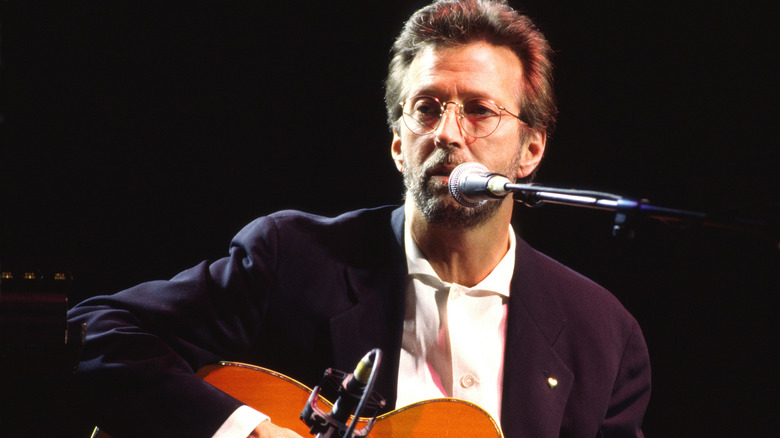
As a solo artist and as a member of bands like the Yardbirds and Cream, Eric Clapton has spent most of his 60-plus-year career cementing his legacy as one of the greatest and most influential guitarists of all time. Time after time he reinvented himself, whether touted as a god of the psychedelic blues scene, an early ambassador between reggae and pop, or as a gifted songwriter and hitmaker. Sadly, Clapton has taken on some less admirable roles in his career, including, as he himself put it during a 2018 Q&A, that of a "semi-racist" (via The Daily Mail).
Clapton was specifically referencing an incident from a 1976 concert of his in which he drunkenly implored any foreigners in his crowd, and indeed anywhere in England, to leave the country. He then descended into a tirade chock full of racist slurs and capped it off with "Keep Britain White," a well-known far right motto at the time. To make matters worse, Clapton refused to apologize for the remarks at first, even telling Sounds Magazine months later that he still found it "quite funny."
To his credit, as part of the aforementioned Q&A, Clapton said he was disgusted by his past behavior. For many, however, any goodwill Clapton earned back with his eventual apology was short-lived, as just over two years later, the aging rocker began a multi-year campaign to end mask mandates and lockdowns in the wake of the COVID-19 virus outbreak.
Jimmy Page
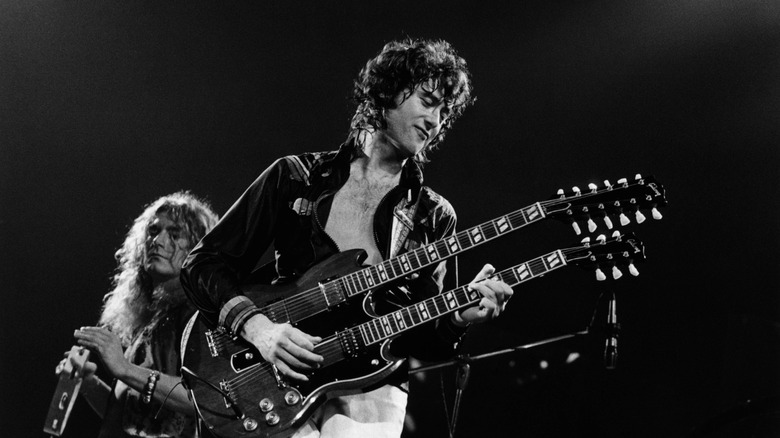
There are few bands that embody pure rock 'n' roll like Led Zeppelin, and Jimmy Page is arguably the clearest embodiment of the band's sweaty, Satanic, smoke-filled image. A perennial entry near the top of best guitarist rankings and oft-cited inspiration for guitarists to follow him, Page's contribution to the world of rock guitar playing is almost unparalleled. To put it simply: Jimmy Page simply is rock 'n' roll. People can be many things, however, and in Page's case, he's not only a rock god but also a man who, alongside his Zeppelin bandmates, has been plagued by allegations of songwriting theft.
Over the years, Page and Led Zeppelin as a group have repeatedly been accused of stealing material from other artists. There's the lawsuit filed by Randy Wolfe, who alleges the band stole portions of "Stairway to Heaven" from his song "Taurus," though to Zeppelin's credit, the court ruled that there was not enough evidence for copyright infringement. The band fared somewhat worse, however, when they were forced to settle out of court with Willie Dixon, who claimed that Zepp's "Whole Lotta Love" cribbed lyrics from his own "You Need Love," and recently, when Page had to settle out of court again with Jake Holmes, the songwriter who actually wrote "Dazed and Confused," not Page, as was originally credited.
Ritchie Blackmore
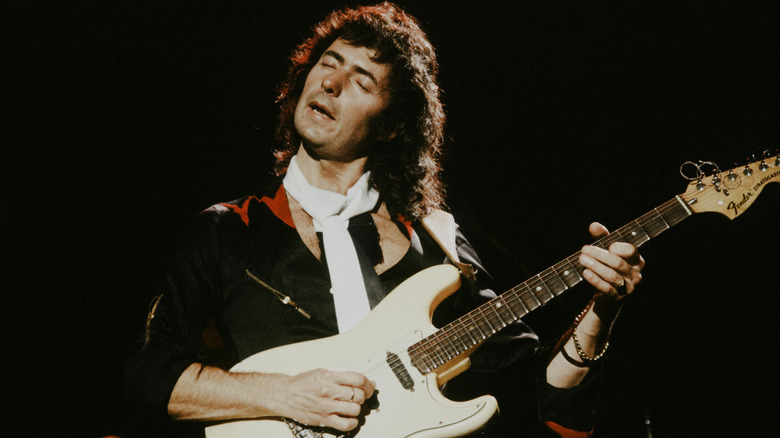
Though not as much a household name as Clapton or Page, Richie Blackmore is every bit as integral to the history of classic rock. As a founding member of Deep Purple, Blackmore was an integral part of the formation of hard rock and an enduring influence throughout the genre's evolution. If he had done nothing else, Blackmore's creation of the signature "Smoke on the Water" riff would have cemented him in rock guitar history, but as part of Deep Purple and later of Rainbow, Blackmore did plenty more.
Despite his contributions to rock guitar history, Blackmore's reputation today is clouded by numerous allegations of being confrontational and unprofessional, something the legendary rocker doesn't refute. Blackmore once told The Guardian that he got his reputation "by being very moody... telling people to f*** off when I shouldn't have done. But I don't care, not at all. I quite like it." Blackmore famously found himself at odds with his Deep Purple Bandmates on multiple occasions, including with frontman Ian Gillan — enough for him to quit unceremoniously twice, and according to some, the main gist of his grievance was not having enough control.
In later years, Blackmore reunited Rainbow without its mainstay former members, despite their complaints, which former Rainbow vocalist Joe Lynn Turner told the Rock of Nations podcast was a "trainwreck" that "damaged the legacy... of Rainbow" (via Blabbermouth.net). Perhaps nothing is more telling of Blackmore's damaged legacy than the fact that, when Deep Purple were inducted into the Rock & Roll Hall of Fame in 2016, Blackmore was told by the band's management not to attend.
Chuck Berry
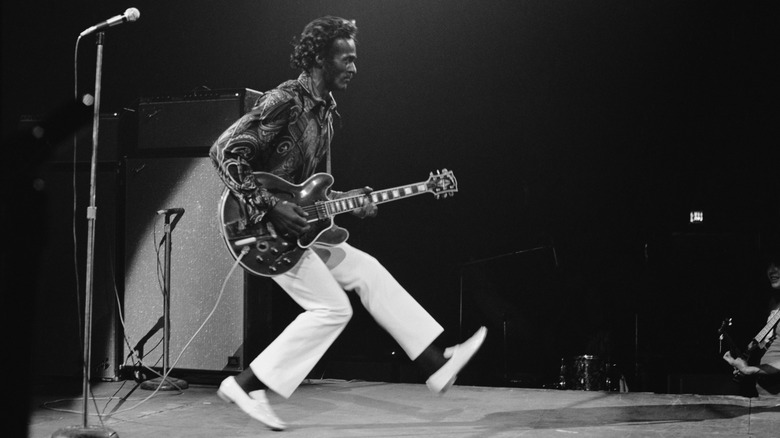
The late Chuck Berry is widely known as the father of rock 'n' roll, and at times even its outright inventor. Berry was instrumental in creating the signature blend of country, R&B, personal songwriting, and showmanship that came to define rock 'n' roll and does to this day. His early singles, especially "Johnny B. Goode" are often considered the archetypical rock songs, and likewise his double-stop-heavy guitar style is often cited as the archetypical rock guitar style. Even genre pillars have cracks, though, and for Berry, those take the form of armed robbery, tax evasion, harassment, and worse.
The first of Berry's brushes with the law began when he was just a teenager after he tried to commit armed robbery with a handgun. For that, he spent three years in a youth correctional facility. Another incident occurred in 1979, when Berry was sentenced to four months in prison for tax evasion. Yet another came in 1987, in which Berry was accused of assaulting a woman, though he was able to plead guilty to a lesser charge of harassment. Most infamously of all, Berry was sued by several women who alleged that Berry had secretly videotaped them using the bathroom in Berry's restaurant. To that, Berry settled out of court for an undisclosed sum, but no amount of money could fix Berry's reputation.
Ted Nugent
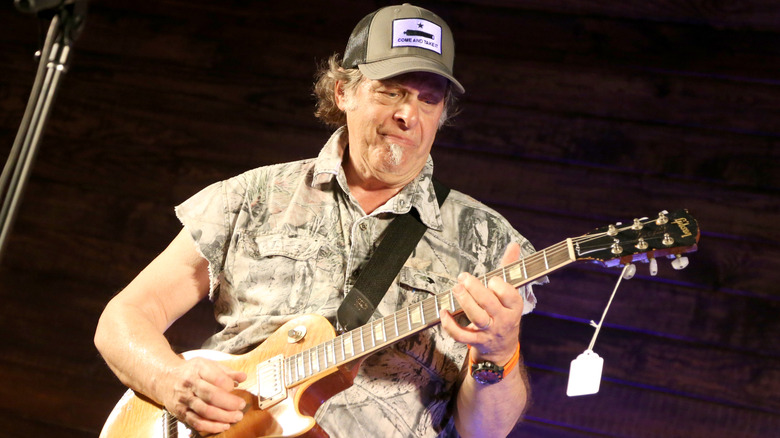
Ted Nugent, or The Nuge, is a singular figure in the world of rock guitar. Despite achieving success as a solo musician in the '70s and with bands like the supergroup Damn Yankees, his public image has over time become almost entirely wrapped up in his politics, personal beliefs, criminal history, and shady practices. Indeed, whatever legacy Nugent created as a guitarist has long since been eclipsed by his seemingly steadfast determination to be a terrible person, at least in the eyes of many.
It's hard to know where to begin with Nugent's many controversies. He once told The Independent that he wished the U.S would "Nagasaki" the country of Iraq. He called the children survivors of the Parkland school shooting "mushy brained children" with "no soul" (via The Associated Press). He called former president Obama a "subhuman mongrel" (via MS Now). He said that Hillary Clinton should be "hung [sic]" (via Media Matters). Talking about the abolishment of South African apartheid, he said the issue "isn't that cut-and-dry. All men are not created equal" (via Salon). These incidents only scratch the surface of The Nuge's monolithic oeuvre of controversy, one that has come to completely overshadow his legacy as a guitarist.