

5 Songs Featured In EPiC: Elvis Presley In Concert That Define The Untamed Spirit Of Rock And Roll
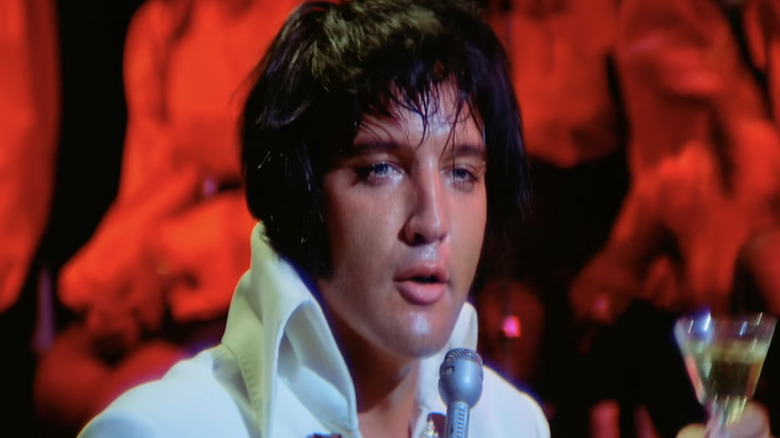
The songs showcased in the 2026 film, EPiC: "Elvis Presley in Concert," demonstrate exactly why Presley became the personification of rock 'n' roll. Overseen by "Elvis" director Baz Luhrmann, "Elvis Presley in Concert" features presumed lost footage from "Elvis: That's the Way it Is" and "Elvis on Tour," painstakingly restored, edited, and digitally juiced to create an authentic concert experience that's both immersive and dreamlike. If Luhrmann aimed to show contemporary audiences what a powerful and electric force Presley live could be, he effectively managed the task. Grunge attended an advance screening and was in awe of Elvis' energy and his almost otherworldly connection to the music — from his physical movement onstage to the behind-the-scenes jam sessions.
Even the most jaded fans would agree that the film gives new meaning to Elvis' title as "The King," deconstructing what once felt like a cliché and revealing the raw current of rock 'n' roll coursing through him during this iconic moment of time in Las Vegas. These archives reflect the best parts of Elvis — and that story is told in spectacular color. "Elvis Presley in Concert" features songs from the King's entire career, performed in the bombastic, showy style he thoroughly embraced in the '70s. But the sheen and grandiosity can't mask the pure, gritty, rock energy inside. Here are five songs that we think stand out from EPiC: "Elvis Presley in Concert" because they capture the essence of all-American rock 'n' roll.
That's All Right
"Elvis Presley in Concert" takes its subject full circle, back to where the story of Elvis Presley as a superstar began. The film presents a bold and rapid-fire live take on "That's All Right," an early 1950s rave-up that was the very first song Elvis Presley recorded, back at a Sun Records studio in 1954. The iteration captured in "Elvis Presley in Concert" reflects where Presley stood musically in 1970, but it's hard to hide the fire and natural acumen its performer was already demonstrating before he was even famous. "That's All Right" is jittery, exciting, and unpredictable, and it's easy to see how it launched an influential career.
Both in the concert film and the original pressing, "That's All Right" sounds like a rock 'n' roll song from a time when rock 'n' roll was still a work in progress and trying to figure out its identity. And that's part of the charm. "That's All Right" wears its influences out loud — one can hear lots of foundational rock elements like gospel and R&B, as well as plenty of country and rockabilly. It's frenetic, raw, and jumbled, and Presley was probably always going to sound like he was singing it at some wonderful and obscure roadhouse.
Hound Dog
It was common practice in the 1950s for multiple artists to record the same song, particularly with white artists covering tunes marketed to Top 40 radio that had originally been hits by Black artists on the R&B charts. One of Elvis Presley's signature songs, "Hound Dog," is an example of this. Originally made famous by Big Mama Thornton as an electrifying blues-forward number recorded in 1952, Presley and his team sped up the pace, added an insistent drumbeat, and replaced the blues licks with a pervasive and wandering electric guitar groove.
Early rock 'n' roll was largely formed by taking R&B and applying country techniques, and Presley's "Hound Dog" did just that. It was also an excellent showcase for the singer's unique skills. On the original recording, he sounds irritated and angry with the ne'er-do-well subject of "Hound Dog," but he can't help but snarl and wail his way through it. In this instance, rock 'n' roll is catharsis that can work a person up. In the live version captured for and presented in "Elvis Presley in Concert," "Hound Dog" comes early in the show and works up the crowd, reminding attendees of their misplaced youthful rock 'n' roll vigor, or what it must have been like to be an Elvis Presley fan in the 1950s.
Polk Salad Annie
Presley's 1970 live album "On Stage" was recorded at around the same time as the footage that makes up "Elvis Presley in Concert," and it's on that LP where the singer's take on "Polk Salad Annie" first appeared. That song also pops up in the 2026 concert documentary, and it's clear that Presley had honed and perfected his approach, turning it from a mere cover of a contemporary song by Tony Joe White into a captivating performance. Elvis Presley had a knack for showmanship and audience service, which were two big parts of rock 'n' roll from the beginning and what helped make the genre so infectious, as well as partly why it spread so rapidly. It's in "Polk Salad Annie" on "Elvis Presley in Concert" where those factors are very obvious.
"Polk Salad Annie" is a down-and-dirty swamp rock story, sounding a lot like the music of Creedence Clearwater Revival, which was extremely popular at the time "Elvis Presley in Concert" depicts. It's the story of a no-nonsense-taking woman foraging for wild and possibly toxic greens deep in Louisiana. The lyrics match Presley's fully rockabilly performance: It's folky, informal, and more than a little bit sinister. Presley punctuates his singing with showy touches, like drawing out long, spoken sections with musical backing and punctuating big moments with braying instrumental pops.
Little Sister / Get Back
In his early 1970s concerts, Elvis Presley gave fans a career-encompassing performance, and that idea is intact in the 2026 concert film "Elvis Presley in Concert." He seamlessly bridged the old with the new, telling the story of the evolution of rock 'n' roll from his own, unique perspective in musical form and over the span of only a few minutes. One of the many live medleys preserved in "Elvis Presley in Concert" is a "Little Sister / Get Back" combo.
As simultaneously languid, cocky, and crackling as pretty much any other song Presley recorded in the mid-1950s, "Little Sister" was actually released in 1961 and became a No. 5 hit — a throwback to a period not that far removed, but still somewhat distant because the style of its performer's output had so rapidly transformed.
In "Elvis Presley in Concert," the singer blasts through "Little Sister" almost breathlessly, as if he can't wait to get to the twist that elicits audible delight from the audience. All of a sudden, and with zero awkwardness in transition, "Little Sister" turns into the hard-charging "Get Back," one of the last songs performed live by the Beatles before the band's story ended. With this two-part song in "Elvis Presley in Concert," Presley was making a statement about rock 'n' roll heading in the right direction; as the lyrics to "Get Back" would suggest, he was getting back to where he once belonged.
A Change of Reality (Do You Miss Me?)
Baz Luhrmann didn't just take and restore old clips of Elvis Presley singing live and have them strung together for "Elvis Presley in Concert." He allowed a few modern-day musical minds, including producer and "Elvis" collaborator Jamieson Shaw to experiment with some of the audio. In helping Luhrmann to realize his creative vision with "Elvis Presley in Concert," Shaw revisited and reinvented two Presley tracks, one obscure and one very well known, to create an aural pastiche that explores rock 'n' roll's many uneasy dichotomies.
Presley's 1970 non-hit "Edge of Reality" is one of the artist's more experimental songs, marrying emotional country themes with an aggressive horn section and some light psychedelia. "Are You Lonesome Tonight" is a quiet, subtle, and restrained acoustic ballad that spent six weeks at No. 1 a decade prior. In "Elvis Presley in Concert," Shaw merged those two songs into "A Change of Reality (Do You Miss Me?)." The track, raunchy and overwhelmed, and then moody and sad, sends out mixed messages. Presley rails against a partner who has done him wrong, only to then plaintively pine. This person drove him literally mad, he claims, but then he's also just lonely, a mid-century euphemism for lacking physical affection. It's all a jumble of love, lust, and frustration, and Presley was a master at putting all those feelings to music and finding a massive audience that could relate.