

The Sickest Album Closers In Rock History
We are no longer in the era where albums are the primary way for rock fans to enjoy the music of their favorite artists — playlists and shuffle functions have changed the habits of the majority of listeners. Yet these long-form collections of songs can still be the most satisfying way of approaching the musicians' discographies. When special thought goes into how tracks are sequenced, it can take a listener on a journey they wouldn't get by listening to the songs at random. And sometimes, they can be rewarded with a cinematic climax: an album closer on which the artist goes all out and rounds things off with a sense of occasion.
Here, then, are five of the sickest closers in rock history. These tracks have been specially selected for being ultimate deep cuts where the artists in question decide to go big. This can be either by taking the listener somewhere new and exciting or by saving their best for last, pulling a rock classic out of the bag at a point where lesser acts might opt to hide their weaker material. Enjoy.
Tomorrow Never Knows — The Beatles
There's an argument for saying that "A Day in the Life" is the sickest closer in The Beatles' discography. The epic finale of 1967's "Sgt. Pepper's Lonely Hearts Club Band" combines John Lennon's psychedelic meanderings with Paul McCartney's weird-yet-quotidian portraits of daily life. But "Tomorrow Never Knows," which was released the previous year as the closer to "Revolver," really was the track that changed everything.
With a line adapted from Timothy Leary's "The Psychedelic Experience" — "Turn off your mind, relax, and float downstream" — "Tomorrow Never Knows" is one of Lennon's most mind-opening tracks. It reflects his experiences taking LSD and genuinely attempts to capture the feeling of disembodiedness that such drugs create. As George Harrison noted in "The Beatles Anthology," the lyrics are also informed by traditional approaches to meditation that are intended to help practitioners achieve pure consciousness. But it isn't just the lyrical content that makes the song so expansive.
"Tomorrow Never Knows," which was the first track recorded for "Revolver," includes several innovative instances of studio trickery that give the song a trippy feel. Innovations included applying heavy compression to Ringo Starr's atypical drum pattern, adding a plethora of distorted tape loops, and channeling Lennon's vocal toward the end of the track through a speaker usually used for Hammond organs to give it the feel of a religious chant. Utterly mind-blowing to listeners at the time, it remains one of the band's greatest studio achievements.
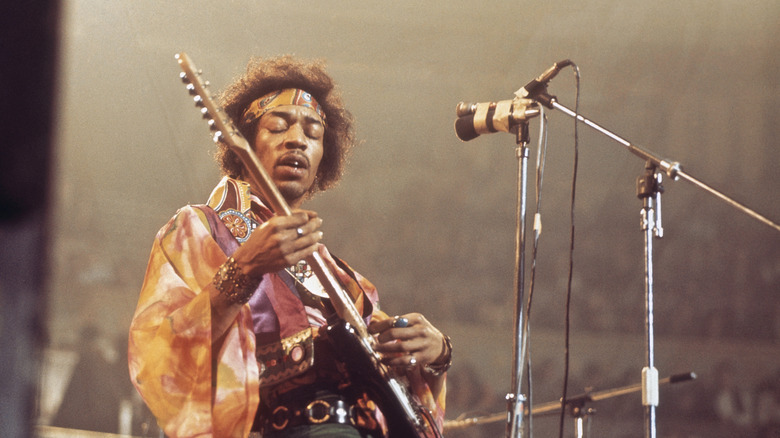
Voodoo Child (Slight Return) — The Jimi Hendrix Experience
Is there a cooler final track in the whole of classic rock than Jimi Hendrix's "Voodoo Child (Slight Return)"? If the title sounds familiar, it's because the song is a nod to the 15-minute blues jam "Voodoo Chile" that rounds out side one of The Jimi Hendrix Experience's 1968 classic double album "Electric Ladyland." But "Slight Return" sees the trio ramp up the tempo, power, and effects to create arguably the most thrilling track in Hendrix's discography.
Beginning simply enough with a gentle funky riff, which is soon accompanied by just a touch of Mitch Mitchell's drums, the track suddenly switches into a wailing, swashbuckling screamer drenched in reverb. The shift transforms Hendrix himself into a supernatural priest-like figure who tells us he will chop down a mountain "with the edge of my hand." But there is magic, too, in the music, with exceptional bass playing from Noel Redding, whose bass lines slide around the fretboard and give the track its woozy foundation, while Hendrix delivers the wah-wah performance of a lifetime.
The track remained important to Hendrix. He performed it toward the end of his career with the Band of Gypsys and even dedicated it to the Black Panthers during his "Live at Fillmore East" appearance. After Hendrix's tragic death in 1970, it was released as a single in the U.K. and reached No. 1, his only song to do so in the country.
When the Levee Breaks — Led Zeppelin
Typically, "Stairway to Heaven" is considered the standout track from "Led Zeppelin IV." But those willing to delve for deeper cuts get their reward at the end of side two with "When the Levee Breaks." The grinding blues-rock epic takes its cue from a 1929 recording about the 1927 Mississippi flood by Memphis Minnie and Kansas Joe McCoy.
Drummer John Bonham is exceptional on most Zeppelin cuts, but he sounds especially bright here, reportedly due to his playing for the first time on a brand-new kit. The track comes blaring at the listener thanks to one of vocalist Robert Plant's most exuberant harmonica solos. Then there are Jimmy Page's hypnotic guitar parts, with a haunting sound that was achieved in the studio by playing at a higher tempo and then slowing the recording down. Plant's vocals are also at a career high, expressive and melancholic, but always in the service of the track's defiant, plaintive atmosphere. Surprisingly, the track was only performed live on the first dates of Zeppelin's 1975 tour of the U.S., but it has remained a classic album closer.
Emerald — Thin Lizzy
Thin Lizzy is best known today for its upbeat, party-friendly brand of hard rock, as captured best on the evergreen hit "The Boys Are Back in Town." But as album listeners know, Phil Lynott and the lads could take things to an epic sphere when they wanted to. Just look at "Emerald": The final track on the group's multi-million-selling classic album "Jailbreak."
As with many hard rock epics, the track describes a vicious battle scene: "Down from the glen came the marching men / With their shields and their swords / To fight the fight they believed to be right / Overthrow the overloads." The bloody act of rebellion is a distillation of Irish history, complemented by the interplay of guitarists Brian Robertson and Scott Gorham — the first time duelling guitars had been deployed on a Thin Lizzy record. Celtic motifs add to the historic atmosphere, while Lynott's vocal performance is utterly commanding. "Emerald" would become a favorite at Thin Lizzy gigs, with the version captured especially full-blooded on the classic live album "Live and Dangerous."
Purple Rain — Prince and the Revolution
The "Purple Rain" era is when Prince went into the stratosphere, holding the No. 1 album, movie, and single ("When Doves Cry") in the U.S. around the same time. And while almost everything that The Purple One released in 1984 is solid gold, nothing reaches the epic heights of the album's self-titled closer. Prince had trained prodigiously as a musician under his father John L. Nelson, and "Purple Rain" pulls together many of his key influences from his formative years.
This is a gospel track as well as a ballad, which evolves over the course of six minutes into a febrile lead guitar showcase. If the album is framed as a religious ritual — the opening track famously begins, "Dearly beloved / We are gathered here today / To get through this thing called 'life'" — then this closer is the communal moment of religious fervor. The song ties together Prince's faith and gospel background with the rock-infused, psychedelic aspects of his artistry. Despite the oblique nature of the imagery and the song's genre-blending sonic palette, it's a total crowd-pleaser, suited to epic moments. No wonder Prince selected it to close his famous Super Bowl halftime show back in 2007.