

5 Chart-Crushing Songs That Deserved To Flop
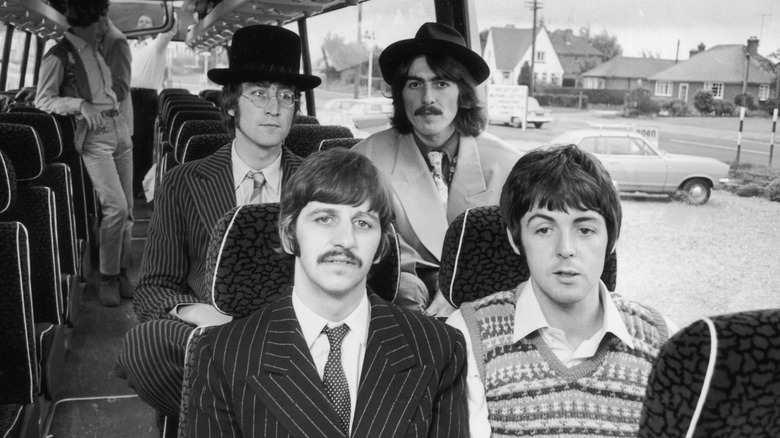
Over the decades, fiendish fan ignorance has sent some absolute clunkers to the top of the charts. Sometimes it's a sub-par track from an established band that gets undeserved bonus points for being by an artist known to have produced better work, such as the Beatles or the legendary Chuck Berry. Other times it's a novelty gimmick that rises on the strength of being about adultery or a half-hearted naughty pun. Put these grade-inflating tactics together with underdeveloped and trite lyrics, and you've got a gold or platinum record that, under the glitz, still stinks like a week-old tuna melt.
For our examples, we've selected songs that reached No. 1 on the Billboard Hot 100, yet were lacking in some musical quality that such high-achievers typically possess. And while we wouldn't expect a classic Beatles song, say, to flop so hard as to languish at the bottom of the charts, these entries ought not to have come close to No. 1. Whether it be inane lyrics, hodgepodge compositions, rapidly dated attempts to cash in on the zeitgeist, or all of the above, we think these songs say more about the fickle tastes of the public than the skills of the musicians who profited from them.
My Ding-a-Ling – Chuck Berry
Quick, without looking: What was Chuck Berry's first No. 1 hit? The country-inflected "Maybellene," from 1955? "Roll Over Beethoven," the triumphalist rock anthem from 1956? Surely he didn't have to wait until the wry young-love ditty "You Never Can Tell" came out in 1964? Chuck Berry, in fact, had to wait until 1972, the friggin' Nixon administration, to hit the top of the charts, with one of his worst songs: a novelty number called "Ding-a-Ling." It was his only No. 1.
"Ding-a-Ling" tells the improbable story of a little boy being given a string of bells as a toy and then playing with his "ding-a-ling" at church, showing it to girls, protecting it from snapping turtles, and so on. How you feel about this song will depend largely on how you feel about lazy double entendres, but even the most committed genital-humor aficionado would admit that it's not Berry's best work. (And with some live versions being more than four minutes long, it wears out its welcome.) "Ding-a-Ling" also can be read as a perverse taunt: Berry had served a short term in prison for sexual crimes before this release and would face investigations later in his life, but he never got fully "canceled." Dirty jokes are one thing, but they're better if they're good ... and if they're told by decent people.
Hey Jude – The Beatles
"Hey Jude" is one of the few completely unforgivable songs in rock history. At an interminable seven-plus minutes, depending on the recording, it's one of the longest tracks ever foisted on innocent radio listeners, blasting away even the six-minute multi-act opera "Bohemian Rhapsody" and making Janis Joplin's decades of ululation at the end of "Me and Bobby McGee" feel like the blink of an eye.
And of course, a colossal percentage of that seven-plus minutes of "Hey Jude," over half the runtime of the song, is the pseudo-word "na." There's apparently no full consensus on how many times the ostensibly Fab Four sing "na" during the song, as there's more than one recording and even dedicated Beatlemaniacs can only take so much, but it's a ludicrous amount. Imagine the sheer hubris of stopping writing a song but continuing to sing it when you're out of words, just making sounds like a child asking for a banana. Perhaps the breakup of the Beatles actually saved future songwriting.
Aquarius / Let the Sunshine In – 5th Dimension
If you don't believe in astrology, a certain type of person won't be dissuaded: They'll just tell you that's how Scorpios are. Since 1969, people who would rather blame the moon than structural racism, their parents, or mere fate have had an unofficial anthem, the unrealistically optimistic "Aquarius / Let the Sunshine In" by 5th Dimension. This weird chart-topper is a medley of two songs from the hippie-dippy musical "Hair," which the members of 5th Dimension caught by chance and, unfortunately, loved.
According to band member Florence LaRue, who gave an interview to American Songwriter, the band wasn't even astrologically inclined, and LaRue herself liked to imagine the lyrics as referring to letting the Son, as in Jesus, in. 5th Dimension had just liked the upbeat optimism of the songs and decided to Frankenstein them together and unleash them on an unsuspecting America. One man's cheerfulness is another man's drivel: lyrics like "... peace will guide the planets / and love will steer the stars" are dangerous to listen to while driving if you're prone to rolling your eyes, and they do just sing "Aquarius" a lot.
Musically, it feels like two songs, with the seam between the two unusually sharp for a medley. As a cohort, flower children were never especially strong musicians (since it's hard to practice an instrument effectively while stoned out of your gourd), and "Aquarius / Let the Sunshine In" is ultimately a middling entry in a middling era of American popular music.
Escape (The Pina Colada Song) – Rupert Holmes
Few songs have ruined a classic cocktail the way "Escape (The Piña Colada Song)" wrecked its namesake tipple. The tiki mainstay, through no fault of its own, was implicated in a mediocre earworm of a song about chill infidelity and bad dates. It's still hard to order one without worrying someone near you will throw their empty head back and bellow, "if you like piña coladas" — and it's all Rupert Holmes' fault.
Musically, the track is unremarkable, with the melody never rising above the complexity of phone call hold music, and Holmes' vocals can be best described as "competent." Lyrically, it's a nightmare. Farcical attempts at infidelity are one of the classic comedy plots, so Holmes is on okay ground with his story of a man, bored in marriage, who meets up with a gal from the personal ads to find that his would-be mistress is his own wife, herself looking for a little excitement. Cute, maybe! But the exchanges between the spouses make you think they may deserve a bad marriage. Nearly everyone likes piña coladas and champagne, no points there, and the idea of making love on the dunes should repel anyone with a cursory understanding of human reproduction and sand. The worst people you know were already married to each other, saving two other people the misery! We'll toast to that.
Night Fever – The Bee Gees
In a development that still baffles subsequent generations, the Bee Gees hit world charts in the late '70s like the Soviet Army rolling into Germany, sweeping everything before them. Fewer people died, but the victory was as complete; instead of tanks, the Bee Gees had male sopranos. Even for people who like the Bee Gees, "Night Fever" stands out as the weakest of the falsetto chart-smashers put out by one or more Gibbs.
The gimmick made them rich, but the falsetto vocals on "Night Fever" now sound dated, and the difficulty of singing in that register means they never really deliver any power or interesting phrasing. The melody of "Night Fever," such as it is, is unremarkable; this isn't a song many people could or would walk around humming.
The lyrics, though, really take this one into the doghouse: "I got fire in my mind, I get higher in my walkin' / And I'm glowin' in the dark, I give you warnin'." This immortal gibberish punctuated some vagueness about a "sweet city woman" who some Gibb or other is dancing with, or making love to, or singing to, or something. And then they sing "Night Fever, Night Fever" a few thousand times so you remember the name of the song. The very last line of the song is "Feels like forever," and brother, show me the lie.