

Rock Stars Who Regretted Leaving Their Mega-Successful Bands
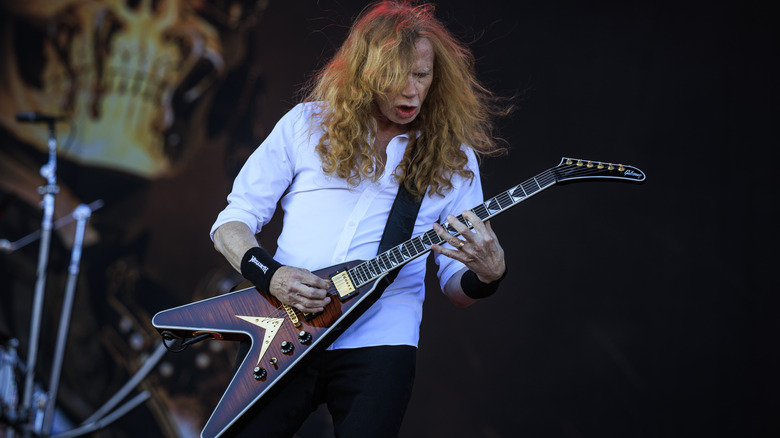
It's not an uncommon phenomenon for a rock star to exit the stage in the midst of roaring success. And while many musicians claim they have no regrets about parting ways, others have been a bit more circumspect about the breakup, expressing regret or disappointment for how things went down.
Whether it's the vicissitudes of the music business, combustible relationships between band members, grueling touring schedules, addiction issues, or other factors, these rock stars either walked away from or were pushed out of ragingly successful bands such as Metallica, R.E.M, and Judas Priest. Some are still sore about it, even if they went on to other successful acts, while others chose a complete change of career that was followed by second thoughts. In some cases, those turncoat rock stars went crawling back to the bands they left. They say hindsight is 20/20, and in the case of these rock stars, that adage certainly holds true.
Rob Halford — Judas Priest
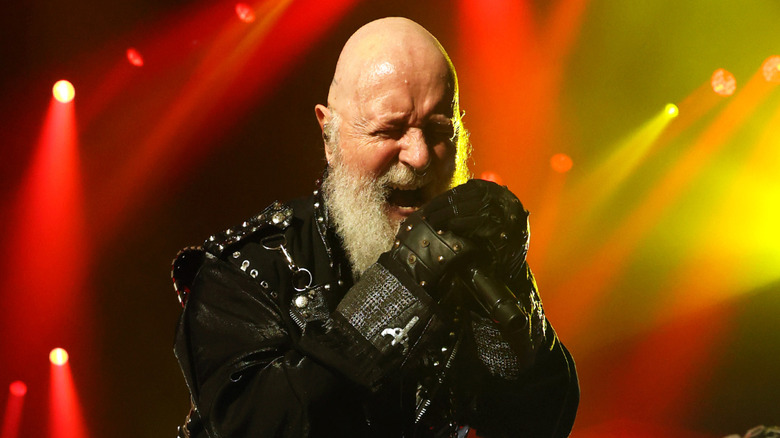
Rob Halford helped transform Judas Priest into one of the premier British heavy metal outfits of the late '70s and 1980s, with chart-topping albums like 1982's "Screaming for Vengeance." With his operatic singing style and penchant for leather and chains, he helped define the sound and look of metal. Halford was riding high, backed by the band's dual-guitar sound, but then in 1992, he walked away from the band.
Judas Priest had just come off of a long tour, which had followed an emotionally charged court case over accusations of subliminal messages in a song, which had allegedly led to the death of two teens. In that atmosphere, Halford decided he needed to make a change and so quit Judas Priest. He decided to go on a "self-journey of discovery," he told Rolling Stone in 2020. "Internally, as difficult as it was for me to be away from the band that I lived for, it kind of brought things into perspective and led me back to the place where I felt this is where I need to be," he said.
Still, Halford has expressed regret at how he left. "Never in a million years would I ever have wanted to leave, formally leave, go away from Judas Priest," Halford told France's Heavy1 in 2021 (via Backstage Pass Rock-News). A decade later and after several other musical projects, including the industrial band 2wo (aka Two), Halford returned to Judas Priest.
Bill Berry — R.E.M.
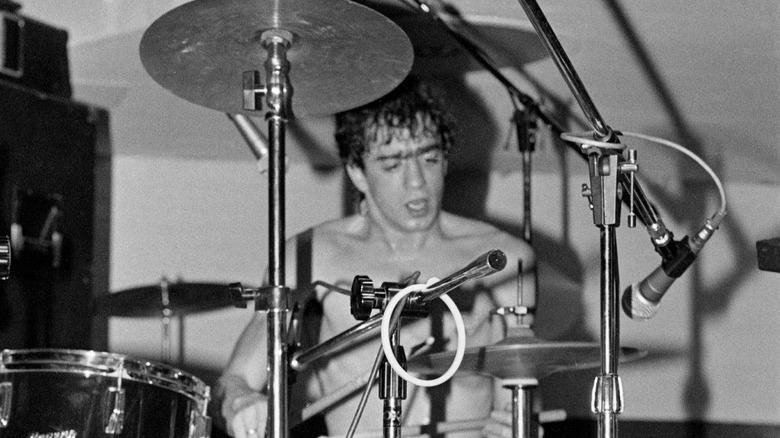
Bill Berry's precise drumming was the heartbeat of R.E.M. from the band's beginnings in 1980 until 1997, when he upped sticks and left. With the other founding members of this Athens, Georgia, group — Michael Stipe, Mike Mills, and Peter Buck — R.E.M. went from the dreamy jangle pop of its first album, "Murmur," to the top of the charts in the 1990s with albums like "Out of Time" and "Automatic for the People." But despite the Grammys and global stardom, after having a brain aneurysm on stage in Switzerland in 1995, Berry decided to call it quits.
Berry became a hay farmer in Georgia and shunned publicity. He's performed with R.E.M. for a few gigs over the years, including for their 2007 Rock & Roll Hall of Fame induction, and in March 2025 he and his bandmates jumped on stage together at an Athens club to perform.
In a 2024 CBS Mornings interview, Berry got emotional about his decision to leave R.E.M., admitting "of course" he had second thoughts about it. "That was a weird time for me," he said, wiping away tears. "And I made it weird for [the rest of the band], too. I was going through a tough time." Following his aneurysm and surgery, Berry said his energy level had become reduced, and while he didn't regret leaving at the time, he admits he has come to in the intervening years.
Dave Mustaine — Metallica
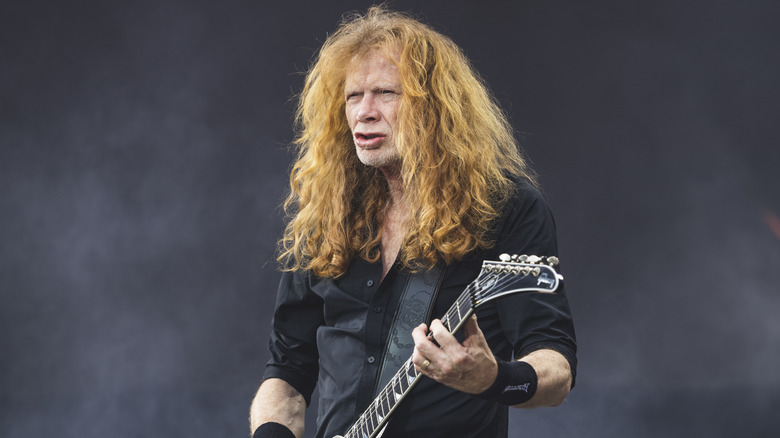
In April 1983, just as Metallica was about to start recording its first album, the seminal "Kill 'Em All," in New York City, the rest of the band woke up guitarist Dave Mustaine and told him he was fired. Mustaine co-founded the groundbreaking heavy metal band in 1981 and wrote several of the songs that would appear on the first album. But his unpredictable and sometimes violent behavior when intoxicated led James Hetfield, Lars Ulrich, and Cliff Burton to replace him with a new guitarist, Kirk Hammett. They stuck Mustaine on a Greyhound bus back to California and washed their hands of him. Metallica would go on to sell more than 182 million records.
Mustaine would then found another band, Megadeth, which went on to sell 50 million records. In early 2026, Megadeth hit No. 1 on the Billboard Top 200 with a self-titled album, but the singer and guitarist never got over his split with Metallica. "Do I wish it was 1982 all over again, and you guys woke me up and say, 'Hey, Dave, you know what? You need to go to AA?' Yeah, I'd give anything for that chance," Mustaine would tell Ulrich during a therapy session that was filmed for the 2004 documentary "Metallica: Some Kind of Monster."
More than 40 years on, Mustaine is still angry about his abrupt ejection from Metallica, continuing to discuss it in interviews through early 2026.
If you or anyone you know needs help with addiction issues, help is available. Visit the Substance Abuse and Mental Health Services Administration website or contact SAMHSA's National Helpline at 1-800-662-HELP (4357).
Pat Smear — Foo Fighters
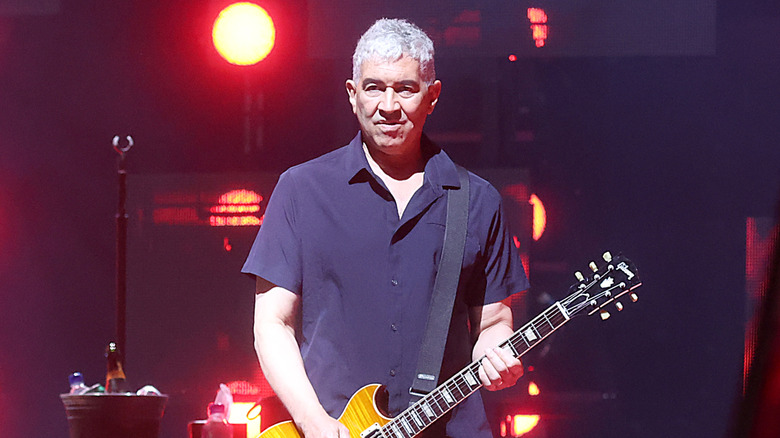
In 1995, Dave Grohl was looking to put together a new band. In the wake of his Nirvana bandmate Kurt Cobain's death by suicide, he'd pretty much single-handedly recorded a solo album under the Foo Fighters moniker and now wanted to move forward. He tapped Pat Smear, who had co-founded the hardcore band the Germs before becoming Nirvana's touring rhythm guitarist. But just two years later, during the recording of the band's second album, "The Colour and the Shape," Smear had begun to sour on the grinding pace of being in the Foo Fighters. He dramatically quit the band during a performance at the 1997 MTV Music Awards.
Smear soon regretted his choice. As the Foo Fighters continued to climb the charts to become one of the biggest rock acts around, he sat on the sidelines. "I started missing it ... when the next record came out. And then every time a new record would come out I would really miss it and I'd be like, 'Aw, I wish I'd played on that'," he told the National Post in 2011.
In 2005, Smear rejoined the band as a touring member before his official return for the 2010 album "Wasting Light." As of early 2026, he's still in the Foo Fighters after his about-face.
Zack de la Rocha — Rage Against the Machine
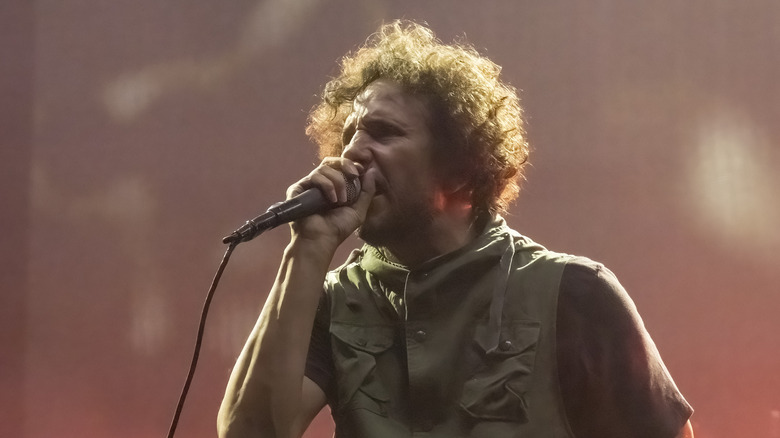
By October, 2000, the revolutionary band Rage Against the Machine had produced four studio albums and been together for nearly a decade, when front man Zack de la Rocha announced his departure. The rest of the band, Tom Morello, Brad Wilk, and Tim Commerford, believed they were just going on a hiatus when the singer issued his statement. "I feel that it is now necessary to leave Rage because our decision-making process has completely failed," de la Rocha said (via ABC News). Indeed, internal tensions had taken their toll and de La Rocha walked away from Rage Against the Machine.
While his bandmates teamed up with singer Chris Cornell and continued with Audioslave, de la Rocha's output was sporadic. Among his various releases was one album with One Day as a Lion and appearances on some Run the Jewels tracks. In a 2008 interview with the Los Angeles Times, de la Rocha said he was "very heartbroken" after leaving Rage, but had in the intervening years changed his viewpoint. "When you get older, you look back on tensions and grievances and have another perspective on it," he said. That year, de la Rocha reunited with his bandmates and performed several one-off concerts, as well as an abridged 2022 North American tour.