

We Bet You've Never Heard These Underrated Paul McCartney Songs
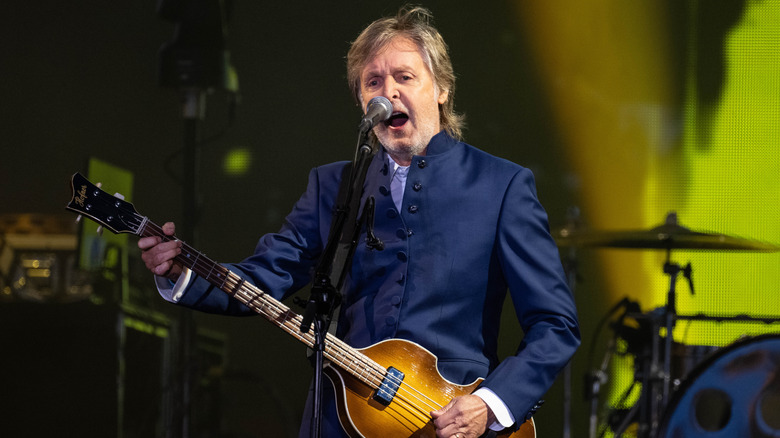
There are certainly a lot of laurels for Paul McCartney to rest upon, yet he has chosen not to do that, continually releasing new music that continues to surprise, and that's before we sift through his expansive back catalog to find underrated songs you've probably never heard. For example, who could have predicted Sir Paul would team up with Kanye West and Rihanna for 2015's "FourFiveSeconds" or join Nirvana's Dave Grohl and Krist Novoselic for the grunge-inspired rocker "Cut Me Some Slack."
With the 2026 release of the nostalgia-tinged ballad "Days We Left Behind" — accompanied by the announcement of a new album, "The Boys of Dungeon Lane" — McCartney, now many, many years past the age most people retire, remains a musical force to be reckoned with. From a John Bonham-backed treat from McCartney's Wings era to a stand-out rock tune from a flop movie soundtrack, here are some of the legend's hidden gems that, for whatever reason, fell by the wayside and never received the attention they deserved.
The Back Seat of My Car
Released in 1971, "Ram" was the second album produced by Paul McCartney after the bitter breakup of The Beatles. The album was reviled by critics at the time; Rolling Stone dismissed "Ram" as "incredibly inconsequential" and "monumentally irrelevant." In recent years, however, the critical pendulum has swung in the other direction. Best known for "Too Many People" and "Uncle Albert/Admiral Halsey," the album is closed out by its most underrated track, "The Back Seat of My Car."
Cinematic in scope, "The Back Seat of My Car" begins with a dream-like feel, sweetened by McCartney's multi-tracked vocal harmonies before building to an orchestral peak as the New York Philharmonic joins in, offering shades of "Penny Lane" alongside vibrant guitar flourishes. Then, at near the two-and-a-half-minute mark, McCartney briefly takes the song into a faster tempo before returning to the original theme and an epic conclusion — which is actually a false ending. But then the guitars return for a brief 1950s-style rock section before fading out.
Interestingly, the song had been kicking around for a while, with McCartney first presenting it as a potential Beatles number during the "Get Back" sessions. "'The Back Seat of My Car' is the ultimate teenage song ... And obviously 'back seat' is snogging, making love," McCartney told Billboard of the song's inspiration.
Beware My Love (John Bonham version)
Released in 1976, "Wings at the Speed of Sound" produced hits "Silly Love Songs" and "Let 'Em In," yet also contained a lot of filler (largely due to McCartney's insistence that each member of Wings handle lead vocals on at least one song). However, concealed amid such inconsequential dross as "Wino Junko" and the Linda McCartney-sung "Cook of the House" is "Beware My Love," a muscular rocker with a dark edge.
There are actually two distinct versions of "Beware My Love" — the one released on the album, recorded with McCartney and the band, and an earlier version that emerged as a bonus track in the album's 2014 rerelease. This latter version is far superior, thanks to drums courtesy of Led Zeppelin's John Bonham, who happened to be in the studio and sat in on the session. Bonzo's drumming provides a propulsive energy that's lacking on the album version (Wings drummer Henry English does a fine job, but he's simply no match for Bonham), while McCartney's vocals are loose, energetic, and raw.
Essentially a rough-around-the-edges demo, McCartney's decision to rerecord the track is understandable. Yet comparing the two versions, it's clearly the Bonham iteration that stands out. "It was fantastic," McCartney said of the session when responding to a post on X in a social media Q&A. "He was always on my top 5 drummer list and a great friend and ballsy drummer!"
Not Such a Bad Boy
On paper, the concept for the 1984 feature film "Give My Regards to Broad Street" seemed solid; with a script written by Paul McCartney (who also starred), it was built around rerecorded versions of various Beatles and solo hits. In reality, though, the movie was a critical and commercial disaster, yet hidden in plain sight within the film's soundtrack is one of McCartney's more solid rock tracks, "Not Such a Bad Boy."
While the glossy '80s-style production sounds dated, the track's energy bursts through. That shouldn't be surprising given the composition of the band backing him, which included former Beatles bandmate Ringo Starr on drums, and guitars handled by Dave Edmunds of Rockpile (one of rock's one-hit wonders who released a single album and then vanished) and session king Chris Spedding.
A straight-ahead rocker, "Not Such a Bad Boy" revives the McCartney-Starr rhythm section behind all those Beatles hits, with McCartney's vigorous bass line driving the song. Meanwhile, the harmonies (from Edmunds, Spedding, and Linda McCartney) sweeten the chorus, all combining for an enjoyable sonic treat. As McCartney later observed, the experience of recording with that particular lineup left him eager to return to the stage. "Yeah, it really whetted my appetite," McCartney told The New York Times. "That Spedding-Edmunds-Ringo lineup wasn't a bad little band, for example — not bad at all."
Stranglehold
Released in 1986, McCartney's album "Press to Play" is most notable for how unmemorable it was — save for the opening track, "Stranglehold." Co-written by McCartney and 10cc's Eric Stewart, "Stranglehold" was the first song written for the album, but flopped hard when released as a single, peaking at No. 81. We think the song is a straightforward rocker, with the added magic of a Hugh Padgham-produced drum sound you may recognize from his other collaborators, namely Phil Collins.
Stewart felt the song, along with the rest of the album, had been over-produced, losing the charm of its earlier incarnation. "God knows what happened, but by the time it was finished there were four producers involved and they'd messed up those songs ..." Stewart told SuperDeluxeEdition in 2017, singling out "... a great song called 'Stranglehold,' which was a beautiful song we'd written together, buggered it all up with blipping saxes going all the way through the verses."
By that point in his career, McCartney recognized that not everything he created was going to be good. "You can't get it right all the time," he told Rolling Stone in 1986 while promoting "Press to Play." "But occasionally a good one comes along ... and that makes it all worthwhile."
Dominoes
Paul McCartney's first studio album in five years, 2018's "Egypt Station" was a return to form, with Rolling Stone describing it as "classic Paul." Among the 16 tracks in the nearly hour-long album, "Dominoes" is a standout. Melodic and catchy, the song is indeed vintage McCartney, referencing the past while remaining fresh.
McCartney plays all instruments on "Dominoes," including acoustic and electric guitar, bass, harpsichord, and drums — he's even credited for creating the tape loops (the backwards guitar solos that appear towards the end of the song, reminiscent of The Beatles' "I'm Only Sleeping"). With its lyrics of dominoes falling and telephones calling, the song concludes with the sense of finality that can easily be attributed to McCartney's advancing age: "In time we'll know, it's all a show / It's been a blast."
"So it's just a people song about how things are really all right but they don't always seem to be alright," McCartney said of "Dominoes" in a promotional video. "I imagined ... how one little action can have such a big effect on this huge line of dominoes ... all these dominoes fall over and life goes on and in fact in the end it's okay."