

Classic Rock Songs We'd Trade The World To Hear Again For The First Time
There are certain songs that command such a wow factor and that are so impactful that we can remember where we were when we first heard them. So wouldn't it be magical to be able to hear the greatest rock songs over again, as though it were the first time? With that appealing fantasy in mind, we've selected five songs from the best in the business that we are certain any classic rock fan worth their salt would want to hear for the first time all over again.
These tracks are notable for infectious riffs that urge you to hit the repeat button or lead guitar work that has you air-guitaring around the room. In other cases, they are recordings that saw the acts in question push the boundaries of rock music and astonished listeners on first release. Or they're simply iconic songs with incredible melodies that helped make rock the biggest popular genre in the world during the second half of the 20th century. Enjoy.
Whole Lotta Love — Led Zeppelin
Is there a riff more recognizable than Led Zeppelin's 1969 classic "Whole Lotta Love?" The track, which opens the British rockers' second self-titled album, bursts out of the gate with its instrumentation at full throttle before vocalist Robert Plant storms in with one of rock music's most swaggering entrances. "You need coolin'," assures Plant, as the track does the exact opposite, taking things up to 11 and barely letting up over five head-banging minutes.
After the mixed critical reception that met Zeppelin's debut album, "Whole Lotta Love" was arguably the true moment that the band introduced itself as one of the very best in the business. Today, the track still has the power to inexorably pull you into its hypnotic groove. Guitarist Jimmy Page masterminded the five-note riff that drives "Whole Lotta Love" forward while living in a houseboat on England's River Thames. Later, he covered the track with reverb and dynamics that made it truly stand out, which may go some way toward explaining why it sounds as fresh as it did back when it was released.
Voodoo Child (Slight Return) — The Jimi Hendrix Experience
From those very first muted notes that announce the start of Jimi Hendrix's "Voodoo Child (Slight Return)," there is a sense of occasion that few rock tracks manage to achieve. Just a few bars later, after Hendrix introduces the track's unforgettable central riff, the whole band swoops in with more epicness than a trio should have any right to make. Closing out the 1968 Jimi Hendrix Experience album "Electric Ladyland," "Voodoo Child" was the result of a studio jam and reportedly came together in eight takes.
Rather than the throwaway album filler you might expect, the result is one of rock music's most thrilling and freewheeling performances, and the track that proved Hendrix's once-in-a-generation guitar genius beyond any doubt. It's a showcase of the countless techniques, tricks, and effects Hendrix had mastered during his journey from working musician in small bands to a rock god in his own right. "Voodoo Child" is truly a track that screams at you to pick up a guitar yourself — or at least indulge in a bit of air guitar when no one's looking.
(I Can't Get No) Satisfaction — The Rolling Stones
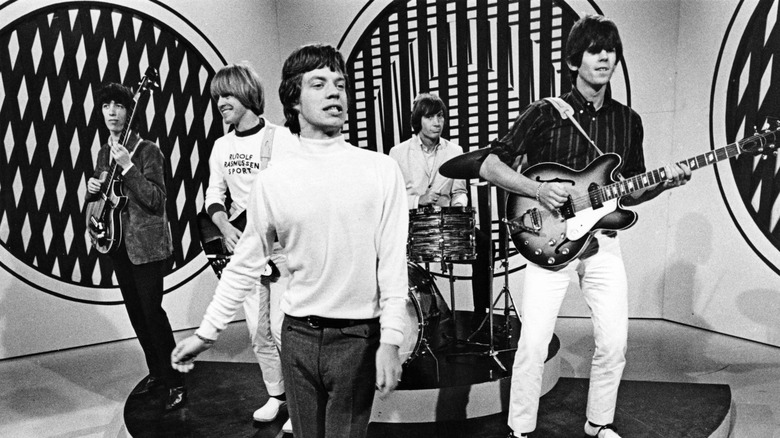
In 1965, The Rolling Stones became rock royalty overnight thanks to "(I Can't Get No) Satisfaction," the perfect single to cement the band as a self-penned hitmaker after years of predominantly performing other people's tunes. The central riff famously came to Keith Richards in a dream while sleepwalking. The guitarist claimed he woke up in the morning with his tape recorder running, and the riff was waiting for him there, followed by 40 minutes of snoring sounds.
"(I Can't Get No) Satisfaction" was laid down in the studio with the use of a Fuzz-Tone effects pedal to give it that pleasingly dense sound, though Richards himself was adamant that this track ought to be replaced with brass. Thankfully, he was outvoted, and what remains is now celebrated as one of rock's rebellious standards, with Mick Jagger's outré lyrics long considered salacious (though he never actually says anything explicit, if you listen to the song). Imagine listening to it again for the first time — that riff would be in your head for weeks.
Life on Mars? — David Bowie
Though David Bowie had a few hits under his belt by the early 1970s, most notably 1969's "Space Oddity," the truth is that in many ways he was still an artist trying to find his feet. But he took a huge step forward in 1971, when he recorded "Life on Mars?", the soaring standout track of his fourth studio album, "Hunky Dory."
The track began life as a rejoinder to Frank Sinatra's "My Way," the instrumental for which Bowie had been commissioned to pen lyrics for before the job was handed to Paul Anka. But though the root of "Life on Mars?" is parody, there is undoubted gravitas to the song, which sees Bowie look to the skies for inspiration, as he would often during his career. The piano part by future Yes keyboardist Rick Wakeman is exquisite, as are the strings arranged by guitarist Mick Ronson.
But what really stands out is the confidence in Bowie's vocal performance. It's clear as a bell and exceptionally emotive, with the singer straining to deliver the refrain at the very top of his range as the song builds and builds. Beautifully constructed, it feels like a miniature rock opera that shows the genre at its theatrical best.
A Day in the Life — The Beatles
Of course, The Beatles' discography is one of the miracles of rock music, and to hear anything the Fab Four created for the first time once more would be a real treat for most fans. But while it might be tempting to pick one of the tracks that simply demonstrates the strength of the band's straightforward songwriting — such as "I Want to Hold Your Hand" or "Hey Jude" — the fact is that much of what makes The Beatles so mind-blowing is its use of the studio to push the boundaries of what rock could achieve.
"A Day in the Life," the epic final track of The Beatles' psychedelic 1967 masterpiece "Sgt. Pepper's Lonely Hearts Club Band," is arguably the band's finest moment. It's a perfect example of when songwriting and performing skill meet confidence and ambition in the studio. Spliced together from two contrasting parts written by John Lennon and Paul McCartney separately, the song swerves from the dreamlike to the quotidian and back again before reaching an orchestral climax from the players' lowest notes to their very highest that can get your adrenaline pumping like little else in rock.
And of course, there is that final chord: The famous E chord played on three separate pianos that lasts over 40 seconds, bringing the song and the album to a close. It is the moment that signifies the highpoint of psychedelia, and it is impossible to imagine that a single chord will ever be hit so hard again.