

5 Rock Songs From 1961 That Sound Even Cooler Today
As anyone who has read the YouTube comments under various oldies will know, those who came of age in the early 1960s are typically convinced they witnessed the best music ever created, and they may have a point, especially when it comes to rock music. So, let's focus on a single year: 1961. Though the charts that year were dominated by tracks performed in other musical styles of the era, such as doo-wop and R&B, there were also many rock 'n' roll tracks that have not only retained their edge, but have possibly seen their appeal grow over time.
In some cases, this is thanks to the primitive recording techniques of the time giving the songs an especially raw edge to modern ears; in others, it is because in looking back, these tracks seem way ahead of their time in terms of pure rock energy. Each is worth at least a spin, and we're sure that in most cases you'll find yourself returning to these tracks again and again, whether you remember them from the first time around or not.
I Just Don't Understand – Ann-Margret
Ann-Margret may be best remembered today as the stunning leading lady whose undeniable chemistry with Elvis Presley on the set of "Viva Las Vegas" led to a brief romantic entanglement, but she was also a sultry vocalist whose work in the early 1960s remains unfairly overlooked. "I Just Don't Understand" was Ann-Margret's only major hit, peaking at No. 17 on the Billboard Hot 100 in September 1961.
Opening with a wild fuzz-guitar part that anticipates the work of mid-'60s garage rockers — The Kinks' Dave Davies would only slash the cone of his guitar amp to get the filthy tone of "You Really Got Me" as late as 1964 — the track soon settles into a seductive groove. Ann-Margret's vocals are subtle and classy throughout as she is accompanied in turns by plaintive harmonica, tasteful backing vocals, and, in parts, that incredible lead guitar. The track is little known today but incredibly ahead of its time — an addictive listen for any fans of garage rock or proto-punk.
Runaway – Del Shannon
Del Shannon's "Runaway" was one of 1961's biggest smash hits, and there is little wonder why. It opens with two equally catchy melodies on guitar and piano, before Shannon himself comes in with a vocal line that begins sweet, before growing more urgent over the verse and finally exploding into that iconic falsetto.
From the cinematic keys — which actually come from an early precursor to the synthesizer — to the subtle brass to the shuffling drumbeat holding everything together, "Runaway" is a flawless, forward-thinking rock recording. According to legend, the kernel of the track appeared when Shannon was performing on stage and keyboardist Max Crook played the wrong note, which gave Shannon the idea for a new song entirely.
It was one of the most fortuitous mistakes in the world of music. And it sent Shannon into the stratosphere as an artist, hitting the top of the Billboard Hot 100 in April that year, and allowed Crook to leave his job as a carpet salesman. The two would never have as big a hit again, but the truth is that "Runaway" is hard to top, as its longevity makes clear.
Quarter to Three – Gary U.S. Bonds
Gary U.S. Bonds was a powerhouse back in the early 1960s, with his dynamic, raucous live shows seeing him top the bill ahead of the Beatles as late as 1963. And that live energy also defined his sound on wax, as his biggest hit, the 1961 chart-topper "Quarter to Three," shows.
A prime example of what became known as the "Norfolk Sound," named after Norfolk, Virginia, the track features lo-fi recording techniques, crowd noise, and rough takes to establish an organic party atmosphere which is utterly compelling. Even down to Bonds' wild vocals, it's a record that puts a smile on your face, and proved, despite its rawness, to connect with the music-buying public at a time when pristine recordings were the norm.
The track was a huge influence on Bruce Springsteen, informing his own recording techniques and becoming a live favorite for the E Street Band, who assisted Bonds with his comeback in the 1980s. Beatlemania may have sparked the garage rock explosion of the mid-1960s, but it was Gary U.S. Bonds' "Quarter to Three" that gave these young bands license to record in such low fidelity.
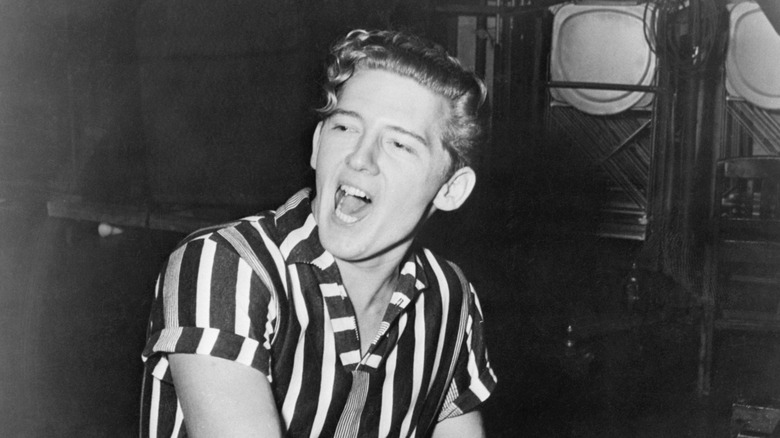
What'd I Say – Jerry Lee Lewis
Early 1960s rock 'n' roll was influenced to a huge degree by the R&B of the previous decade, and Jerry Lee Lewis' "What'd I Say," a cover version of Ray Charles' 1959 song, is a case in point. Charles' version is undoubtedly rocking, but in Lewis' deranged hands the song takes on a new energy while maintaining its bluesy swing.
Lewis' career had taken a few blows by the time he came to record "What'd I Say" in February 1961, including being expelled from the Musicians Union, and he was looking to relaunch himself with an undeniable hit. The recording that would eventually become the single took place at the brand new Sun Studios in Nashville, which managed to capture the riotous atmosphere of Lewis' live shows. Billed at the time as Jerry Lee Lewis and his Pumping Piano, the track ups the ferocity of Charles' much-loved original and found its audience, hitting No. 30 and becoming Lewis' biggest hit during the Billboard chart era.
"What'd I Say" remained a staple of Lewis' live shows for the rest of his career. Though a cover, it remains a reminder of the power of early piano-led rock 'n' roll.
The Mountain's High – Dick and Dee Dee
The early 1960s was the era in which rock and pop was becoming increasingly blended, with sweet and sentimental love songs taking on the edgier instrumentation that had been pioneered by rock musicians over the previous decade. One of the acts to hit it big in 1961 was Dick and Dee Dee, whose single "The Mountain's High" made it all the way to No. 2 on the Billboard Hot 100.
Dick and Dee Dee were a Los Angeles duo that made use of falsetto vocals and off-kilter melodies to haunting effect, with "The Mountain's High" undoubtedly one of the era's weirder ballads. Oscillating between two bass chords, the track features hypnotic guitar work to create a dreamy atmosphere that was especially inspiring for later artists.
Legendary producer Brian Eno is a big fan, telling music writer Tom Schnabel: "What attracted me most about this music was the texture of it, the kind of acoustic landscape that recorded music could create" (via "Rhythm Planet: The Great World of Music Makers"). Though The Beatles would later be credited for pioneering the idea of the studio as an instrument, "The Mountain's High" is an early outlier, with Eno claiming: "'The Mountain's High' has an acoustic that couldn't have existed before the recording studio."