

5 Hit Kenny Rogers Songs That Made Him The King Of Soft Rock For Boomers
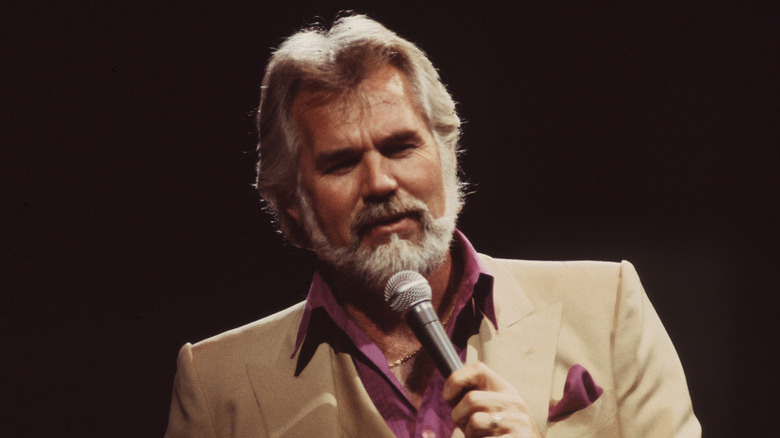
Kenny Rogers' crossover from country to soft rock was so smooth, it's almost impossible to find a transition point, but it was a hit with boomers. His country songs were true to the genre, but somewhere in the mid-'70s he started subtracting elements — a fiddle here, a steel guitar there — until his songs had morphed into easy listening gems. It was a devious shift that his long-time boomer fans didn't seem to mind, revealing hidden talents Rogers fans didn't know he had. Meanwhile, new listeners who may have skirted his straight-ahead country sound were pleasantly surprised at how adaptable his down-home style was to the light-rock world.
We looked back at the era when the transition happened to find a handful of songs that exemplify Rogers' soft rock appeal to the boomer audience who loved him most. We aimed for early songs where the country aspects were dialed back and hinted at a change in the air, but straight-up pop drama like "Lady" was a must; it convinced listeners that the man could step forward without losing the warm, woody voice they loved. And duets like "We've Got Tonight" were our ultimate evidence that discerning boomers were cheering on Rogers' soft rock reinvention from top to bottom.
You Decorated My Life
It sounds like a Hallmark Valentine card set to music, and yet the richness of Kenny Rogers' voice makes "You Decorated My Life" feel fresh and alive. It appears on "Kenny," the same album as one of his best-known country story-songs, "Coward of the County." This was the moment when the singer began making his move, orienting his fan base toward a new direction by weaning them off the stronger country stuff with a taste of easy-listening sugar.
It wasn't instant love for Rogers, however, who passed after first hearing the demo of the song by writers Debbie Hupp and Bob Morrison. Rogers eventually relented and included it on the "Kenny" LP as a pop ballad with hardly a dab of notable country flavor. The orchestral swells and flute breaks gave it a more sophisticated soft rock spirit than Rogers' usual down-home sound.
The switcheroo worked ridiculously well. "You Decorated My Life" latched onto the No. 7 spot in November 1979, regaling autumn with a top-10 tearjerker that soft-launched the new Kenny Rogers sound. There would still be songs that slid back into country mode (and this one did win a Grammy for best country song), but after this cozy ballad proved the concept, even his future hits bearing a touch of twang would be built on an unmistakable soft rock foundation.
Don't Fall in Love with a Dreamer
Kenny Rogers traded lines with whiskey-throated singer-songwriter Kim Carnes on "Don't Fall in Love with a Dreamer," a duet that warned romantics everywhere to be cautious of giving their heart to a starry-eyed lover. Their voices blend like a string section, with Rogers' higher register adding vulnerability to some of the more confessional passages. An ill-fated love affair has seldom sounded so lived-in and authentic, and boomers knew that Rogers had understood the assignment; if he applied his country-based emotion to a soft rock framework, they'd follow him anywhere.
Carnes and Rogers were friends from their days in '60s folk ensemble the New Christy Minstrels. This melancholy love song was one of the tracks on "Gideon," Rogers' concept album written by Carnes and her songwriting partner, Dave Ellingson. Though the story's theme was cowboy-centric, "Don't Fall in Love with a Dreamer" transcended the genre, standing out as an easy listening treasure.
Rogers and Carnes were able to take this aching back-and-forth ballad to No. 4 in 1980. It added a feather in Rogers' pop music cap and let his followers know that the change wasn't temporary; this soft rock switchover would be a lasting thing. The boomers who kept buying his records didn't seem to mind in the least.
Lady
If you were an artist in the early '80s hoping to record a love song that delivered chilling romantic ambiance, you couldn't do better than requesting help from Lionel Richie. It was how Kenny Rogers rounded up "Lady," one of his most striking performances and a lite-rock radio staple when it glided onto the charts. It was ultra-smooth, cinematic to a fault, and the antithesis of Rogers' earthy country creations. In other words, it was soft rock gold.
As Richie recalled during an appearance on "The Drew Barrymore Show," Rogers requested a song; the writer came up with "Going Back to Alabama," a country-light tune, and "Lady" ... sort of. Richie only had part of the song finished when Rogers said he preferred to record that one first. So Richie cleverly requested a bathroom break, sneakily retreated to the restroom, and quickly scrawled a second verse to fill in the blanks.
Thanks to the combined talents of Rogers and Richie, "Lady" became a mainstream colossus and a jaw-dropping No. 1 hit, parking in that position for a stunning six-week run at the end of 1980. The tender love song also held the No. 1 spot longer than any other song of 1980, demonstrating that his soft rock transition didn't just have lungs, it had legs, too. Instead of his experimentation driving boomer-age Rogers diehards away, it seemed to recharge their enthusiasm.
We've Got Tonight
Eighties pop siren Sheena Easton paired up with Kenny Rogers for a cover of Bob Seger's "We've Got Tonight," which showed up in January 1983 on Rogers' album of the same name. It was a savvy play, merging two highly popular adult contemporary voices in a song boomers already knew and loved. Easton lent her clarion voice to Rogers' soulful tones, creating a smoke-and-silk musical mix that cut to the heart of the tune's overt lyrical yearning.
Rogers' cutover to soft rock was well underway by this time, and this album would be his last with his old record company, Liberty. His move to RCA would continue the mainstreaming process, which made "We've Got Tonight" feel like a lyrical farewell to his old ways. His fans couldn't get enough of his new sound, and the power ballad peaked at No. 6 on the Billboard Hot 100 by late March 1983. Thanks to Rogers' lingering country music ties, the song did even better on the Hot Country chart, topping out at No. 1, showing how his adult contemporary leanings spilled over into his old musical stomping ground and gave his new direction additional lift.
Islands in the Stream
Kenny Rogers dipped back into the country music barrel just a bit for "Islands in the Stream," enlisting country music godmother and long-time friend Dolly Parton to help out on this Bee Gees-backed mega-hit. In fact, Rogers put his whole album, "Eyes That See in the Dark," in the hands of a partnership that included the Gibb brothers to work his soft rock wizardry from top to bottom. The resulting collection was capped by this winsome single with an unforgettable syncopated chorus.
Though this song has all the hallmarks of a Bee Gees-produced soft rock confection, there's enough of a lilt to wink at Rogers' country roots, and there's no getting around Parton's Smoky Mountains twang. It helped the tune work with both audiences; with Parton's enormous following, this upbeat crossover bop succeeded in both the country and pop worlds.
The song became Rogers' second No. 1 solo hit on the Billboard Hot 100, topped the Country and Adult Contemporary charts, and reinforced the notion that key collaborations could help solidify the singer's heroic status with easy-listening audiences. Indeed, calling in Parton was a savvy move that gave her a little more crossover chart cred of her own. It also proved Rogers had held on to the hearts of boomers who adored his soft rock persona, even if he did wear his Stetson into the studio every now and then.