

5 Rock Songs From 1960 That Sound Even Cooler Today
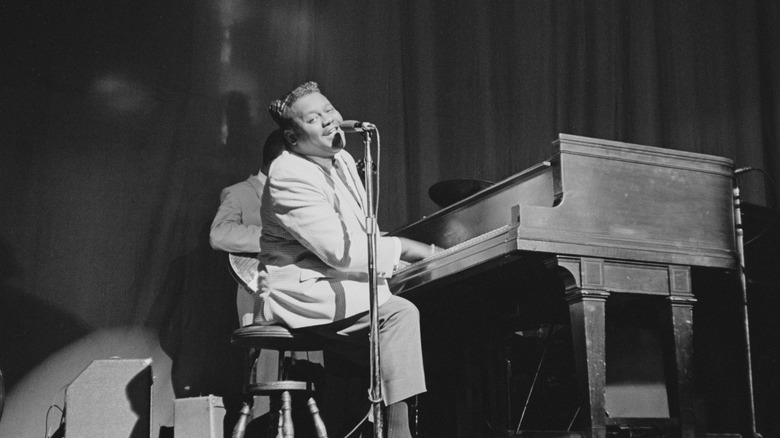
Those who think that the only cool things to exist come from last Tuesday: It's time to check yourself. Everything comes from something, especially rock that built on uptempo blues, country, gospel, jazz, and more. Such "jump blues," as it was once called, culminated in figures we still recognize today: Fats Domino, Chuck Berry, Chubby Checker, and more, whose music in 1960 still sounds cooler than anything nowadays.
In general, music from 1960 sounds fresh if only because it's so far removed from modern-day musical tropes and overly slick production. We really want our choices to stand out from their peers, though, especially because lots of OG rock built on stock 12-bar blues progressions like that of 1954's "Shake, Rattle and Roll." This means we've got to settle on songs that are less conventional for the time, but still retain the spirit of 1960. This also means being a bit flexible with our definition of "rock," which in 1960 was still vastly removed from classic rock's heyday, e.g., the Rolling Stones, Pink Floyd, Led Zeppelin, etc. In general, we're going to focus on core songwriting, unique elements, and some hard-to-define, case-by-case, cool sauce.
In the end, we've uncovered some truly stand-out, even straight-up comical, songs that legitimately sound cool to modern ears. Our choices include tracks from names we already mentioned — Chubby Checker, Fats Domino, and Chuck Berry — plus left-of-field outings from Elvis Presley and Bo Diddley.
Your Feet's Too Big — Chubby Checker
Credit to original composers Fred Fisher and Ada Benson for writing a 1936 song (90 years ago!) that was so funny and strange out that it got covered by the piano's comedic champion, Fats Waller, in 1939 and Chubby Checker in 1960. This song, like the others on our list, ought to prove that people have always been people, no matter the era in which they lived.
So, is "Your Feet's Too Big" an allegorical tale about one's own feet getting in the way of one's forward progress in life or something? No. It really is just a song about someone's actual, physical feet being repulsively large. As the lyrics say, the person's face is nice, as is their "rig" (butt, perhaps, or overall body). But the feet? "All your pedal extremities are colossal," the song says, with opening lines beginning, "Sat in a diner at a table for two / There are four of us, me, your big feet and you / From your ankles up you sure look sweet / From there down there's just too much feet." There's also a line that might blow the minds of 21st-century people because it sounds so contemporary: "I'm mad at ya, 'cause ya feet's too big." Well, we ain't mad at this song, that's for sure.
Checker's version differs from Waller's because its music is firmly "rock and roll," as opposed to a moderate-tempo, jazz-leaning tune. This makes sense, as Checker's song came out on his 1960 album "For Twisters Only," the follow-up to "Twist with Chubby Checker," his other 1960 album that contained the rock 'n' roll hit that made him famous, "The Twist."
Natural Born Lover — Fats Domino
We're not quite sure why so many musicians from the mid-20th century had nicknames related to bodyweight, but we're here for it, especially Fats Domino. The name of his debut 1956 album established what he's all about, "Rock And Rollin'," while his third album from that year granted us his signature hit, "Blueberry Hill." But, it's 1960's "... A Lot Of Dominos!" that finally gave Domino the chance to flex his piano skills on top of his voice and charm. Enter "Natural Born Lover," an album closer that's about twice as long as many other songs of its time, including most other songs on its album, at almost four and a half minutes. The length alone gives the song a chance to develop into something more than a simple, catchy hook.
"Natural Born Lover" stands out for its instrumentation. Its strings swell and recede along with the song's intoxicated sensation, and its sax solo carries as much sexy swagger as saxes usually do. And speaking of Domino's knack for tickling the ivories, "Natural Born Lover" showcases his talents from its opening trills to its final solo. Yes, the song is actually written in a standard blues progression, but its more formulaic qualities are masked in instrumental window dressing.
Lyrically, "Natural Born Lover" is repetitive, but in a clever way that reflects the song's looping musical phrases, saying, "I'm a natural born lover, since I got rid of all my trav'lin." We don't know if it's autobiographical, but Domino was actually a mild-mannered homebody. He packed his own food to cook on the road and stayed married to his wife, Rosemary, for 60 years until she died in 2008.
Let it Rock — Chuck Berry
Brief and punchy: That's the best way to describe "Let it Rock" from Chuck Berry's 1960 album, "Rockin' At the Hops." Clocking in at under two minutes, "Let it Rock" fades out just around when it sounds like it's going to expand into a 10-minute-long jam session that'll keep the dance floor going. That's precisely why the song works, as anything longer would run the risk of letting the song's electric energy fizzle out. In the meantime, it's Berry's guitar work that stands out, drives the song along, and helps it sound cool to modern ears.
When we say "guitar work," banish from your mind any notions of overwrought, note-saturated, tappy-tappy social media guitarist shenanigans. That's a mark in "Let it Rock's" favor, as the guitar sounds clear and fresh, right down to the clean, ever-so-crackling, very-Berry tone. That tone shines through in a way recognizable from other Berry hits, like his legendary 1959 hit "Johnny B. Goode" (which is actually pretty similar to "Let It Rock"), but gets a spot in the limelight from around 55 seconds into the song. At this point, Berry's very deliberate, riffy solo pushes the song past its 12-bar blues structure and helps it sound even a tad reminiscent of rock to come. The song isn't "Let it Rock" in a KISS anthem kind of way, but "Let it Rock" of the finest, 1960 vintage.
Truth be told, Berry's "Rockin' At the Hops" has a few contenders for cooler-than-cool 1960 tracks, like "Too Pooped to Pop" (for the comedy), "Mad Lad" (for the unique, singing guitar lines), and "Bye Bye Johnny" (a sequel to "Johnny B. Goode"). Folks thinking of using our recommendations to dig further have a lot to look forward to.
Fever — Elvis Presley
Everything about Elvis' "Fever" from 1960's "Elvis is Back!" is unconventional and oozes coolness. Neither a rock-out, shriek-inducing, hip-shaking track like "Hound Dog" nor a slow, wedding-worthy love ballad like "Love Me Tender," "Fever" is a song of its own type. It's got no instrumentation other than some bass plucks, finger snaps, and the occasional percussive roll. It's all smoke and sizzle, and sounds like the backing track to a beat poetry night at a small jazz club from days long gone. It really brings Elvis' voice to the forefront and showcases how the King's (a nickname he hated) immense charisma and vocal swank shot him straight to the stratosphere of fame.
"Fever's" focus on Elvis' voice has to be intentional, as the song sounds like it was meant to invoke in listeners the feelings that it describes: a kind of woozy, delirious attraction to another person. In other words, a "Fever if you live and learn / Fever till you sizzle / What a lovely way to burn," as the song concludes. That song, which was part of an album meant to bring Elvis back into the public eye following his stint in the military, capitalizes on what is arguably a more sophisticated version of his voice.
"Fever" also stands out for its storytelling. The song could end after its second verse, but continues into a third and fourth verse by connecting the feelings of the singer to stories of doomed lovers. Romeo and Juliet make an appearance, as do John Smith and Pocahontas (an apocryphal myth, we know). This storytelling, plus Elvis' delivery, makes "Fever" sound like he's telling us a fable in a small, smoky club. It's cool stuff, indeed.
Cops and Robbers — Bo Diddley
If you don't chuckle within about 10 seconds of starting Bo Diddley's "Cops and Robbers" off 1960's "Have Guitar, Will Travel," then you might need to check your pulse. We're not sure if we saved the best for last, but "Cops and Robbers" is a superb track that, production values aside, doesn't sound over 65 years old. It doesn't even sound like a by-product of the '50s, but more like an echo of the decade to come, the '60s. This is even more impressive because the song originally dates to 1956, when it was first released as a single along with "Down Home Train."
Diddley's musicianship, vocal delivery, and oddball humor are on full display in "Cops and Robbers." The song is a rambling, spoken word story that segues into singing for the chorus, "He hollered, 'Reach for the sky' / I said, 'But I don't understand, sir' / 'Don't try no monkey business / I've got a stopper in my hand'." The rest of the song describes the story of a robber's wacky, bungled confrontation with the cop that ends with the robber getting nabbed, saying, "Yeah, we going to put him so far back in jail this time / Until they going to have to pump air into him." The lyrics alone don't do the song justice, though. It's Diddley's voice acting that does it, where he adopts the role of narrator (robber) and cop.
"Cops and Robbers" made such an impression on fellow musicians that The Rolling Stones covered it in 1964 (released in 2017) and George Thorogood & The Destroyers gave it their own sax-filled, country-rock twist in 1993. Indeed, it's that thoroughly good and cool.