

This 1976 Song By Bob Dylan Is His Most Personal By Far
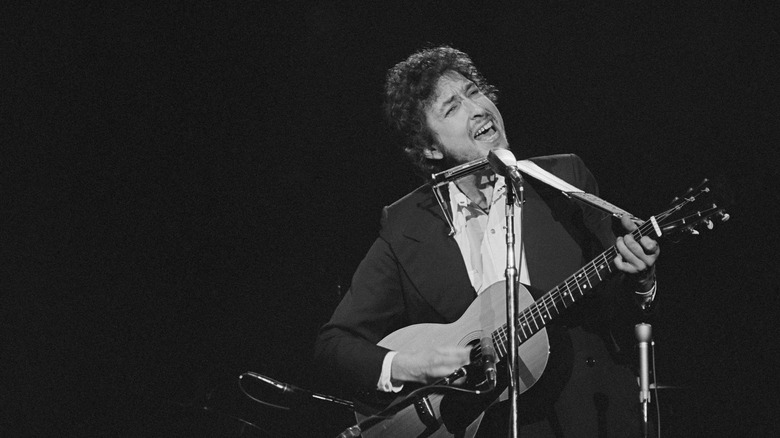
Bob Dylan, in his personal life and in interviews alike, has often kept his distance from his lyrics. In fact, in most kept records, he made a point of it. However, on rare occasions, he opened up, notably on personal songs like the 1976 tune "Sara," which he wrote for his wife. Dylan's songwriting process is one of supposed divine lightning strikes and capturing magic on the page, imposing abstract and ambiguous turns of phrase, and avoiding explaining meaning at any cost. This style took him far, especially in the 1960s, where he headlined the new zeitgeist of folk and rock 'n' roll alike.
His career took a bit of a downturn in the early '70s, but returned in full force in '75 and '76, which featured the albums "Blood On The Tracks" and "Desire," as well as the classic Rolling Thunder Revue tour. Songs on both of these albums were dramatized stories and epics, and though imbued with real emotion, they told tales of narrators that were not, in reality, Dylan himself.
However, on the closing track of "Desire," the album that featured the hit "Hurricane," was "Sara," a song overtly about his wife and his marriage unlike nearly any other Dylan had recorded, though his complicated love life was an often observable theme in his music. It's a straightforward, personal plea with a dramatic tale behind it, which climaxed in a surprise in-studio performance to his wife herself among a crowd of awestruck bystanders.
Sara contained an uncharacteristic openness
"Sara" is immediately evident as a somber, even mournful ballad, with lyrical imagery and detail that perfectly match its sound. It opens: "I laid on a dune, I looked at the sky / When the children were babies and played on the beach," and the meandering strings, wailing harmonica riffs, and sentimental, expressive vocals put the listener right there with Dylan in front of the waves as he reflects on his life and his family. This line, and other scattered lyrics, are rare musical mentions of Dylan's children, though themes of fatherhood have been consistent in his music (even back to the early '60s with "A Hard Rain's A-Gonna Fall").
While Dylan's lyrics are often vague and mystical, "Sara" feels nearly autobiographical in its detailing of his very real relationship and his rarely discussed personal life. Notably, this track was written during a trying part in the pair's marriage, so Dylan bore it all here in the track, without the usual curveballs he liked to throw at listeners.
Dylan laid his heart bare in the 1976 song
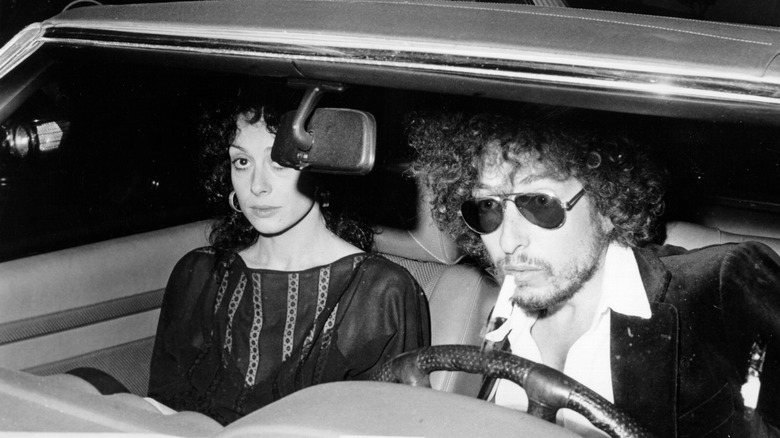
Dylan recalls specific instances from his relationship, and its intersection with his career, that slightly pull back his usual mask of artistry — "Staying up for days in the Chelsea Hotel / Writing 'Sad Eyed Lady of the Lowlands' for you" — and makes blunt, yearning pleas: "Sara, Sara / Whatever made you want to change your mind? ... Sara, oh Sara / Don't ever leave me, don't ever go." You can hear the sentiment in Dylan's voice in each line; he sings as if he is wrapped up wholly in the memory.
These lyrics are only more shocking, and vulnerable considering the circumstances in which Dylan first revealed this track. The pair were still on rocky terms when he invited her to the studio, where he was recording "Desire" in 1975, and he played "Sara" straight to her, with some strange Dylan-like motive of repairing the relationship. And, somehow, it worked, as his wife was moved and the relationship was, temporarily, mended before the couple ultimately divorced in 1977. Still, the take of "Sara" that he sang to her there in the studio at his most vulnerable was the one that ended up making the album, cementing this pleading love song among the most personal Bob Dylan ever recorded.