

1977 Changed Rock Forever — Elvis's Death Was Only One Part
The '70s were a pretty big decade in rock, but why care about 1977 in particular? When it comes to rock music, quite a few things happened that year that forever changed how individual bands operated — just ask the infamously squabble-happy Fleetwood Mac, whose members dramatically fought even while they became legends after releasing the foundational "Rumours" album. Meanwhile, David Bowie released an album that year that's easily among his best, while also helping shepherd Iggy Pop into a new personal and musical era.
Meanwhile, rock was undergoing seismic cultural and artistic shifts that saw both the rise of punk and of what would come after, including major debuts from The Clash and Talking Heads. Tragedy also marked the year, including the plane crash that decimated the Southern rock group Lynyrd Skynyrd and, yes, the early death of the oft-styled King of Rock 'N' Roll, Elvis Presley. One rock legend's music even started a journey to interstellar space that year. Clearly, it was one to remember.
The Clash came onto the punk scene
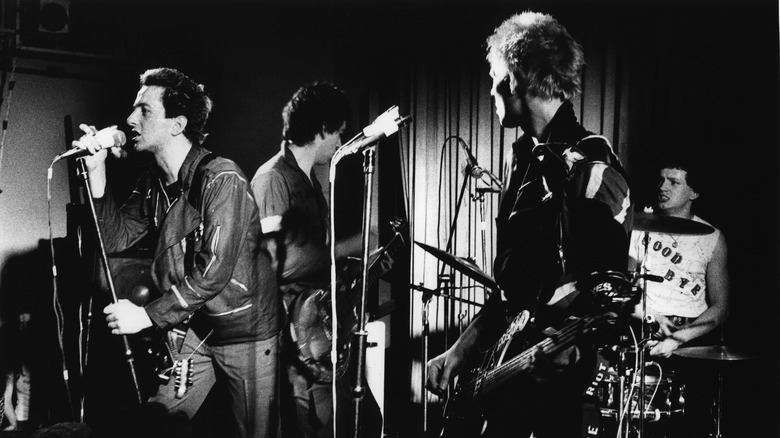
When you talk about punk rock, you simply have to talk about The Clash. This foundational band of the British punk movement got its start in 1977, when it released its self-titled debut album. Far from being a rookie effort — even if it was technically just that — "The Clash" burst into the scene with a sound and message that proved punk wasn't just being contrary for contrariness' sake. Instead, this band genuinely had something to say. Though when filmmaker Julian Temple recorded core members Joe Strummer, Mick Jones, and Paul Simonon during rehearsals in 1976 and 1977, he found that they were initially a bit reluctant to talk about their work.
Even if punk had a reputation as the music of callow youths, The Clash did much to upend that expectation. Of the 14 tracks on the album, many spoke to the anxieties of a world where people felt penned in and discouraged, be it from economic pressure or police violence. It wasn't childish nose-thumbing, either; while other punk bands of the time have sunk into obscurity or made themselves into something they might have once hated (ahem, Johnny Rotten shilling for Country Life butter), The Clash still manages to be relevant decades after its first album was released.
Elvis Presley died
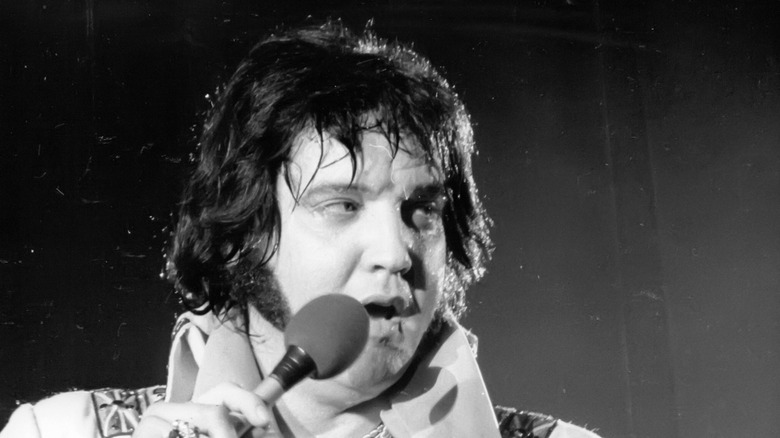
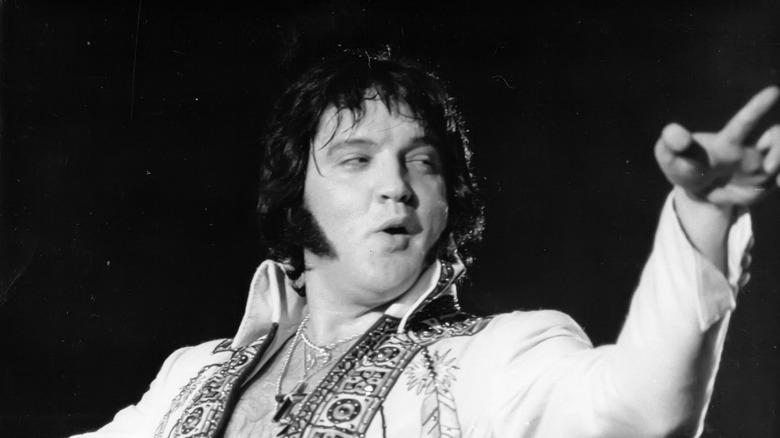
Even if the death of Elvis Presley was just one part of the tumultuous year of rock history that was 1977, his passing was no doubt a major event. And, though he had been experiencing some speed bumps in live performance here and there and appeared to be in shaky health, Elvis' last show went off fine. Yet, those beyond his inner circle were widely shocked to hear that he had died on August 16. Presley was found unresponsive in a bathroom at his Graceland mansion and, though he was transported to the hospital, was soon pronounced dead at the age of 42.
Initially, many assumed that his end came due to a heart attack, an unexpected, if sad, result of his marked weight gain. Yet, while that certainly did not help him, it later came out that Presley had been prescribed several large doses of powerful painkillers by his personal doctor (who later had his medical license permanently suspended for overprescribing dangerous drugs to patients). Many now suggest that the combination of thousands of doses of painkillers over the years, combined with lifestyle factors and genetic predispositions (Presley had multiple relatives die fairly early of heart and liver conditions) were what killed Elvis. Regardless, his passing marked a major turning point with the loss of a music icon and, with him, an earlier era of rock 'n' roll.
The Talking Heads released its first album
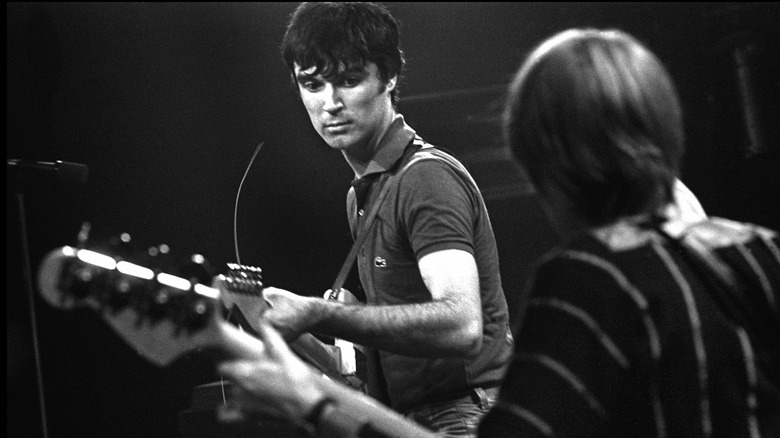
Same as it ever was ... wasn't really the case at all in 1977, at least not when the Talking Heads released its debut album, "Talking Heads '77." When it came out that September, it came to epitomize the groundbreaking, genre-bending new wave that would dominate the music world in the following years. That's not to say the Talking Heads doesn't have punk roots, with its founding members attending shows at the legendary (and legendarily filthy) CBGB in New York City and even taking to the stage for the first time in 1975 as openers for the Ramones at the very same club.
Even just a couple of years later, what had once seemed like fresh, exciting punk may have started to feel a little stale. At least you get the sense that's what the Talking Heads was thinking, as "Talking Heads '77" showcases no single genre but a delighted mishmash of, well, everything. Listen closely, and you might pick up on everything from jazz trumpeter Don Cherry to minimalist composer Philip Glass, all accompanied by the energetic discontent of punk — "Psycho Killer" certainly gets at that kind of frenetic anxiety — and yet tempered with a kind of joy or at least engaged interest with the world that went beyond screaming from the stage at CBGB. For many, it was nothing short of revolutionary.
The Sex Pistols experienced major drama in 1977
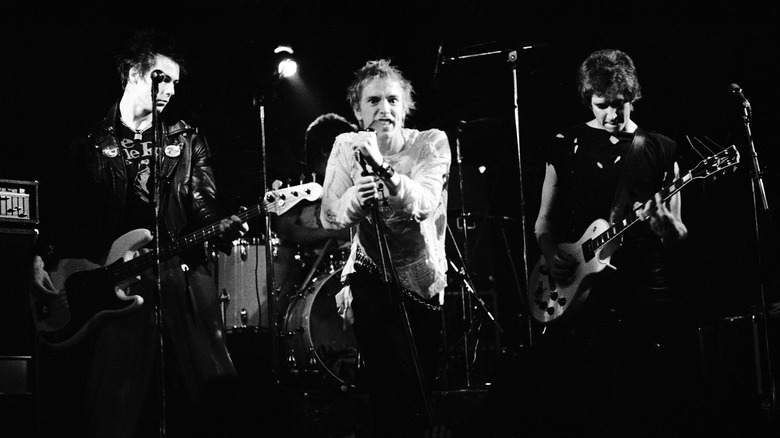
You may or may not want to take the Sex Pistols seriously — besides the name, there are controversial allegations that they were a carefully selected boy band assembled by manager Malcolm McLaren. But you can't deny that they were part of punk history ... though they barely made it through 1977. That year, the group released its only studio album, "Never Mind the Bollocks," and experienced genuine upheaval. Original bassist Glen Matlock (the source of some of those boy band allegations, for what it's worth) was replaced by the legendary and self-destructive Sid Vicious in 1977.
It was a tumultuous time; two record companies dropped the band before Virgin Records signed it and released the incendiary single "God Save the Queen." When it came out that the Sex Pistols was working on other albums, Virgin Records rushed and put out a sloppy LP that didn't even list all the tracks. Still, it proved a rousing commercial success.
Yet not all attention was good — "God Save the Queen" not-so-coincidentally released the same year as Elizabeth II's Silver Jubilee, and the band even played the song live while floating past Parliament on the River Thames. The performative antics also led to a rather prickly reception on the group's sole U.S. tour in January 1978. After just two weeks in America, the Sex Pistols abruptly broke up.
Def Leppard formed and presaged the rise of hair metal
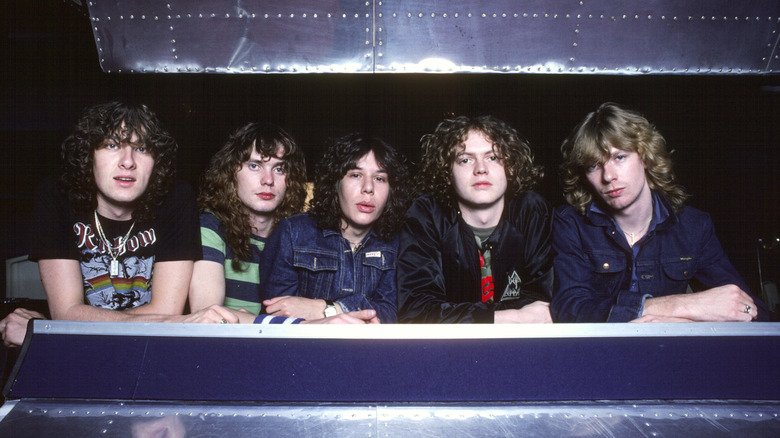
While new wave and punk were getting started, 1977 also saw the beginnings of a genre that would come to utterly dominate rock (and hairstyling trends) the following decade. That would be hair metal, sometimes also referred to as glam metal. Broadly, this subgenre juxtaposed hard-driving music with bands going through makeup palettes and cans of hairspray like they were about to be outlawed. This didn't come out of nowhere — just look at earlier glam rock, best epitomized by Bowie's carefully coiffed Ziggy Stardust persona. But Def Leppard, another British band that formed in 1977, arguably brought hair metal to the fore. Coming at the height of British punk, Def Leppard and its more polished sound didn't immediately catch on at home, but it soon found success in the U.S.
Whether or not the group really deserves that "hair metal" designation depends on who you ask. Even today, lead singer Joe Elliot bristles at the term, saying it was unfairly applied. After drummer Rick Allen was in a serious 1984 car accident, the band took a break. Only when it returned to the scene in the late '80s was it slapped with the hair metal label. "Something happens in Los Angeles while we're living in a freaking windmill in Holland, and we get roped into it," Elliot said (via WBZ NewsRadio 1030). But, for many, the association still stands, and Def Leppard's 1977 formation was the beginning of the trend, even if other bands took their follicles to greater heights.
Lynyrd Skynyrd's plane crashed
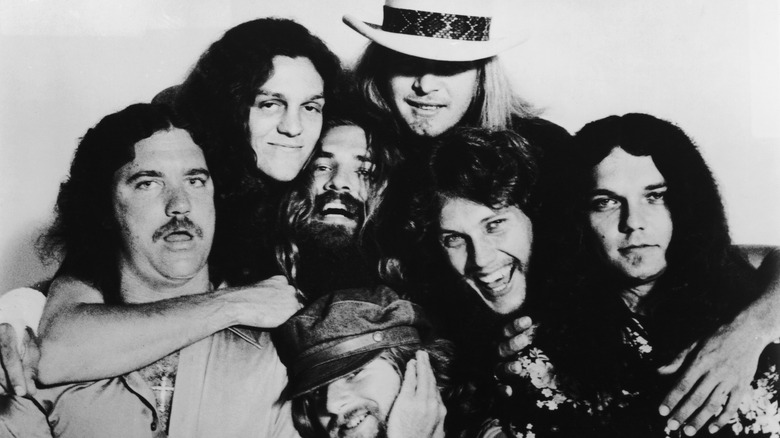
While 1977 held plenty of promise for some groups, other rock acts were hit by tragedy. This included Lynyrd Skynyrd, the Southern rock group that formed in 1964 in Florida. With hits like "Sweet Home Alabama" and "Free Bird," the band was well on its way by 1977. But, that October, with its fifth studio album just released and even more artistic success on the horizon, all that momentum came to a terrible, abrupt stop with an airplane crash.
On October 20, band members boarded a small 1940s-era Convair CV-240, meant to take them to a performance in Baton Rouge, Louisiana. On approach, the engines failed — the result of critically low fuel. Pilots attempted an emergency landing near Gillsburg, Mississippi, but the plane instead crashed into the woods. Though some passengers survived, fatalities included lead singer Ronnie Van Zant and guitarist Steve Gaines, along with backup singer Cassie Gaines, assistant road manager Dean Kilpatrick, pilot Walter McCreary, and co-pilot William Gray.
While all the deaths each represented an individual tragedy, the loss of Van Zant in particular was a heavy blow to the band. As lead singer and songwriter, he was instrumental in shaping the path of Lynyrd Skynyrd. Though some band members survived the crash, many faced serious injuries and long recoveries; Lynyrd Skynyrd broke up for the time being. It would eventually reform 10 years later, with Ronnie's younger brother, Johnny, taking his place as lead singer.
David Bowie began recording and releasing his Berlin trio
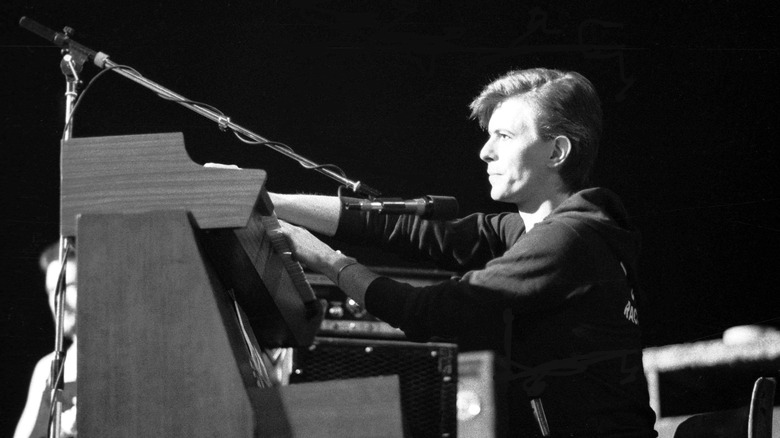
In 1976, things were looking pretty dire for David Bowie. He was experiencing real success, but was also struggling with substance use. To remove himself from temptation in the recording scene, Bowie moved to West Berlin in December 1976. Soon after arrival, he began recording and assembling "Low," the first album in what would come to be known as his "Berlin Trilogy." Bowie, in the midst of withdrawal symptoms, was ready for something truly different and creatively engaged — a stark departure from earlier albums and performances, which he later said he could barely remember due to his substance use.
Besides the dramatic backstory, what makes "Low" all the more unique is its daring take on just what a rock album could be. Its spare lyricism and ambient music were beautifully haunting, reflecting not just Bowie's state of mind but perhaps also the starkly divided city of Berlin, split as it was between its Western half and its communist Eastern portion. When critics got the first listen, "Low" was unsurprisingly divisive. Some hailed Bowie's new direction, while others decried it as oddly removed or even pompous. But, if nothing else, the divided reaction showed that Bowie had produced something that was truly groundbreaking, and, if the increasingly awed reactions to it over the years are anything to go by, this 1977 release is something he ought to have been proud of creating.
Iggy Pop got a major second chance
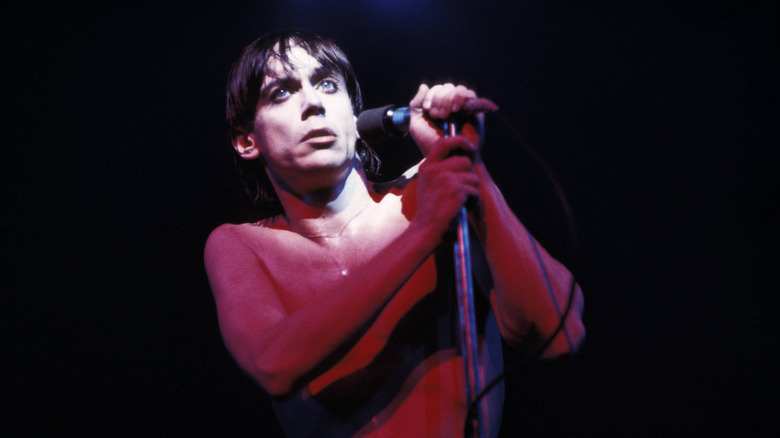
By 1977, David Bowie wasn't the only major rocker who was beginning to grapple with the effects of substance use. Iggy Pop was also beginning to face the realities of addiction, and, much like Bowie, he was realizing that he needed to make some major changes. The two were pretty intertwined at this point, as Pop's original band, The Stooges, had broken up in 1973 and Bowie took Pop on tour with him to promote the latter's "Station to Station." They also recorded their own albums in a highly collaborative environment, as Pop also retreated to Berlin to escape addiction and transcend his old artistic boundaries.
One of the results of the David Bowie-Iggy Pop sojourn in Berlin was Pop's first solo album, "The Idiot," released in 1977. His second, "Lust for Life," came out later that same year, having been written, recorded, and released at the blistering speed of only one month. The combined forces of these two albums, with their intensively crafted songs that pushed past the increasingly cliched sounds of punk, served to make a new Iggy Pop.
But the resulting resurrected career wasn't going to see Pop dressing up like Mr. Rogers and handing out teddy bears or anything. He was still very much a punk rocker in behavior that year and beyond. Even decades later and much healthier by comparison, Pop was still notorious for live performances that hinged on raw, chaotic energy — even if he tempered that with a love for the History Channel and C-SPAN, as he told Rolling Stone in 2003.
Fleetwood Mac's Rumours hit the airwaves
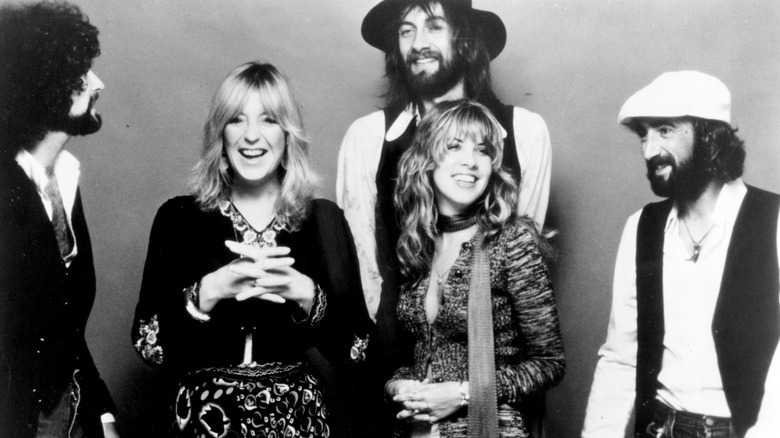
You want a truly messy backstory? No need to dig through the annals of punk rock — just look at Fleetwood Mac. With the release of the "Rumours" album in 1977, the band, which had already gone through a personnel shakeup that brought Stevie Nicks and Lindsey Buckingham to the stage a few years prior, Fleetwood Mac cemented its place as a legendary band. Yet, the album also came out of a chaotic environment that would dog the band for decades, with Buckingham finally kicked out of the group in 2018, reportedly after a spat with Nicks.
So, what happened in the lead-up to the album's release? The band's five members recorded the album in 1976 in San Francisco, doing so in a creatively intimate environment that was marred by interpersonal strife. Though members Christine and John McVie were married at the time, their relationship had deteriorated so much at the time of recording "Rumours" that they were hardly talking to one another. Nicks and Buckingham, previously longtime romantic partners, had also split just before the sessions began and were often decidedly vocal in expressing their newly open dislike for one another. Everyone, it seemed, turned to a variety of substances, both legal and otherwise. But you must admit that all that strife produced legendary work, with "Go Your Own Way" a direct callout of Nicks by Buckingham, while "The Chain" was a searing take on disloyalty — clearly a top-of-mind theme for the band.
Led Zeppelin performed in the US for the last time
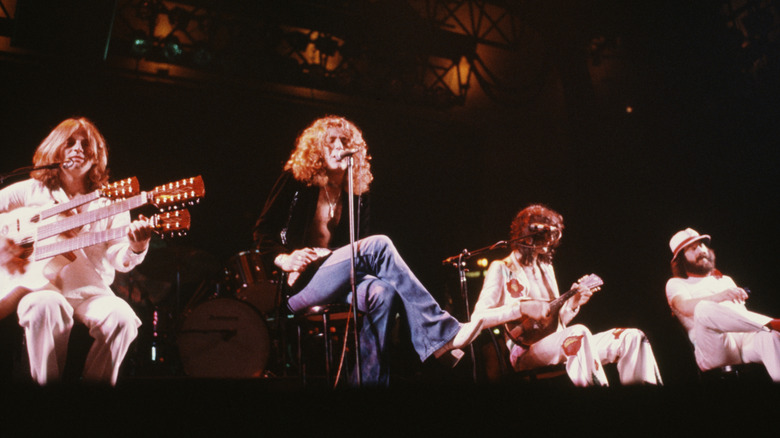
Led Zeppelin was a legendary British rock band, but its 1977 U.S. tour was beset by all manner of problems. Journalists were even warned to limit their contact with band members and to only discuss music, the result of the band's rather bad attitude about previous press coverage and increasingly obvious substance use. Vocalist Robert Plant was also still reeling from a serious car accident he and his family had experienced in Greece two years prior. Then, when the American tour finally came, dates had to be postponed after Plant suffered laryngitis. The rest of the band couldn't practice for a month, as the equipment had already been shipped across an ocean while they lingered in Europe. Once stateside, some performances were marred by violent fan encounters.
The worst came in July 1977, when Plant's 5-year-old son, Karac, died abruptly of an infection while Plant was in New Orleans, separated from his family by thousands of miles. Naturally, the rest of the tour was canceled. Plant still considered leaving rock altogether, abruptly stopping all drug use and looking into a career in education (guitarist Jimmy Page later convinced Plant to stick around). Things were allegedly made worse when many band members failed to appear at Karac's funeral, though Plant himself has never said as such. Led Zeppelin finally broke up when drummer John Bonham died in 1980.
Chuck Berry went to space (kind of)
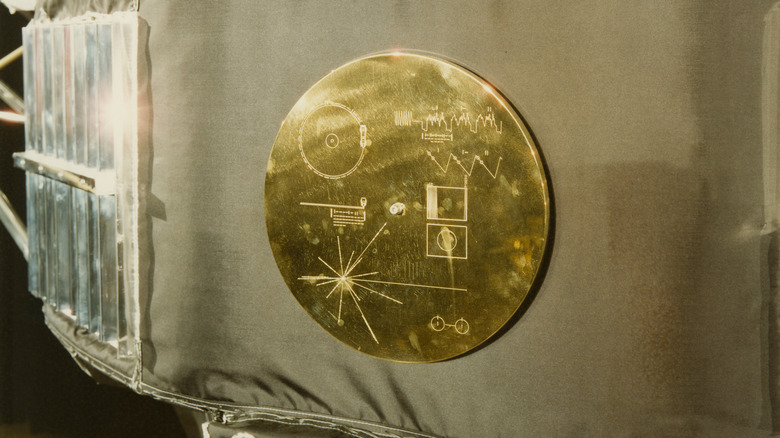
Few rockers have reached quite the same literal heights as Chuck Berry did in 1977. Though he himself remained firmly planted to the ground, Chuck Berry's 1958 song, "Johnny B. Goode," took to the stars that year aboard both Voyager probes. The two spacecraft, Voyager 1 and Voyager 2, were meant to carry out a closer study of Jupiter and Saturn, but each also carried a "Golden Record." Actually a 12-inch copper record plated in gold and nestled inside a metal case inscribed with playing instructions, the Golden Record was meant to communicate something of Earth's unique place in the cosmos. The playlist, assembled via a committee headed by astronomer and science educator Carl Sagan, included a diverse array of music, from Bach to Berry.
The inclusion of Berry's hit on the interstellar record wasn't always a done deal. Some worried that rock music was a bit juvenile, but Sagan's response was that adolescents were very much part of the human population and deserved representation, too. Thus, Berry's foundational rock track was included. Voyager 1 and 2 have now passed out of the solar system and are in interstellar space. Though scientists will eventually lose contact with the probes, they'll carry the records for much longer and may theoretically be playable by someone else many millennia in the future. Hopefully, those music aficionados will be able to appreciate Berry's guitar playing as much as humans did back in 1977.
The B-52s played its first live show
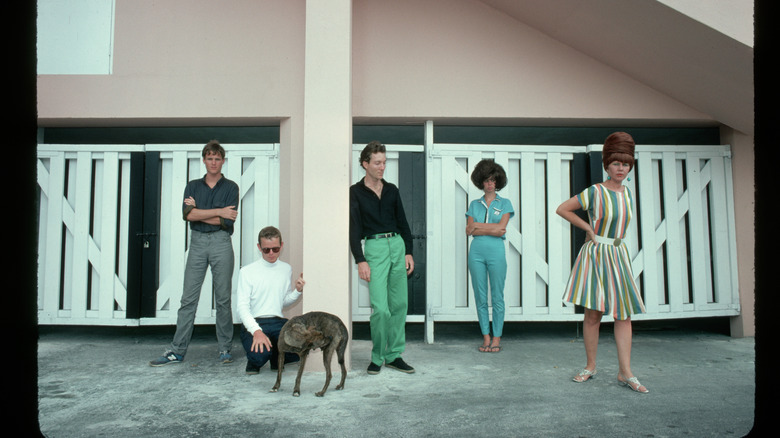
Technically, the B-52s' first single, "Rock Lobster," wouldn't hit the airwaves until 1978, but the group actually first formed back in 1976, reportedly after a night out at dinner turned into an impromptu jam session. The members must have wanted to take their time — the Athens, Georgia-based group only began performing live in 1977, a major milestone for a band that would become legendary for its energetic party atmosphere at live shows. This wasn't on a huge stage, however. Instead, the group — so deemed because the characteristic beehive hairdo some sported looked like the nose of the plane of the same name — first performed at a friend's Valentine's Day party.
Besides the sort of party atmosphere that would come to characterize its shows, the B-52s also represented another major entry in the growing new wave subgenre. And, while some new wave bands tried to put out accessible music, the B-52s weren't afraid to get genuinely weird with it, throwing out jangly chords and pitchy vocals — but in a cool, interesting way.
If you or anyone you know is struggling with addiction issues, help is available. Visit the Substance Abuse and Mental Health Services Administration website or contact SAMHSA's National Helpline at 1-800-662-HELP (4357).